Nominations for World Heritage Sites … worth including on a Grand Tour of Kyrgyzstan
|
A few years ago, a local newspaper, (Public Rating), published a series of articles highlighting seven “unique objects” in Kyrgyzstan which were nominated for inclusion into the UNESCO World Heritage List.The UNESCO list contains over 800 sites which the ‘World Heritage Committee’ considers as having outstanding universal value and are part of the cultural and natural heritage of the peoples of the world. There are over 600 classified as cultural sites, 120 natural and 24 “mixed” properties in the official list. Only one of them is located in Kyrgyzstan – The Suleyman Mountain in Osh – but there are a couple of others located nearby in Kazakhstan, (the Mausoleum of Khoja Ahmed Yasawi in Turkestan and the Petroglyphs within the Archaeological Landscape of Tamgaly in the Chu-Ili mountain range). You can find the complete UNESCO list here.
The list of sites located in Kyrgyzstan that have been nominated to UNESCO for consideration for inclusion in the list:
|
|
| Lake Issyk Kul is also known as “The pearl of the Tien Shan”. The name means “warm lake” and signifies that it never freezes over. (This is because, lying at the bottom of a draining basin, it has no outlet and evaporation means that the water is salty – lowering the freezing point, although the very north eastern corner which is shallower and narrower may sometimes develop a thin covering of ice.) The lake lies at 1600m a.s.l. at the bottom of a depression, ringed by mountains. At about 180km long, 60 km wide and a maximum depth of about 700 m. it is the world’s second largest mountain lake (after Lake Titicaca in South America). It is also claimed to be the world’s second most transparent lake (after Lake Baykal) with a visibility of about 20m. |
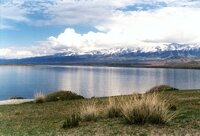
Issyk Kul |
| Tash Rabat - a carefully restored stone building that once housed an inn on the Great Silk Road. Its date of origin is strictly unknown – but there is archaeological evidence to suggest that the site was occupied in the 10th century. Set some 15 km up a small, beautiful valley in the foothills of the Tian Shan, embedded against the hillside. There is evidence that it was a place of both rest and worship and would have served to protect caravans to and from China from both the ravages of the weather and of bandits – from before the time of either Tamerlane or Genghis Khan. According to one author, this is probably the best-preserved Silk Road site you will find and “no other retains as much of its original atmosphere”. |
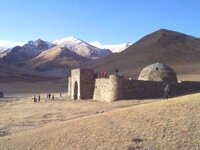
Tash Rabat |
| The Manas Mausoleum is located in the village of Tash Aryk, just outside Talas. It has been dated to about 1334, although it appears to have undergone at least two reconstructions. Made of bricks, held in place by clay, it measures a mere 5 meters square, and has a domed roof. The walls display a number of typical Islamic patterns. There are some inscriptions – but not all are readable. It is said that archaeologists discovered the corpse of a tall man inside. It is said to be the last resting place of the hero of the Kyrgyz, Manas, whose life and deeds are described in the Epic poem of the same name. |
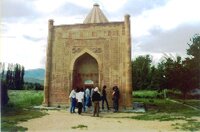
The Manas Gumbez |
| The Burana Tower is believed to have been a minaret and originally stood 45 m tall, but only the bottom 25 m remain – the top was lost in an earthquake in the 15th century. The tower has an octagonal base and on this was constructed a conical tower. It is all that remains of the ancient city of Balasugan which was established in the 10th century on the site of an older settlement and was one of the capitals of the Eastern Khanate when the Karakhanid state split up. The city was spared from destruction by Genghis Khan’s Mongols, and renamed Gobalik (=”good city”) in the 13th century, but it lost its importance and had disappeared by the 15th century. |
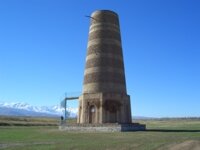
Burana Tower |
| Safed Bulan where the brick mausoleum of Shah-Fazil is located. The mausoleum was reputedly built by his son around 1050 AD. Shah Fazil is reputed to have brought Islam to Central Asia. The site is still an operating Sufi mosque and pilgrimage site. The central cupola is almost 16 m tall, and the interior is decorated with decorative panels, rosettes and relief inscriptions with Quranic texts and inscriptions in Farsi. Ibn-Nasir’s tomb stands in the middle surrounded by Islamic grave stones or kayrak. |
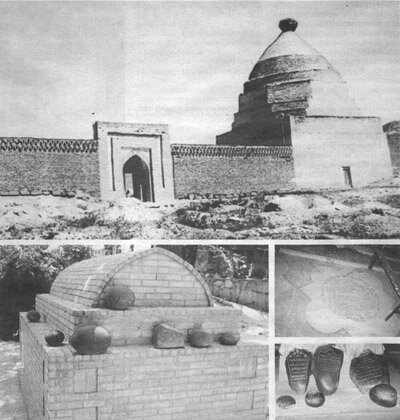
Safed Bulan |
| Suleyman Too is a hill in the heart of the city - rising from the floor of the valley of the Ak Buura River in which Osh is located. The busy city centre surrounds the hill – which is said by some to resemble the profile of a pregnant woman lying down. The hill lies in an East-West orientation and is 1140m long, and 560m wide. The name alludes to the various legends that link the founding of the city to a visit by the Biblical King Solomon. It is home to a number of Muslim holy sites and, as such, is a place of pilgrimage for many.In 2009 this particular nomination was approved and Suleyman Too was one of the sites officially incorporated into the World Heritage list. |
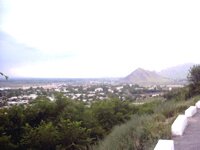
Suleyman Too |
| The Uzgen Complex about 50 km to the north-east of Osh – consists of three mausoleums which date from the 11th and 12th centuries and a minaret. It is virtually all that remains of an ancient major trading centre on the Silk Road. The complex has been recently restored and is featured on the back of the 50 som note. |

The Uzgen Complex |
One of the problems with a list of this sort is not so much what is included, but what is omitted … apart from Lake Issyk Kul, several other natural monuments are missing … for example: Lakes Son Kul and Sary Chelek. Kyrgyzstan has had four entries included in list of Intangible Cultural Heritage:
… but that’s another story … for another postcard. |
|
Write comment | Trackback





 Bishkek