The Gas man cometh …

Never welcome … bills
Back in the UK, I rarely ever had to worry about paying the household bills for the utilities … they were all taken care of by Standing Orders or Direct Debits with the cash disappearing out of my bank account on a regular basis each month. Here I get utility bills, (for electricity, water, gas, telephone, Central Heating and Hot Water and Rubbish Collection), delivered, (they are left in the door), and then I have to pop off down to the Post Office to pay money (actual cash) over the counter and get a slip form the till pasted onto the bill as proof of payment.
Popping off down to the Post Office can be a bit of a problem – because it has to be done when they are open … and when I am supposed to be busy at work. It wouldn’t be so bad if I could make the trip just once a month … but you’ve only a few days to pay after receiving the bill, so it means several trips during the course of the month.
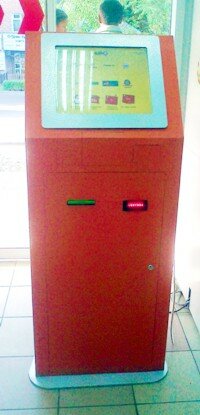
Payment terminals have been springing up almost everywhere
Recently, however, things have got easier as payment terminals have sprung up all over the place … and these are open all day and all night – or, at least, whenever the public space in which they are placed, is open.
There are also pretty simple to use – some even offer a choice of operating in three different languages: Kyrgyz, Russian and English. You select which service you want to pay from a menu on a touch screen display, enter your account number, (which is checked against the appropriate database on-line), and put your money through the slot when prompted. It then issues a receipt and it takes just a couple of minutes … if that.
Although this is convenient, there are some drawbacks …
- although the Post Office takes the exact sum, these terminals only take certain sized banknotes and you end up paying a little extra … but that’s not really a problem because it is carried forward as a credit to the next month;
- sometimes it can reject the notes you are trying to enter – if they are dirty, torn or heavily creased – even if they would have been accepted by the post office;
- it’s not a free service – there’s a handling service … even through there isn’t one at the Post Office;
- sometimes, the terminal cannot make a connection with the database … and so you have to go away and try again later;
- one of the utilities always rejects my account number … it says there is no such account – but the post office always takes the money … no problem.
- sometimes, the terminal runs our of paper for the receipt and then you have to phone up to confirm that the transaction has been successfully completed … and although they will send you a copy of the receipt by email – although the payments have always gone through successfully, I have yet to have this system of getting a receipt by email work.
The receipt is actually very important … you are supposed to hang on to it for three years … and sometimes you can be asked to present it. On a couple of occasions, for example, I have had a visit from an inspector who has asked to see the receipt in order to decide who to disconnect from their particular service. On the first occasion it was no problem: “Here you are”, “Thank you”, a tick on the list and “Goodbye”. The other occasion, however, was more problematical … “I haven’t paid because I haven’t received a bill … how much am I supposed to pay?” This option wasn’t particularly appealing to him because it meant he had to come back again and check to see if I really had paid the bill.
As it happens, for several months I haven’t received a Gas … It’s not a problem because I am still on the system of paying a set fee every month that used to operate in the days of the Soviet Union.
Some of my neighbours, however, decided long ago that it would be more economical to install gas meters and simply pay for the gas that they actually used – especially those who rent out their apartments which can in fact stand empty for some periods throughout the year. No tenants – no gas consumed … so why pay a set fee?
That’s a good point, but as I live in my apartment and am home virtually all the time, the set-fee system probably costs about the same as if I had paid to have the meter installed. It also has some advantages … it avoids, for example, the disadvantage of having to take the meter readings each month …
Although the sum can actually vary as and when the tariff changes, I do know roughly how much I need to budget each month, which is just as well … because, for several months now, I haven’t received a gas bill and every time I ask an official from the KyrgyzGas, “why not?” … they always reply “I don’t know … that’s not my job”. Even though I don’t have a bill I pop off to the terminal and make a payment … after all, I don’t want to have the Gas cut off for non payment – which, incidentally, means not only having to pay for the gas, but also a penalty for late payment and a fee to be reconnected once again. The Post Office wouldn’t take the payment without the bill. As I said, it’s not a problem if I pay too much as the excess is simply carried over as a credit for the next month … but it would be nice to see how much I am being charged and how much I am in credit.
Gas has been in the news quite a bit recently … every now and again there has been a news story about interruptions to the supply of gas here in Kyrgyzstan. Usually it is connected with debts run by the national Gas company for supplies received from neighbouring Uzbekistan or Kazakhstan … debts which contributed to the recent sale of KyrgyzGas to Russia’s giant GasProm for just $1.
Sometimes there are claims and counterclaims of how gas has been siphoned off, (“stolen”), as it passes along the pipework from one country to the next.
Well, last week, the southern part of Kyrgyzstan found itself without Gas … Uzbekistan had cut off the supply, just as temperatures plummeted … apparently because the contract with KyrgyzGaz had expired … and they were waiting for a new one to be concluded with the company’s new owners.
Every now again there is a story about gas explosions … such events are usually caused by leaking gas, (such as natural gas, methane, butane or propane), coming into contact a source of ignition … and cause damage and, unfortunately, occasionally claiming lives.
Gas is, by its very nature, highly combustible. That makes it extremely useful for cooking and heating, but introduces a significant risk to both life property. Correctly fitted and maintained gas appliances ensure that gas is burned in a safe and controlled way to heat our homes and to cook with. If gas leaks from a faulty appliance or pipework it can spread quickly and there is a risk of it accidentally igniting causing a fire or explosion.
Faulty gas appliances can also create a risk of carbon monoxide poisoning. Un-burnt natural gas and LPG (liquid petroleum gas) are not poisonous in the same way that carbon monoxide is but both can still lead to fires and explosions. To aid detection of a leak an special odorant is added to gas which makes it easy to smell.
The “leak” can be caused by poorly serviced or faulty gas appliances … or pipework. Any damage or signs of corrosion – such as rusting or discolouration of copper pipework – should be checked by an engineer as soon as possible.
So, when I thought that I could smell gas in my apartment, I got nervous and was about about to call the “Emergency Service” … but before I did so, I asked several people if they also smell it. They all said “No”, so I began to doubt my senses … maybe there was another explanation.

Easter table decoration
I remembered that this had happened once before in the office … they came and checked and said, “No, everything is OK” … but the smell didn’t go away … so we called them back … and got the same answer . “No, everything is OK”. Eventually, we discovered that the smell wasn’t from leaking gas, but some hard boiled eggs, which has been decorated as Easter Eggs, and put on desk as a table decoration … but that cracked and gone bad … hence the smell.
Then, a few days ago, I had a visitor who exclaimed as soon as he walked in through the door … “I smell Gas”.
I explained that I had smelled this before, but nobody else seemed to notice it. Ironically, I now had a bit of a head cold and so couldn’t smell a thing … but because I HAD smelled it before, I decided that we should call the Emergency Service … just in case.
What happened next was very strange …
“When did you first notice the smell? … WHEN? … Why didn’t you call earlier? … It’s very dangerous …”
There was no disputing that … but I was taken aback by what they said next …
“There’s nobody available at the moment … it’s the end of the working day … so turn off the gas at the mains and open the window a little …
This was when the temperatures had already plummeted below zero!
… call this number – xxxxxx – tomorrow morning and we’ll send a team of engineers to you.”
Anyway, the next morning we telephoned as instructed … only to be told …
“OK … we’ve made a note and a team will be with you sometime between eight and five. There’s a call out fee of 100 som and there’ll be a fee for any work that needs to be done.”
One hundred som … that’s less than two dollars or just over a pound … no problem – especially if you compare it to the cost of the possible material damage am explosion might cause or the value of a human life … and if the work needs to be done, then it NEEDS to be done.
BUT …
If a gas leak is so dangerous … and it’s meant to be an Emergency service … then why does it work nine-to-five? … sorry, eight-to-five?
As it happens … the Gas man turned up the next morning … on time, at eight o’clock … found the problem – and, yes, there was a leak … fortunately not a serious one and, when the temperature had been warm, I had had the window open so the room had been well ventilated … but when the temperatures fell, I had closed the window which had allowed the gas to settle … and hence the smell.
… But, in the end … all’s well that ends well … and the problem has been solved!






 Bishkek