Victims
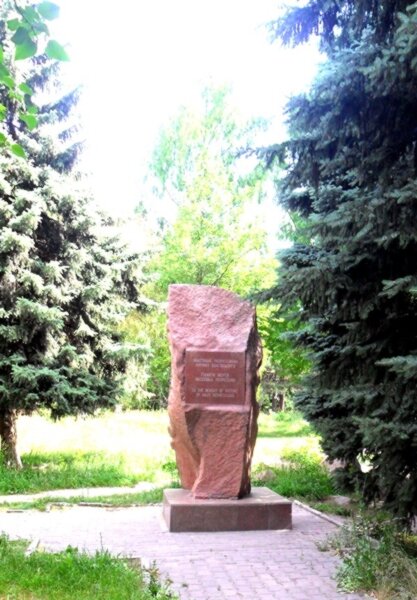
Monument to the Victims of Political Repression in Bishkek
Tucked away beside the Semetei Youth Center in Bishkek is a small monument, a stele made from a block of red granite, with a plaque bearing a simple message dedicating the monument to the victims of Political Repression.
It has been the subject of some minor controversy over the last year or so. One of the deputies has particularly criticized its placement, hidden away surrounded by trees, so that it is almost unnoticed – implying a certain disregard for the tragic fate that befell thousands in the Great Terror.
It’s not that the fate of the thousands who were arrested, imprisoned, exiled or executed – often arbitrarily, without trial and/or on the basis of falsified evidence and/or forced confessions – as part of the campaign of repression intended to suppress any dissent among the population have been forgotten of ignored.
On the contrary, as well as this modest memorial there is also the Ata Beyit national cemetery and memorial at Chong Tash which is regarded as a place of pilgrimage and included in the standard programme for foreign dignitaries in Bishkek as part of a diplomatic Mission.
Then, of course, there is the Day of Remembrance for the Victims of Political Repression – a special day set aside to commemorate the victims … and today is that day!
For the record: As I have already written postcards on the Stalinist repressions and Chong Tash – and also about some of the enforced migrations that brought whole communities to Central Asia, (such as Operation Lentil which brought the Chechen and Ingush populations to Central Asia), I’ll try not to repeat the details.
It is worth pointing out, however, that many of those who suffered under the repressions were later rehabilitated when their cases were reexamined after
The decision to dedicate a special Day of Remembrance came quite late … in January, 2008. In Russia, a similar decision had been taken as early as October, 1991 – shortly after the dissolution of the USSR.
The date, 30th October, was chosen because a monument dedicated to the victims, the Solovetsky Stone, had been unveiled the previous year, (when there was still a Soviet Union … the Supreme Soviet of the USSR had adopted the Declaration on the recognition of illegal and criminal acts of repression against the people who have been forcibly displaced in November, 1989).
In Russia, the Rights Center “Memorial” records the names of about 8000 victims … which includes not only those who were “repressed” but also their children who had been left without “parental care”. However, eight thousand seems a remarkably small number given the scale of the “Purges”. In fact, according to the chairman of the Commission for the Commission of the Unjustly Repressed, …
As an aside: I “love” that phrase “unjustly repressed” … it implies that some “repression” can be, (and presumably was), “justifiable”.
In fact, according to the General Prosecutor’s office … since the process of rehabilitation began in 1954, some 636,302 cases have been reviewed involving 901,127 people … of which 637,614 had been “rehabilitated”. In other words, the review had found evidence to support the “convictions”, and presumably the punishments – but that’s another question – for the remaining 263,513 people.
To be fair, not all those cases and individuals were victims of Stalin’s Great Purge … it also covers the rehabilitation of the Rudolf Nureyev , Patriarch Tikhon and his entourage, well-known figures of the Menshevik Party – Mark Broido, Nikolai Sukhanov, and the biologist Nikolai Timofeev-Ressovsky.
… it’s probably not possible to calculate the actual number of people involved … especially with the enlarged definition to include their immediate descendants. What’s more, a significant number of the victims were not documented and so there is no record or account of what happened to them … yet alone whether their “repression” was “justified” or not.
In Kyrgyzstan, the preamble to the formal decision of the government began with the following points:
Recognizing the rights and freedoms of the highest social value of the state and society, condemning the mass terror of thousands of people expressing their commitment to building a democratic and constitutional state based on ideological and political pluralism, the creation of effective mechanisms to protect the rights and freedoms of citizens, state responsibility for violations, and pursuant to the Law of the Kyrgyz Republic “On the Rights and Interests of the rehabilitated citizens who have suffered as a result of persecution for political or religious beliefs on social, national and other characteristics” …
and the document went on to record the decision that October 30 would commemorate the Day of Remembrance of the Victims of Political Repression in the Kyrgyz Republic.
However, after much discussion and consultation with historians in the country, the parliament late decided that this “violated the principle of historical authenticity”. The choice of 30th October was simply following the example of Russia, and that it would be more appropriate to chose a date tied to specific local events.
Attention focused on two dates in particular: the 5th and 8th November – the two days when 137 members of the political elite had been executed/murdered at Chong Tash.
So, on 10th October, 2008, an amendment was passed to the January decision changing the date from 30th October to 8th November, “as a tribute to the victims of the mass repression in the Soviet Kyrgyzstan in 1937-1938.”
I don’t know whether it was considered, but I suppose another date that might have been appropriate was 30th August, as this was the day in 1991 of the state “reburial” of the remains of the victims at Chong Tash … the day before Kyrgyzstan declared its independence.
As it happens, the Chong Tash cases are well documented … indeed, according to one source, it’s the only such documented case in Kyrgyzstan – although one of the local newspapers has published articles with claims that there others.


 Bishkek