Stalinist Repressions
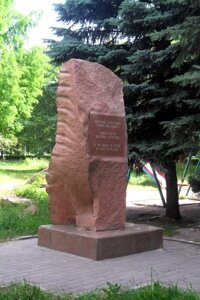
Monument to the victims of Reoression
Some years ago, I wrote an article about Bishkek which began with the words: “Bishkek cannot claim to be one of the major cities of the world, like London, Paris or New York. It is, however, the capital city of Kyrgyzstan and does have a number of important and interesting buildings, monuments, parks, museums, galleries, theaters and other places worth seeing or visiting. “
I’ve seen this paragraph quoted in a number of places, but I am not going to claim copyright. Sometimes, however, I think that a lot of things in Bishkek are overlooked or simply missed by visitors and locals alike.
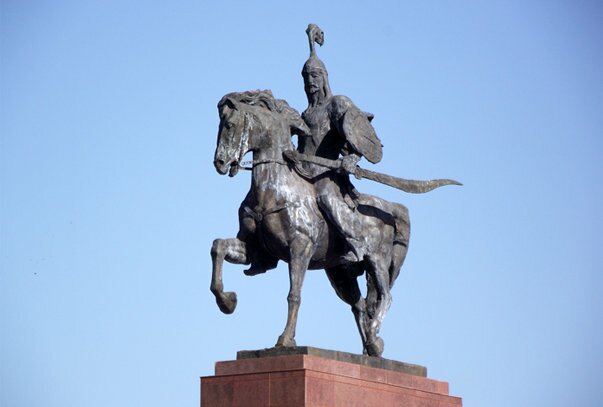
Take the monuments, for example. Bishkek can boast a huge variety of monumental art that lines its streets and adorns its parks. Some of it is grand and other examples are less imposing, but perhaps that simply adds to their poignancy.
For example, there is a striking monument in a small area by the side of the Seitek Youth Center in Central Bishkek. It’s easy to both miss and overlook, (if you do happen to come across it). It’s on a street just off the old Central Square, opposite Oak Park, and is set back from the road, behind a low hedge and in the shade of a huge fir tree, with a children’s playground behind it.
A simple block of red rock on a small plinth covered with red marble tiles, and with a square plaque bearing a short inscription in three languages, (Kyrgyz, Russian and English), which reads: “To the Memory of victims of Mass Repressions”.
.
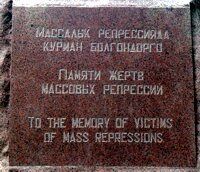
Plaque containing the dedication
In what seems to be an example of understatement, simplicity and reticence, (especially when compared to the monuments to the glories of the Socialist Revolution, their grandeur, magnificence and prominence), this small monument, almost hidden away, seems to possess a special, poignant significance.
The phrase “mass repressions” is a synonym used here to refer to what are known in the West as the “purges” of the Stalinist period when “anti-revolutionaries” and “enemies of the people” were prosecuted by the Soviet authorities.
Although the term “purge” is usually associated with the Stalinist period, the first “purge” took place as early as 1921 when almost a quarter of a million people left or were expelled from the Communist Party, people who were perceived to have joined simply in order to be “on the winning side”. The first “Stalinist purge” occurred in 1929-30 when membership of the party was literally decimated, (i.e. reduced by 10%), although there were also a large number of new members recruited from amongst the industrial workers. Then in 1933 special Purge Commissions were established to examine members of the Party and which resulted in almost two million members leaving the party, almost one fifth of the party.
These measures, however, were probably aimed mainly at preserving the purity of the party. Most of those who left the party or were deprived of their membership, suffered nothing worse than the loss of their Party Card and the privileges which is conferred. That was to change, however, in 1936 when the full terror of the term, as we know it in the West, came into its own with the commencement of the Great Purge.
It was once thought that the Great Purge caused havoc in the Red Army, but it is now thought to have affected only somewhere between 4% to 8% of the officer corps instead of the vast numbers (anything between 25% and 50%) that we previously thought. Even so, the senior leadership of the military was severely hit and the country lost three out its five Marshalls, 13 from 15 Army Commanders (Generals), 8 out of 9 admirals, 50 out 57 army corps commanders, 154 out of 186 Division Commanders, all 16 Army Commissars, and 25 of the 28 Army Corps Commissars.
For some, the effect of the purge simply to lose their Party Card, but for others the results were far more drastic … internal exile to a distant part of the Soviet Union, imprisonment in the Gulags, and even execution. It was on June 11th, 1937, that eight of the top leadership of country’s military were executed following a “show trial” which made use of falsified evidence and forced confessions.
.
Central Asia, (including the Kyrgyz Socialist Soviet Republic), was not to escape the ravages of the Stalinist era – which followed those of the Revolution itself and the civil war. For example:
- there was a “gulag” in Naryn, (not far where our guesthouse now stands at the Eastern end of town);
- many public figures were accused, arrested, and executed for a variety of “crimes” as part of the “purges” and in his autobiography, Alexander Dubcek describes how they were taught to admire revolutionary heroes – who were suddenly declared villains, put on trial, and executed. He and his schoolmates were instructed to cut out the photos of these former heroes - ”the unwanted” and to cover-up their names where they occurred in the text. Apparently the teachers carefully collected and counted the pages so that none were missed.
- many people were banished to Central Asia from other parts of the Soviet Union as a form of internal exile, (for example: Trotsky who was sent at one point to Almaty and the ethnographer Clavdia Antipina) and
- The largest known purge of the period in the Kyrgyz SSR took place in November 1937, at Chong Tash, just to the south of the republican capital Frunze (now Bishkek). Chong Tash is now a small, low lying, ski resort, (and a favourite place amongst residents of Bishkek to while away a few free hours over a weekend). Over two days some 137 people (or possibly 138 – there is some doubt about the actual number) were killed by the secret police – executed by a single shot to the back of the head. It is believed that this included the entire Supreme Soviet Central Committee of the day – and possibly some other notable characters such as Kasym Tynystanov – the linguist whose portrait appears on the 10 som banknote, and Torokul Aitmatov – father of the famous Kyrgyz author and diplomat, Chinghiz Aitmatov.
.
Many scholars suggest that one reason behind the purges was the insecurity of Joseph Stalin who sought to remove anyone who could threaten his authority or position. It is thought that over one and half million people were detained, just under half of whom, (about 700,000), were shot.
Ironically, many of those were later “rehabilitated” in the period following Khrushchev’s “secret speech” to the 20th congress of the Communist Party of the Soviet Union in which he denounced the Personality Cult of Joseph Stalin, opening the events of these difficult times to the critical examination of History.
However, although the Stalinist period is known throughout the West as one of repression and cruel authoritarianism, of “Purges”, “Show Trials”, and the “Gulags”, there are some people in the countries of the former Soviet Union who look back on this period from a different perspective – as one of strong government and an orderly society.
It is sometimes difficult to determine the facts and obtain a realistic picture of life in these times because our hazy knowledge of this period of history is riddled with rumours, (for example about one official losing one of the southern enclaves to Uzbekistan in a card game); inconclusive research, (often written with one eye towards the censors and the “official” view of history), and contradictory accounts. To many of the surviving members of the older generation who lived actually through those far-off days … it is sometimes a period of dim and distant childhood memories.
.
It seems to me, however, that there is something that this small and seemingly insignificant memorial has to say to us today, and especially to our leaders, that History is watching us … the truth will come out no matter the cost, in terms of human lives and misery, of whatever steps we take to “cover our tracks”.
In the words engraved on other memorials: “Lest we Forget” and “People, Don’t forget the lessons of the past”.
.
For the record: I’ve written a postcard about Clavdia Antipina, and will post some about some of the other characters mentioned here in the future.
I’ll also add some postcards about some of the many monuments that are to be found in Bishkek.





 Bishkek