Is it the real thing?

Twenty years ago ... the Som was introduced
Twenty years ago today saw the introduction of the Som as the national currency of the Kyrgyz Republic.
Because it was unexpected, the introduction of the new currency plunged Kyrgyzstan into a crisis with its neighbours, (especially Kazakhstan and Uzbekistan), which at that time were still in the “ruble zone”. Shortly after, however, the other countries of Central Asia also introduced their own currencies.
Since its introduction, there have been many changes in the design of the banknotes – partly in order to counter the threat of forgeries.
Producing or using counterfeit money is a form of fraud or forgery that is almost as old as money itself. It is obviously something that governments and Central Banks around the world want to avoid, prevent, and punish.
Throughout history the production of coinage was a tightly controlled and licensed activity with heavy penalties imposed on those caught attempting to produce forgeries. In the days of the Silk Road, Roman coins were known in the East and acknowledged as being of good value, (not debased by base metals), which would have been tested by weight as in the case of Archimedes and the crown. In the United States, the Secret Service which is charged with the protection of the President, (and, ironically, was created by Abraham Lincoln on the day that he was shot), was originally established to combat counterfeiters.
Here in Kyrgyzstan, the penalties can be quite severe: for “the manufacture, possession or sale of counterfeit notes shall be punished by imprisonment for a term of three to five years with the confiscation of property. However, those same acts committed on a large scale and a group of persons shall be punished by imprisonment for a term not exceeding ten years with confiscation of property.”
Over the past 5 years, there have been 179 criminal cases brought for the counterfeiting currency and 44 people have received sentences of various terms – from three to nine years.
Some of the ill-effects that counterfeit money has include:
- a reduction in the value of real money; leading to
- an increase in prices (inflation) due to the fact that there is more “money” getting circulated in the economy – an unauthorized artificial increase in the money supply;
- a decrease in the acceptability of paper money – one of the key roles of a Central Bank is to maintain confidence in the currency; and
- losses, when traders are not reimbursed for counterfeit money detected by banks, even if it is confiscated.
Having come across the odd counterfeit note over the years, that last point has particular significance. You can accept the notes from a client in all good faith, (and the chances are that they had also accepted them in “all good faith” and had no idea that the notes were forgeries), and when discover that it is an imitation, there is nothing you do about it … apart from reporting it to the authorities and accepting the loss.
Mind you, I think I would be a little more incensed if I had experience like this one: a seventeen year old student withdrew money from his bank account and then tried to deposit it in an account at another financial institution – only to be told that one of the hundred banknotes in the bundle he presented was a fake … he went straight back to the first bank only to be told that they were not responsible because he “should have inspected the notes before leaving the bank”.
Even though that might take some time. it’s actually quite good advice here … I have often been caught in a queue behind another customer in the bank whilst they and/or the teller, carefully inspect every banknote – especially US dollar bills or Euro banknotes … the slightest imperfection, (dirt, discolouration, tear, stamp, pen or pencil mark … and so on), is likely to get the note rejected and handed back across the counter … because virtually no-one else will accept the note even if it is perfectly genuine!
Even discounting the time that such an inspection would take, there are still two issues which add “insult to the injury” he suffered.
First of all, the implication seems to be simply that they don’t trust their customers not to try and pull a “fast one” and pass off a forged note on them by pretending to have received it from them. On the other hand … it was a Bank … money is their business and surely they had a responsibility to inspect the notes before they issue them to a customer … so how could it have happened? They seem to have accepted the note from somewhere – presumably from a client – so why wasn’t it detected then?
Incidentally, the cashier at the second financial institution discovered that there was forgery in the bundle by weighing it … so it was the weight that gave it away rather than the appearance so presumably the “paper” was wrong and the note might easily have passed a cursory visual inspection.
Secondly: it assume that you know what to look for … although some forgeries are pretty amateurish and easy to spot with just a cursory inspection … as the counterfeiters become more sophisticated and skilled in what they do … even experts can be caught out … as in the case of Operation Bernhard … immortalized in the BBC comedy series Private Schulz and the Australian Oscar winning film The Counterfeiters.
For the record: Operation Bernhard was a plan devised by the Germans in the Second World War to destabilize the British economy by flooding the country with forged banknotes produced by expert counterfeiters who were inmates at concentration camps … the results, (at one point, a million “banknotes” were being printed each month), were so impressive that although most of the forgeries were lost or destroyed at the end of the war, many forgeries were still in circulation over ten years later that the Bank of England decided to introduce new notes – with a new design – in 1957.
Although there are people working for the Mint who scrutinize sheets of banknotes “hot off the presses” at incredible speed who can identify and isolate examples with misprints – it’s a very skilled task and even they, occasionally, miss the odd note.
Apparently, the Bank of England reports that in 2012, over 700,000 forged British banknotes were discovered – and although that represents a small proportion (0.025%) of the almost three billion banknotes in circulation – it still represents a nominal value of over over thirteen million pounds:
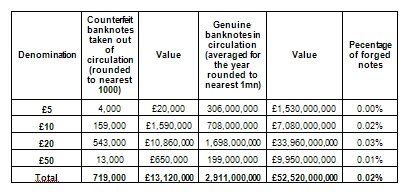
Forgeries in Britain : 2012
(That represents the notes detected and taken out of circulation – but there were at least another 9000 notes found by police before they had entered circulation.)

To a large extent, Central Asia is still, basically, a cash based society.
Although Coca Cola may advertise itself as “the real thing”, just occasionally it is possible to come across something that is not the real thing – and most of the time the difference is distinctly noticeable. That’s not always the case with money, however, as counterfeiters become more and more sophisticated.
As a result, the design and production of money has also had to become more and more sophisticated.
According to the National Bank, the Kyrgyz som is making headway in the constant battle against counterfeiters. Although there are still occasional stories appearing in the press about the appearance of forgeries, (accompanied by appeals for people to be careful and vigilant in examining banknotes that come into their possession), it seems that in 2012 the appearance of counterfeits has fallen to a sixth of the level the previous year.
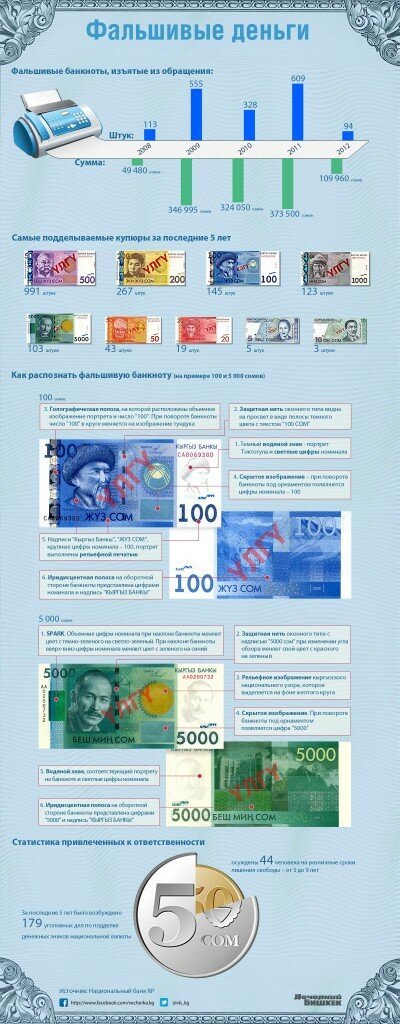
An infographic on Counterfeit money published in the Vecherniye Bishkek (Evening Bishkek) newspaper
The banknotes contain over 30 individual security features to assist in the battle against counterfeits. They fall into three different levels.
- The features in the first level of security are designed for the general public and need no special equipment – the watermark, presence of a security thread, holograms, an iridescent stripe … and so on.
- The second level require the use of special detectors, such ultra violet or infra red lamps, the use of micro lettering and micro images.
- The third level are specially hidden features that have been specifically designed and included for the experts of the National Bank.
New notes tend to have a specific look and feel but this is lost over the course of time as the notes are in use and passed from hand to hand. As a result, counterfeiters often take special efforts to “age” their notes so that they attract less attention – especially if they are being passed in the right circumstances, in the dark or when someone is in a hurry and less likely to check the notes.
They will often attempt to re-create some of the security features – like the watermark – but the quality is usually not very good – not good enough to pass anything but the most cursory glance to see if one is present.
As it happens, the new banknotes produced by the bank are sufficiently sophisticated to impress international specialists. For example, the 5000 som note was a finalist in the competition “Banknote of the the Year” in 2009 when it was first released – and incorporates features that are now being adopted by a number of countries around – including, for example, Switzerland.
Here is an image from the website of the National Bank of the Kyrgyz Republic showing some of the security features of the 100 som banknote:
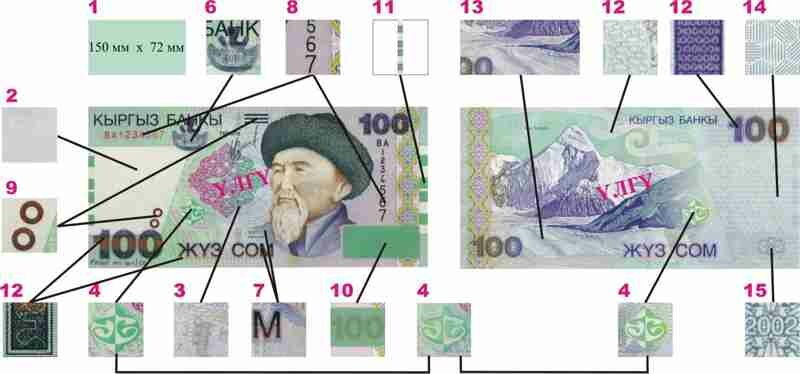
- Individual size of the banknotes
- Watermark – the portrait and the digital value seen through against light.
- Security thread. Numbers of the value are seen against the light.
- See through register – superposed fragments on the obverse and reverse of the banknotes.
- Metallic paint. The image of the value is executed in metallized paint.
- Foil on 100 and 200 som banknote, while the hologram – on 200, 500, and 1000-som banknotes.
- Relief of the image in the area of the portrait and inscriptions on the obverse of the banknotes.
- Serial number. Vertical number is printed in novelty style (row of numbers growing in size).
- Relief marks in the form of the geometrical figures and stroke codes to allow people with poor eyesight to see the value of the banknotes.
- Latent image of the digital value.
- Strip code.
- Micro lettering.
- Iridescent paint.
- Security net – thin lines form a cellular system that couldn’t be counterfeited.
- Year of issue.


 Bishkek