The Turkic Council
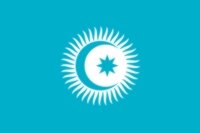
The flag of the Turkic Council
On October 3rd, 2009, the presidents of Azerbaijan, Kazakhstan, Kyrgyzstan, and Turkey signed the Nakhchivan Agreement on the Establishment of Turkic Council – or, to give it its full title, the Cooperation Council of Turkic-Speaking States, (CCTS; in Turkish: Türk Dili Konuşan Ülkeler İşbirliği Konseyi - TDİK ).
As a result, today has been designated the Day of Turkic Unity.
We tend to think of the Turks as being the people of Turkey, but this is a simplistic concept … the country is named after the people, not the other way around – just as Palestine is named after the Philistines.
The first mention of the Turks as a people came in the 6th Century – a reference to the Göktürks – in a letter – but there are previous references to peoples identified as Turks using different names. It is possible that they can be identified with various ethnic groups in Chinese records dating back to the 6th century BC.
The general opinion seems to be that the name comes from a nomadic term that could mean “created”, “born” or “strong” … although there are other suggestions. There is, for example, a suggestion that it refers to a helmet worn by these people and the 11th century linguist Kashgari, among others, suggests that it is a reference to the “sons of Japheth” – one of the sons of Noah.
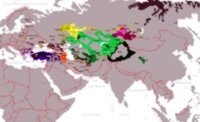
Map showing distribution of the Turkic peoples
The Turks, (as in the population that inhabits the country of Turkey), are actually part of a much larger collection of ethnic groups which includes: the Azerbaijanis, Balkars, Bashkirs, Chuvashes, Gagauz, Karachays, Crimean Karaites, Karakalpaks, Kazakhs, Krymchaks, Kyrgyz, Magyars( or Hungarians), Nogais, Qashqai, Szekelys, Tatars, Turkmens, Uyghurs, Uzbeks and Yakuts, as well as historical civilizations such as the Avars, Bulgars, Göktürks, Huns Khazars, Khiljis Kipchaks, Kumans, Mamluks, Timurids, Turgeshes, Seljuk Turks, Ottoman Turks, and the Xiongnu.
They share, to a greater or lesser extent, certain cultural traits, language, and historical backgrounds. Down the centuries they have carved out for themselves over a hundred different states, empires, khanates and sultanates.
Today, the Turkic peoples are found throughout a wide geographical are: in Asia, (northern, eastern, central and western – including Kyrgyzstan where something like 90% of the population are “Turkic”), in northwestern China and in parts of eastern Europe.
After a period of “almost three hundred years of decline and hardship”, there has been a movement to recognize these common roots and an attempt to create a common identity. In particular, since the dissolution of the Soviet Union, the “Turkic States” have been forging closer ties. This was marked by a series of summits of the Heads of State of the Turkic speaking countries.
Turkey and Kyrgyzstan have established close bilateral ties on the political, economic, (with a number of large Turkish investments in Kyrgyzstan) and military spheres.
Then, in 2006, President Nazarbaev of Kazakhstan floated the idea of formalizing the work that was being undertaken by creating a new and separate inter-governmental organization: The Turkic Council. This led to the agreement signed in Nakchivan, in Azerbaijan, that October day in 2009.
The basic tasks of the Turkish Council are defined as:
- Strengthening of mutual trust between the parties;
- The preservation of peace;
- The adoption of common positions on foreign policy;
- To coordinate actions to combat cross-border crime, international terrorism, separatism and extremism;
- Promoting effective regional and bilateral cooperation in areas of common interest;
- The creation of favorable conditions for trade and investment;
- Contributing towards comprehensive and balanced economic growth, social and cultural development;
- Ensuring the rule of law, good governance and protection of human rights issues discussed;
- Facilitating the expansion of interaction in the fields of science, technology, culture and education;
- Promoting interaction and a more intensive communication through the Mass Media;
- Judicial cooperation in civil matters and promoting the exchange of information.
The organization has its headquarters in Istanbul and the member countries are Azerbaijan, Kazakhstan, Kyrgyzstan, and Turkey; (Turkmenistan and Uzbekistan are not currently official members of the council although it is expected that they will join in the future.
The organization is working on a variety of projects in order to address its aims and objectives, and acts as an “umbrella” for coordinating the work of a number of other organizations. It also has observer status and maintains relationships with a number of international organizations.
This year saw the suggestion of creating a Turkic Economic Community.



 Bishkek