Potatoes

Potatoes on sale at the roadside
A week ago I was driving back from Naryn and as we drove through Kochkor, there were sacks of potatoes stacked by the roadside. We stopped and had a look. The potatoes had just been dug out from the ground, and the they were a good size and shape. We asked how much and for a sack of about 28 kilograms the price of 400 som, whilst not exactly cheap, seemed reasonable.
As it happens, Kochkor is well known for its potatoes, and I have bought potatoes there in the past. You have to be careful, however … even though you are buying straight from the field, the cost is not always cheaper than the price paid in Bishkek’s markets – despite the lack of “middlemen” – I am obviously a foreigner and not very good at bargaining, so I usually leave that side of the transaction to my driver.
The timing is also important – this year we saw the workers in the field digging away, so I was confident that the crop was fresh, but one year I bought a sack a couple of months later than this and they turned out to be sweet and difficult to cook without lots of seasoning. Another year, I bought much later, after the first snows, only to find when I got home that the potatoes were frozen and practically unusable – although I daresay that they could have been
For the record: Potatoes are a starchy tuberous crop from the same family as Nightshade and Tobacco. The are not native to Asia, coming from the Americas, probably from Peru although wild potatoes are found throughout the Americas from the United States down through the Andes region of South America to Southern Chile. In the last four hundred years, however, they have been introduced around the world and are now a staple in much of the world’s cuisine. It is the fourth largest food crop grown globally, (after rice, wheat and maize).
There are thousands of different varieties – although these have been bred into a few well known and suitable for particular types of cooking, (boiled, mashed, baked, fried, roast, … etc.)
In theory, potatoes are a good crop – producing two harvests in a year: early and late. A successful early harvest not only provides food, but also sales will help generate income in order to plant a second crop.
There are, however, some problems. Ten years ago growers in Kochkor producing just over a ton per acre, whereas elsewhere in the world farmers would expect to get a crop of anything between 20 and 40 times as much … in New Zealand crops can be as much as 60 to 80 times as great!.
Apparently, the problem doesn’t lie in the soil as in the farming practices.
First of all, most of the farmers have small plots of land … with the end of collectivization, farmers were allocated about 100 square meters per family member and the small plots meant that .
Then again, many of the growers are not farmers at all, but engineers or belong to other professions and turned their hand to growing in order to supplement their income and feed their families. As a result, many lacked experience and skills needed to make the most of this staple crop. One report tells how, contrary to best practice elsewhere, the best potatoes were consumed (eaten or sold), whilst the poorest were retained as seed for the subsequent crop, thus weakening the quality of subsequent harvests.
Although they may have attempted to diversify their crops in order to make the most of the land they had available, they were not rotating their crops, (for example, on a cycle with potatoes with alfalfa or cereals, and peas – a practice which helps to prevent insect pests and diseases from building up in the soil – and decimating future crop yields).
They had limited access to to the pesticides that help to keep pests in check, or to fertilizers which would help to boost yields.
To be fair, in a way, the lack of pesticides and synthetic fertilizers helped in that farmers were growing truly organic crops. This is a trend which Kyrgyz agriculture is looking to develop further …
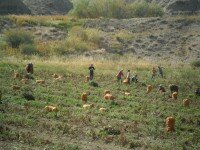
Workers in the field harvesting the potato crop
Another problem was that the labour intensive work is carried out by hand, with little access to mechanized equipment . There was also a problem due to the lack of, or inadequacy of, facilities for irrigation and storage – .
Following the devastating riots in Osh in June 2010, growing potatoes was quickly identified as a priority area for the recovery of the region – providing both food and a source of income for the farmers. One problem was, however, that supply often outstripped demand resulting in a glut of the corp which meant that marketing the crop for export was an issue that needed to be developed.
A few years ago, a friend of mine from the Osh region, a doctor, told me how he had planted potatoes when the cost of the seed was typical – but by the time it came to harvest the crop, the glut was such that price had fallen to well below what he had paid for the seed. To harvest the crop meant that he would sell it at a loss. He was at his wits end as to what to do. Collecting the harvest was difficult and he was thinking of leaving the potatoes in the ground. This, however, would mean possibly damage the ground, as well as leaving them with less income in order to plant subsequent crops.
As it happens, a recent news item reported that potatoes was one of the few foodstuffs in which Kyrgyzstan was self sufficient, (along with milk, other vegetables and melons). We produce only about 86% of the bread we consume; 57% of the meat, 40% of the eggs, 28% of the fruit and berries and 10% of the sugar.
Maybe, as one of the commentators suggested, we’ll have to turn vegetarian.





 Bishkek
I saw this report on http://akipress.com/ which I thought was interesting:
Potato processing plant in Issyk-Kul region to produce potato flour, starch
Potato processing plant in Issyk-Kul region will produce potato flour and starch initially, according to the Economy Ministry’s report.
The plant will produce 10-12 tons per a shift.
The plant is supposed to be built in Ak-Suu village.
The industrial complex of Issyk-Kul region includes 57 big and medium-sized enterprises, 37 of them function on a sustainable basis.
The restoration of the production process at the Issyk-Kul construction materials production company is in process. This enterprise will supply products for Kumtor mine.
2013-10-03 14:05:26