Pilgrimage
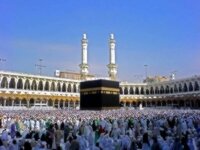
The Kaaba in Mecca - one of the world's great pilgrimage sites
One of the oldest forms of tourism is the Pilgrimage: a journey or search of moral or spiritual significance, typically a journey to a shrine or other location of importance to one’s beliefs and faith.
Its a growing aspect of tourism with the numbers of people involved continuing to rise. For example, just 39 of the most popular sites alone receive an estimated 200 million visitors every year. The result is that there is a growing awareness within the major religious organisations that “fulfilling the spiritual obligations of pilgrimage may paradoxically conflict with the spiritual obligation to care for the natural world”.
Even during the early years of the Christian Church, believers made visits to sites in the Holy Land associated with Jesus, but not everyone was able to undertake such a long, arduous and expensive journey, and in the course of time other shrines assumed importance. One of the classics of English literature, Chaucer’s Canterbury Tales, tells of a group of pilgrims en route to the shrine of Saint Thomas Becket in Canterbury Cathedral (… although some of the tales can hardly be described as religious or spiritual).
In Islam there are a number of places associated with pilgrimage – the classic, of course, is Mecca and the annual Hajj, one of the Five Pillars of Islam, which should be attempted at least once in the lifetime of all able-bodied Muslims who can afford to do so. It represents a huge movement of people, and is such “big business” that the Saudi authorities strictly control the activity. Each year, for example, numbers are controlled and although many Kyrgyz want to undertake the journey, the allocation of places has proved controversial has proved controversial in recent years.
Kyrgyzstan might not be the Holy Land, or contain any of those 39 most popular sites, but we do have a number of sites of importance which attract their fair share of pilgrims – at least on a local level.
In Islam, the most frequently visited sites or Sulaiman Too in Osh and the Mausoleum of Shah Fazil in Safed Bulan in the Ferghana Valley.
The Safed Bulan Complex is still an operating Sufi mosque and pilgrimage site, consisting of the mausoleum itself, (along with several others), several vaults, a necropolis - about 700m from the main mausoleum and including a collection of 2700 heads – and a mosque – as well as the holy mountain Archa Mazar. It is connected with the Shah Fazil, a relative of the Prophet Mohammed, who is credited with bringing Islam to Central Asia.
The importance of Sulaiman Too has been recognized in that it has been recognized as a World Heritage Site … in justification for its inclusion in the renowned list, UNESCO points out that for more than one and a half millennia, Sulaiman Too was a beacon for travelers and revered as a sacred mountain. Its five peaks and slopes contain numerous ancient places of worship, (including a prayer house built by the young Babur before he went forced South to become the first of the Mogul emperors of India), and caves with petroglyphs as well as two largely reconstructed 16th century mosques. In all, there are 17 places of worship which are still in use, (and many that are not), which are distributed around the mountain peaks and are connected by footpaths. The cult sites are believed to provide cures for barrenness, headaches, and back pain and give the blessing of longevity. Veneration for the mountain blends pre-Islamic and Islamic beliefs. The site is believed to represent the most complete example of a sacred mountain anywhere in Central Asia, worshiped over several millennia.
This coalescence of faiths in a single site is found elsewhere as well.
On the southern shores of Lake Issyk Kul, for example, in Manzhyly Ata. Although it now has a mosque and people come to read the Koran at the mausoleum of Father Manzhyly – a moldo, or wise man, who could tell the future and was also healer, a sort of doctor. Over the course of years people would come to him with illnesses and he learned how to diagnose their problems and prescribe a course of treatment. There were no medicines so he would tell what herbs to use, sometimes they would be poisonous but taken in the right dose would fight the illness. There are also a number of springs each of which is associated with healing properties.
Tengrism, the traditional religion of the nomadic Kyrgyz before the adoption of Islam, incorporated elements of Shamanism, Animism and Totenism as well as ancestor worship. A sense of place had a particular importance and as a result there are many sacred sites throughout Kyrgyzstan … and there have been several books published on the topic. One, published in 2002, concentrated on sacred places in Osh, another, published in 2004, identified many such sites in the Chui valley (13) and in Naryn (33). In 2007 there was a publication on Mazar Worship in Talas. Another, published in 2009, concentrated on sites in the Issyk region identifying 120 individual sites. (There’s a lot of information about such research on the site of the Aigne Cultural Research Center, which has been publishing books on sacred sites since 2007.
In terms of Christianity, the main site of interest is Svetly Mys, the Armenian Monastery which is thought to be the last resting place of the evangelist, St. Matthew.
Although we in the Celestial Mountains Tour Company do not organize pilgrimages as such, we do often receive requests about some of the sacred sites and are happy to include them in an itinerary for interested parties.



 Bishkek