Arhat
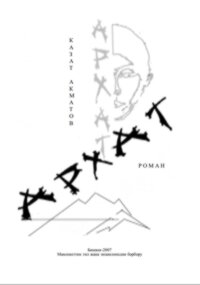
Frontispiece from the Kyrgyz version of the novel
A few weeks ago I received a copy of a book, (Thirteen Steps Towards the Fate of Erika Klaus), by the Kyrgyz author Kazat Akmatov and was asked if I could write a short review.
To be honest, although I knew the author’s name, I had never read any of his works so I found the experience interesting. Interesting enough to see if I could find anything else that he had written … especially his recent “masterpiece”, Arhat.
It tells the story of Adilet, a Kyrgyz boy who, when he was born, is acknowledged as the millionth resident of the Bishkek … only to have the honour given to another. He grows up in a poor family and proves to be a troublesome child … and is taken by his uncle on an expedition to study in Tibet to explore the ancient connections between the Kyrgyz and Tibet. There, the monks determine that he is the reincarnation of one of the greatest Buddhist saints, Milarepa, and he embarks on a course of study as a “yellow hat” Buddhist monk. As the story unfolds there are interwoven elements of mysticism, “black magic”, psychology, science fiction and fantasy.
The book was originally presented at at the Bibliobraz festival in Moscow in 2007. The entire print run was distributed free of charge to schools and universities around Russia as a gift from the author and the publisher, the Center for Development of the Russian Language. It was well received and has been awarded several prizes … and also recognized by the Central Tibetan Administration, (the organization claiming to represent the Tibetans in Exile established by the 14th Dalai Lama in 1959 shortly after his exile from Tibet and based in India. It is commonly referred to as the Tibetan Government in Exile – although it denies the appellation saying that it will be dissolved “as soon as Freedom is restored to Tibet”).
Although it was originally written in Kyrgyz, Arhat has been translated into Russian, Bulgarian, Turkish … and English with Farsi and German in the offering. To my amazement, I found a copy of the English version available for download in pdf format from the internet … where it’s also available in Kyrgyz – but surprisingly not Russian.
In many ways, the story of Adilet mirrors that of Milarepa … cheated out of his “inheritance”, he follows the mystic life, descending into the use of black magic only to renounce the evil influence and setting out on a spiritual journey to build a better future.
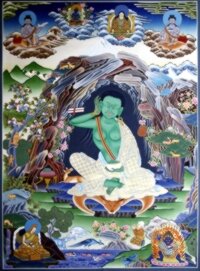
A portrait of Milarepa
For the record: Milarepa, (c. 1052—c. 1135), is a fascinating character; considered to be one of Buddhism’s greatest yogas and poets. He was born into a prosperous family, and was given the name Mila Thöpaga, which means “A joy to hear.”
When his father died, however, his mother was cheated out of the family estate by his Aunt and Uncle and the young Mila resorted to studying sorcery in order to extract revenge on them.
Later, he was to lament the evil way that he had followed in his youth and studied under the famous tutor Marpa – who had him build towers, one of which allegedly still stands – Marpa had him demolish the earlier ones.
After twelve years of study under Marpa, he achieved a state of enlightenment and then when he bacame known by the name Milarepa, which means “Mila, the cotton clad one”. At the age of 45 he became a travelling teacher, but spent a lot of time in what is now known as Milarepa’s Cave in Nepal.
He survived on a diet of nettle tea which apparently gave his a greenish hue, which is why he appears green in many of the portraits painted of him.
The book has received high praise since its first appearance in 2007. Personally, am not sure that I would consider it to be a masterpiece … but I come from a different culture and am used to a different literary style. I did, however, find the book quite challenging in many respects … and if the purpose of literature is “to entertain, educate, edify and challenge us in a wide variety of ways”, then Akmatov certainly achieves that.
Entertain: “something that holds the attention and interest of an audience, or gives pleasure and delight” … although I did enjoy the experience, I am not sure about the question of “pleasure and delight”, however, he certainly held my “attention and interest”. Akmatov tells a story which at times may seem fanciful … unbelievable, even … but it is well told and has a number of interesting aspects.
To be fair, some of the more fanciful mystical elements seemed overkill, but when they appear in the early part of the story they helped to arouse interest and later on they, as in any other novel in the “fantasy” genre, are accepted as an integral element of the story; an instrument to stimulate our imagination.
Educate: The biggest challenge was, perhaps, the references to Tibetan Buddhist culture. Although I had some basic knowledge of this, (I was, after all, a child of the sixties when there was a burgeoning interest in Eastern Religion – and was a student of Theology – albeit predominantly Christian Theology but with an element of Comparative Religion), much of it was new to me. Although I chose to follow up researching some of these points, it wasn’t absolutely necessary.
It was also interesting to see the historical connections between the ancient Kyrgyz and Tibet. Recently, there has been a considerable amount of interest ion the Kyrgyz diaspora … whether in Turkey, the Wakhan Corridor of Afghanistan, just over the border in the Xinjiang province of China or even in the United States. There was certainly a connection between Tibet and Central Asia – with a Buddhism just one of the religions represented along the Great Silk Road … Buddhist communities in various Silk Road cities, a Tibetan mantra carved into a rock above Tamga on the Southern shore of Lake Issyk Kul. In Tibet there is a lake called Manas, which may or may not have a connection with the legendary Kyrgyz hero … and so on.
Edify: deriving from its Latin roots, this verb means “to instruct and improve especially in moral and religious knowledge” … It seemed to me that Akmatov is trying to get his readers to move beyond the material, physical world and think about the importance of “otherness”, not necessarily a religious concept but a recognition that there are are things beyond our current state of knowledge and understanding … and consequences for our actions.
In his introductory message, for example, the celebrated Kyrgyz author, Chinghiz Aitmatov, concentrates on the novel’s theme of the place of the “ego” in human relationships.
Challenge: Although Arhat tells a story, it is far more than that.
I suspect that those who read it simply for the story may be disappointed … but it challenges readers to think about some of the fundamental issues of society: where are going and have we, (like the youthful Milarepa), lost our way, or, (like the young monk Adilet becomes), been led astray by those in authority who should know better but are too intent in pursuing their own interests; are we in need of finding once again the path to enlightenment – whatever form that might take.
In some ways, it seemed appropriate to post this today because it happens to be Asaki Puja – a holiday in Thailand that commemorates the occasion when the Buddha achieved enlightenment and delivered his first sermon to a group of five yogas … an event which is considered to be the establishment of Buddhism.



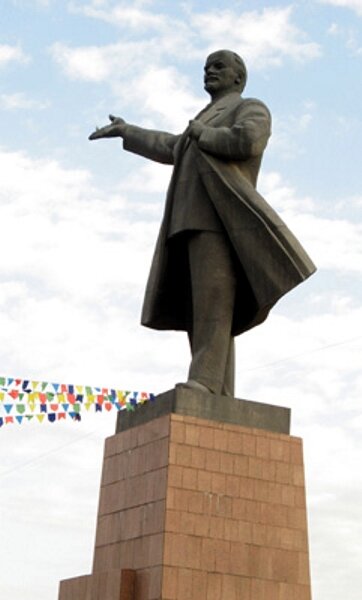

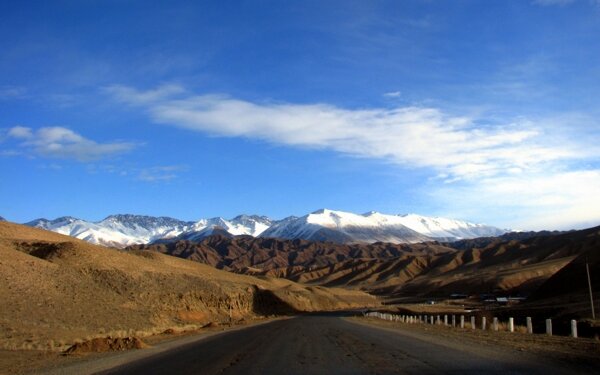

 Bishkek