Sun Worship

The Morning Sun
We all like the sunshine, which cheers us up and makes the world seem a better place.
When I first came to Kyrgyzstan, I was promised something like three hundred days of sunshine a year. We never seem, however, to make it and that was probably an exaggeration. Indeed, I once read that there are an average of 322 sunny days a year, (although I am not sure how they define a “sunny day”), whilst in 1999, Bishkek received 247 days, (which is quite a big difference!), whilst another source recently said that the average was just over two hundred and seventy days of sunshine a year, (which still strikes me, as an Englishman, as pretty impressive).
Now, sunshine is usually thought of as a good thing.
For example, we talk about someone, especially our loved ones – our spouse or our children, as being “the sunshine of our lives”.
It seems, also, that it is important for our health: Sunshine is the source of Vitamin D, a chemical generated in skin which is exposed to sunlight and is important for the maintenance of the body’s organs and the immune system. A deficiency in Vitamin D can lead to a number of disorders such as Rickets in children and weak bones in adults.
In addition, sunshine seems to be important for our happiness and well being: It seems that sunshine is important factor in making us feel happy. At least, a lack of sunlight is considered to be one of the primary causes of “Seasonal Affective Disorder”, (appropriately abbreviated as SAD ), which can bring on severe mood changes and depression in people. The disorder occurs mainly in the winter and is markedly more – and is also known as Winter depression or the “Winter Blues”.
Perhaps that’s part of the reason why early man was often a “sun worshiper”. Indeed, it has been said that sun worship is one nearly as old as mankind itself and it’s not all that surprising that the sun became deified in societies that were primarily agricultural, depending on it for life and sustenance, power and energy, light and warmth.
The Ancient Egyptians worshiped Ra, the sun god, who drove his chariot across the skies. Likewise, the Greeks Helios, the Romans Apollo and the Persians Mithra. Elsewhere in Mesopotamia at different times, the Babylonians worshiped Shamash, the Hittites Arinna or Heta, and in Scandinavia there were Freya and Sol. Even among native American communities such as the Iriquois and tribes of Plains Indians recognized the power and importance of the sun and in Meso American culture the sun was associated with Kingship, many rulers to be direct descendants of the solar deity, (such as Huitzilopochtli or Tonatiuh – the Aztec sun gods, or Inti - the Inca version).

A sunburst petroglyph
There is evidence to suggest that sun worship was an feature of life in ancient Kyrgyzstan.
Many examples of petroglyphs, (stone inscriptions), found at Saimaluu Tash and other places around the country seem to depict the sun or a solar deity. These have sometimes been traces as the origins of traditional schematic decorative patterns to be found in Kyrgyz shyrdaks and other works of traditional craftsmen.
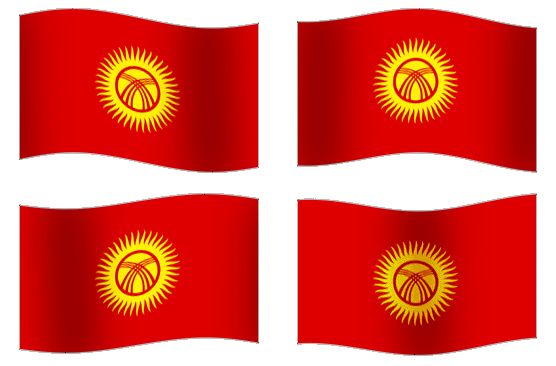
The Kyrgyz flag showing a sunburst of 40 rays symbolizing the original Forty Kyrgyz Tribes
Even the modern Kyrgyz flag depicts a sunburst of 40 rays, (one for each of the traditional 40 tribes), being emitted from a circle bearing a symbolic representation of the Tunduk which crowns the apex of the traditional yurt – a symbol of home and harmony.
The strong dependence of the nomads on the forces of nature may have shaped an early reverence for, and belief in Animism, (tokenism), Shamanism and Tengriism.
Although we cannot guarantee that the sun will be shining all the time, for most of July and August, the days are hot and balmy … with plenty of opportunity for the modern “sun worshiper” to be able to lie back and ”absorb the rays”.





 Bishkek