Romashka
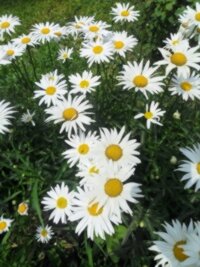
Romashka
It was Roma’s birthday, so a group of his friends gathered to go and commemorate it … but it wasn’t exactly a happy gathering. Roma was just 31 when he died on a cold January night, three and a half years ago …
We settled down in the car and set off for the cemetery, some 25 kilometers or so out of town. It was a bright sunny day, with temperatures soaring into the thirties – quite a contrast to the snowy over cast day when we gathered to say goodbye to him.
I remember going to the local florists back then to buy a bouquet for the funeral – an even number of blooms as tradition dictates. I asked if they had any Romashka, as that was his favourite flower – something to do with the name, I suppose. ”Sorry,” they said, “it’s the wrong time of year …”, so I settled for carnations like everyone else. Carnations are the traditional flower for funerals here …
Carnations in January? I actually remember wondering where the flowers came from … I presumed locally, grown in greenhouses, but it seems I was wrong
As we reached the city limits on the way to the cemetery, one of our number started to fret. ”Flowers! … We didn’t but flowers. We should have stopped off in the city center, on Kievskaya, and bought some flowers.”
“Don’t worry,” said our driver who travels this stretch of road twice a day, “you aren’t leaving civilization behind you … they’ll be flower shops on the way.” He was right. He pulled up at a parade of shops and we took our lives in our hands as we crossed to the florists, shops we could see on the other side of the road … as it happens, we needn’t have risked our necks because there were two more which we didn’t notice until later on our side of the street.
We split up and went into different shops so as 1) get a better choice and 2) speed up the process, reducing the time to get served. This was July. which is the season for Romashka, bu once again I was out of luck. ”We had some earlier, but they’ve all gone,” I was told, so I settled for Chrysanthemums which are the traditional funeral flower in France – Roma was a great fan of France and everything French.
The others chose Roses, Gladioli and Irises. On the way back to the car, one of our number stopped, turned around and went back to the shop. She had instinctively bought five blooms … only realizing her mistake as she was almost back to the car, and setting off to add another to make it even number.
In answer to a question, we had been told in the shop that the flowers came from Columbia. That took me aback. It shouldn’t have because, whereas some forty years ago, most of the flowers grown for retail sale throughout the world originated from California, nowadays they mostly come from South America. Even in the US, something like 80% of the flowers on sale come from Columbia or Ecuador. It seems that the capacity for year-round production, low land values, low labour and energy costs, all combine to make South American a very attractive source for the trade in cut flower.
So, why couldn’t I get Romashka in January? Maybe there just wasn’t enough demand at that time of year to warrant the transport costs involved in the import of this particular flower.

The 1994 postage stamp featuring the Romashka
Romashka are a perennial, (although some sources suggest that they are annuals), flowering plant of the Aster family, which comprises about twenty different species of low fragrant herbs which produce flowers in their first year of life … the most famous of which is probably Chamomile. It’s basically a large Daisy with long white petals arranged around a yellow central portion. Apparently, it has a weak, but distinctive smell – but I am no expert. It starts flowering early, (depending on the weather), and can be seen right through the summer to the autumn … although deadheads can look unsightly.
It is found throughout temperate regions of Eurasia, America, South Africa and Australia – where it is not a native but was introduced by humans. It used to be found in Central Africa as well – but has been wiped out, probably because of superstitions associating the plants with attracting “evil spirits”.
It grows wild throughout Siberia, the Altai, the Tien Shan and the Pamir. It grows on the edges of fields, roadsides, near houses, on vacant lots and in meadows … almost as a weed … in fact it is known as one of a group of ruderal species – one that is the first to move in and colonize disturbed lands … for example following avalanches, wild fires or human activity such as construction … often, soon being replaced by other, native, species.


 Bishkek