A fire in the Bard’s theater …
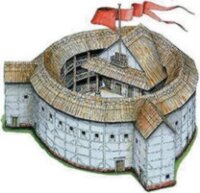
An artist's impression of Shakespeare's Globe Theater
On 29th June, 1613, a stage canon was fired off as part of production of William Shakespeare’s play Henry VIII in the Globe Theater in London.
Now, Henry VIII is not one of Shakespeare’s better known plays, and it might seem a little unusual that might fire off cannons as part of the performance, but it wasn’t really anything unusual in itself in that such stage props were not uncommon, but on this particular occasion it turned out to be a far from usual “special effect” in the performance.
The cannon shot caused a spark to catch the the thatched roof and a fire broke out. Fortunately, so it appears, no one was hurt, but the theater burned to the ground. I can imagine the news reports if the likes of CNN, Fox News and BBCworld had existed at that time.
For the record: The Globe was built in 1599, using materials following the demolition of London’s first public theater – imaginatively calledThe Theater. It was owned by a group of actor’s from Shakespeare’s company, the Lord Chamberlain’s Men, including Shakespeare himself … it could house up to 3000 people.
A year later a new Globe Theater opened on the same site – but this time out of stone, not wood. It finally closed in 1642 by the Puritans … and pulled down in 1644.
Shakespeare’s fame and popularity kept the name alive and in 1997, a new reconstruction was opened, not quite on the original site, but nearby.
As it happened, a couple of months ago we had a fire in the Russian Drama Theater. It was in a store room at night and not during a performance so, once again, fortunately no-one was hurt and the this time building didn’t burn down and so there was no dramatic coverage in the news.
In fact, most of the news this week has been fairly similar … that is, there was little sensational to provide dramatic coverage – but that’s not to say that there was no drama.
Consider, for example, the debate that took place in the parliament about the Ombusman – about whether he should be dismissed, even though he has only recently been confirmed in office. There are accusations that he was somehow implicit in the early release from prison of a gangland boss who subsequently left the country, and claims of “abuse of power”, (which seems to be a common charge levied against officials here). It seems that during the debate he complained of feeling ill and was examined by medical staff who had him immediately admitted to hospital, where he lost consciousness and, (as far as I am aware), still hasn’t recovered. That didn’t seem to phase the deputies, however, who proceeded with the debate eventually voting to dismiss him from his post.
In many ways, perhaps the most significant news of the week provided no drama at all … after a debate in parliament which resolved to renounce the agreement with the Americans establishing the Manas Trasit Base established originally following the 9/11 attacks on New York and Washington DC in 2001 to provide logistic support in dealing with those held to have been responsible in Afghanistan. Well, this week the President signed the law and now the diplomats have to go through the motions of implementing the new law – giving official notice and negotiating the details of how the withdrawal is to be handled.
Unlike this week’s momentous decisions by SCOTUS, (the Supreme Court of the United States), about “Gay Marriage”, this particular decision did not lead to parties or celebrations and more or less passed by almost unremarked. Perhaps that’s because everyone was expecting it. The President has been adamant about his position for some time – the Military has to go … even if the Russians are allowed to stay, (and even extend their presence in Kant). Maybe one reason for the lack of reaction was that everyone was expecting it, but then again, it’s not clear what will happen now.
Although the decision has been taken and all the main players, (here, that is, in Kyrgyzstan), that now the law has been passed that the Americans will honour their commitment to Democracy and “go” … but there are still plenty of people who think that there could still be room for a “fudge” – probably not a complete about turn as in 2009, which apparently upset the Russians and many locals alike, but it is thought that they will want to get something out of their considerable investment in setting up the facilities – even if they seem to be making progress with neighbouring Uzbekistan.
The relationships with Uzbekistan and Tajikistan seems to be just as contentious as ever with discussions about trying to solve the border disagreements. Apparently the European Union have allocated some funding to help facilitate the process but one foreign commentator responded with something like, “in that case expect it to take forever”.
Fortunately, a lot of the emotion and heat seem to have dissipated as the daytime summer temperatures have been soaring – reaching almost forty degrees here in Bishkek. That doesn’t, however, mean to say that everything is quiet and “hunky dory”. There have been comments from officials about the need to strengthen the border zones and of the most of the many reports it’s clear that this doesn’t just mean putting more soldiers in place to patrol the borders, but looking at the economic and social welfare in these regions … which tend to be quite poor – and attracting more investment into these areas.
There was a bit of a tiff in the parliament over the incident about a week ago when a Kyrgyz citizen was shot by Uzbek border guards. It seems that the Kyrgyz Foreign Ministry quickly fired off a diplomatic salvo in the form og an official protest. One of the deputies had apparently come forewarned and forearmed and asked something like, “and what good will that do?” She pointed out that in the last two years Kyrgyzstan has delivered 21 diplomatic notes of protest, and asked what good they had done. The deputy Foreign Minister also came to the debate well prepared and in his answer he pointed that only three have ever elicited a response – one where the Uzbeks admitted fault and agreed to pay compensation for the harm incurred and another where their account of the events which led up to the note differed somewhat from that presented by the Kyrgyz.
He also pointed out that in the same period, Kyrgyzstan has received some 14 official protests from out neighbours in Tajikistan and Uzbekistan … but he didn’t elaborate with any details, (or if he dd it doesn’t seem to have been reported), like how many from each country and what responses the Kyrgyz government have made to them.
One example of cooperation relating to the border was the news that Kyrgyz borer troops are now undertaking some joint borer with the Chinese province of Xinjiang together with their Chinese counterparts. Now that raises an interesting question: if the Chinese can agree on such a joint venture – then why can’t the others “play ball”? To be fair, it has probably got something to do with the fact that most of the border between the two countries, (Kyrgyzstan and China), is remote, mountainous territory and sparsely populated … whereas the Ferghana valley is a melting pot where groups of the various nationalities live in close proximity to each other … and remembering that there is a long history of distrust and rivalry between them all, there is more opportunity for emotions to boil over.
The ethnic minorities have been in the news again this week, especially among the foreign correspondents some of whom have finally caught up with the debate over the precedence being given to the Kyrgyz language, pointing out the damage this could do to the already strained inter ethnic relationships by making the minority groups feel more and more isolated. To be fair, once again, the authorities have been taking great pains to try and stress the multicultural and multi ethnic nature of Kyrgyzstan and its population. In fact I was reminded of the slogan that used to be seen everywhere in Akaev’s time: “Kyrgyzstan – nash obshe dom” – “Kyrgyzstan, our common home”.
A couple of other minortoties have also been in the news, For example, the Seventh Day Adventists have just appointed their first home grown pastor – a former policeman, no less. The adventists don’t get as much press coverage here as some of their counterparts, Jehovah’s Witnesses and the “Baptists”, which seems to be a general term applied to all sorts of evangelical protestant groups, but they have a reasonable sized active community of about 800 members and even run a school here.
Interestingly, another report from abroad, quoting a CBN but datelined Bishkek, said that “one hundred thousand Christians are murdered because of their faith each year”. I thought that opening sentence was pretty misleading, although bit was clearly made for dramatic effect. The report went on to highlight how they were coping with the rise of Islam in daily life drawing parallels with the situation in the Soviet time – how they face beatings and arrest. To be honest, I thought that was overstating the case … although it is true that some believers do face some difficulties. There are sometimes problems, for example, over the registration of places of worship, (and hence the believers in the report felt that needed a secret hideaway in the mountains outside Bishkek for their meetings), and in some of the rural areas there has been hostility towards families where people have converted … but that is only a part of the story and I don’t think there are many Christians in Kyrgyzstan that are likely to be counted in that annual count of a hundred thousand martyrs.
The Orthodox Church, for example, (which doesn’t really do much in the way of evangelizing and seeking to make converts), is accepted and clearly given precedence, being accorded a special place in the community.
The bone of contention seems to be the question of evangelism – seeking converts. There has even been some criticism of the young Muslim “missionaries” who travel the country trying to bring the people back to a more traditional way of life – especially and especially working among young people. Many people seem to worry about their impact on “highly impressionable” young people. There has even been criticism, for example, about the way they adopt Pakistani and Pashtun dress … “What is wrong with traditional Kyrgyz costume,” people ask, “which is just as in keeping with the teachings of Islam as the Hibab. These criticisms are more commonly heard here in the, cosmopolitan, capital than in the rural regions.
The authorites are anxious about the spread of fundamentalism, and some more members of the “radical” Islamic group Hizb-ut-Tahir have been arrested.
Everyone seems to agree that the mountains offer some sort of protective respite – it doesn’t matter if you are Christian, Muslim … or gay – or Lesbian. Another report in the foreign media gave an account of a visit to Kyrgyzstan by a couple of Lesbian travelers. It told how they telling how they met up with some of the LGBT groups, (Lesbian, Gay, Bisexual and Transgender), that exist here somewhat surreptiously … keeping themselves to themselves and trying to keep out of the public eye for much of the time. They are unlikely to be celebrating Single Sex Marriages here in Kyrgyzstan for a long time to come – if ever. But they did speak very highly of their impressions of Kyrgyzstan’s mountains.
Reading the three accounts, (about the Adventists, the secret churches and the Gay and Lesbian communities), I couldn’t help but be drawn by the comparisons … all commented on the social pressures that members of their community felt – especially as a result of the increasing Islamization of the country – and the perceived need to keep asn important part of their lives private.
Corruption, and the struggle to combat it, was, once again in the news this week. If “abuse of power” is a charge often levied against people in authority, with the emphasis on those in positions of authority – it used to be said that the only “corrupt” people who actually faced any real difficulties were the “small time”, “low ranking” officials; “small fry” who make “slim pickings” in order to supplement their meager government salaries. The “Big gins”, however, always seem to come away looking and seeming to be “squeaky clean”. The only real risk that they seemed to face was falling out of favour with someone higher up the political and social ladder.
That’s started to change in recent years, however, as more and more people have been apprehended and prosecuted … even the son of one of the deputies found himself sentenced to nine years for corruption this week. Although it has to be admitted that there is still a commonly held opinion that the really “big fish” still manage “to get away” and escape any serious consequences.
Well, there now seems to be a new trend emerging in the anti-corruption drive … as well as targeting the corrupt official who extracts a bribe in exchange for putting a stamp on a particular document … whether it be a contract, a permission or whatever … it now seems that law enforcement has remembered that it’s not only illegal to accept a bribe … it’s also illegal to give one, and they seem to have made a number of arrests of people that were apparently trying to entice some public figure or other to “stray off the straight and narrow.”
I suppose that one of the factors that has influenced I sea change approach is the controversy that surround Kumtor … there is a general feeling that some as paid something - and that it wasn’t a case of “small fry receiving small change”. It seems quite ironic, therefore, that it has been announced that Kumtor will be sponsoring (funding) a transparency and anti corruption drive.
If “it takes two tango”, then why should only one party be punished whilst the other I left free to reap the benefits of his wrong doing. Although an see the logic, it seems to me that there s a flaw in the argument because it assumes a level playing field and a game where everyone understands and plays by the same rules.
Talking of Kumtor, they have had a rare success in that they appear to have persuaded a judge to dismiss a case against them regarding pollution. As I understand it, they said that the court had no jurisdiction to hear the case brought against them because the fateful 2009 agreement said that such disputes between the parties had to settled by international arbitration. Their victory, however, might be short lived … the fateful, hated, agreement is one of the things that the crowds of protestors want changed.
The protestors were back this week in Barskoon – but they didn’t cause too disruption. I think their main aim was to keep the pressure on and remind the government that this issue will not simply go away. They have a long list of demands for social projects which they want funded by the gold mine … and they say that they wont wait until September for a resolution of the issue.
There has been a lot attention paid to energy, and particularly to the generation of electricity – in part, I think to the fact that the World Bank have raised the issue – calling for tariffs to be raised. That’s not going to be popular and although the Prime Minister has said that the people will be consulted … there are already that people are not prepared to see an end to the current low rates – no pun intended.
The work on the construction of a number of projects has only just got underway … and one commentator has pointed out that the cost of renovating just one of the larger Hydro electricity power station (about USD130 million) seems excessive and the money could have been better used in renovating a number of small ones.
Another controversial measure is the Parliamentary decision to charge school children and students a “textbook fees” in order to help the government fund the development of more titles.
The good news is that Kyrgyzstan new tourism brand, logo and slogan …. (So Much to Discover) came amongst the top three in a competition of Destination Marketing strategies in a conference. Ironically, the logo from Bulgaria, (which many in Bulgaria seem to think was lifted from Kyrgyzstan as the two are so, so, similar), wasn’t placed.
_______________________________________
Postcard from Bishkek: the weekly postcard that I send out as an email also gets posted on the website ianbek.kg each week – and there are other postcards which don’t get sent out. This week, for example, there has been the following postcards:
- The “authentic” Silk Road - Anyone who want to travel along the Silk Road overland these days, more or less, has to travel through Kyrgyzstan … giving them the opportunity to experience something that ancient travelers might find familiar – 23/06/13
- Tien Shan Fir trees - Fir trees are a common sight in Kyrgyzstan’s mountains – 24/06/13
- Climatic factors - what is happening with the weather these days? – 25/06/13
- Nam shestnadtset let! - Sixteen years in business – What changes have we seen? – 26/06/13
- 21 to 14 - We often hear about “Diplomatic Notes” and “Protests” but what are they? 27/06/13
- Extending the season - The “tourist season” in Kyrgyzstan is reckoned to be just 40 days! – 28/06/13
It is possible to follow me on Facebook, (where I have specific pages for Celestial Mountains and ianbek … and also links.kg, Kyrgyz Diary and Kyrgyzstan Visitki), and also on twitter, (@Bishkekpostcard and @celestialMTC ).


 Bishkek