Tien Shan Fir trees
In the grounds of the Silk Road Lodge we have a large number fir trees – Some of them were already in situ when we built the hotel but some we have planted ourselves. Of those, some have taken well and are flourishing, others not so well, although there are signs that they are improving, whilst a couple simply didn’t take at all and died on us.
They are of different types and to the uninitiated, (like me), it can be quite confusing when people start talking about them by name: Sosna, Golubaya Yolka (Blue Firs), Semyenovka Fir; the Tien Shan Fir (which is also known as Schrenk’s Spruce) and what I think is a Norwegian Spruce – which we in the West would call a Christmas Tree but is universally known here as a Noviy Godniy Yolka, (New Year Fir).
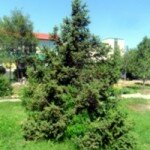
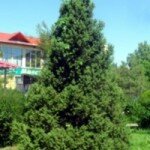
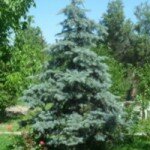
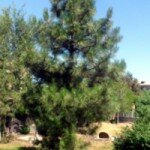
Fir trees are evergreen conifers - which include cypresses, cedars, firs, juniper – Archa, larches, sequoias, and spruces – it’s thought that there are something like 700 different species of conifers around the world. To confuse matters even more, the conifers are also known as Spruce and Abies. In Russian it seems to be seems to be simpler … they are simply known as yolka.
Firs belong to the family Pinaceae, (Pine trees), and there are something like 50 different genuses distributed around the world; throughout the mountain regions of much of North and Central America, Europe, Asia and North Africa.
Conifers are often used as decorative trees in gardens and landscaped territories, (as in the case of our garden), making use of their distinctive attractiveness, symmetrical shape and, the fact that most of them are evergreens which means that they offer an all year round appeal – and especially a stark contrast to enhance a winter landscape. Oh, yes, and course, they can serve as Christmas Trees.
The wood from fir trees is generally considered unsuitable for use as timber because its useful “life expectancy” , depending on the conditions in which it is used, is just about a year, and so it is usually used for pulping and in the manufacture of paper or plywood, although planks can be used for “rough timber” and for short term use indoors, crates and also for the construction of wooden aircraft, (the plane flown by the Wright brothers was made of Spuce wood), and musical instruments, (such as guitars, mandolins, violins and cellos – as well as in the harp and piano).
Amongst the most common is the Picea schrekiana, or Shrenk’s Spruce, which is a native of the Tien Shan – which is why it is sometimes called the Tien Shan Fir Tree. It takes its name from the Russian naturalist Alexander von Schrenk, (1816-1876), who traveled in Lapland, the Northern Urals … oh yes, and also Kyrgyzstan.
It is thought that it might be related to the Miranda Spruce, which is found further South – in the Himalayas, and the Siberian Spruce which is found further North – a native of Siberia, of course.
It can grow as tall as 40 to 50 meters tall, (that’s somewhere around 130 to 160 feet), and sometimes even higher. The trunk can measure anything between one and two meters in diameter. The crown takes a narrow conical shape with horizontal branches, and the dark green needle-like leaves which are attached individually to the branch, can measure anything between 1.5 and 3.5 centimeters. When the needles are shed, after 4-10 years, they leave behind a part that connected it to the branch creating a rough surface. The cones measure anything between 6 and 12 centimeters and are basically cylindrical with conic ends.
It is found at altitudes of between 1200 and 3500 meters above sea level and although it is sometimes found alongside Semyenov Fir Trees, it is usually to be found in “forests” which contain just this one type of tree.
The trees are used as habitat and provide food by the larvae of a variety of Lepidoptera – butterflies.
Although the Picea schrekiana is listed in the ICUN Red List of endangered species, it is only in the final category of Low Risk, Least Concern.






 Bishkek