Extending the season
One of the problems that those of us who work in Tourism here in Kyrgyzstan face is the shortness of the Tourism Season.
I have said before how I used to refer to the season as lasting three months – from mid: June to mid-September …
I say “used to” because on one occasion I was taken to task and informed in no certain terms that the High Season lasted only 40 days!
 We always used to reckon that “celebrations” to commemorate the International Day of Tourism, on September 27th, marked the end of the season. These days, however, at least in some respects, the season seems be getting longer, “officially” starting earlier – this year in the middle of June – and stretching later into the autumn.
As it happens, however, in a way there was some logic behind the idea of three months:
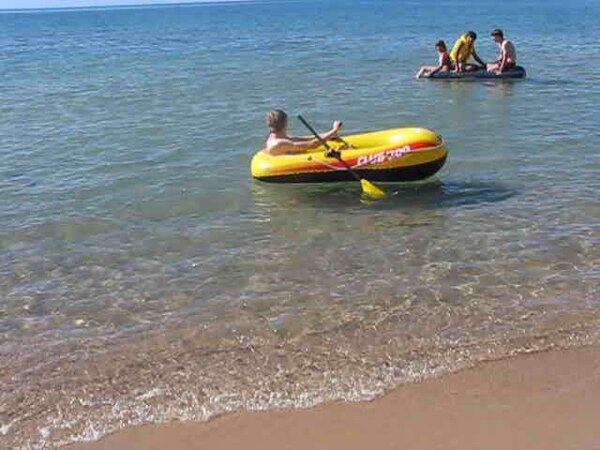
- Even in the West, and the situation in Kyrgyzstan is no different – the High Season is usually associated with school holidays, (which here last from the Last Bell the end of May until the start of the new academic year on Dehn Zanaiye, 1st September). This is especially true for the “Sun, Sand, Sea” type of recreational tourism, (well, “Sun, Sand, Lake” in our case), which typifies the vast majority of the tourism industry here … the vast majority of visitors to Kyrgyzstan being Kazakhs and Russian who arrive to take their leisure around Lake Issyk Kul.
-
- Incidentally, this correlation is not just limited to the tourists – it’s also applies to the staff. Many of the people who work in tourism are students employed during their long summer holidays in order to earn enough to eek a during the rest of the year. Although some staff are employed all year round, students are ideal candidates for these additional “seasonal workers” are employed to cater for the crowds that arrive during season – but … they also have to be back at their places of learning at the start of September.
- I happen to run a tour company, as a result I tend to see things in the light of the tours that we are asked to deliver … Most of the tour groups we serve, for example, following the Great Silk Road, and they take place during the the five months from May to September.
- Indeed, the yurt camps in some of the jailoo, (high mountain pastures), were usually erected in the last ten days of June, and dismantled three months later at the end of September – although these days they normally go up a little earlier and come down a little later.
- Before and after this period, despite the fact that the weather can be very good, it can get quite cold – at least, that is at night, and …
- Some of the mountain passes are still covered in snow (and impassable) until July, and usually close once more with the arrival of the first snows in the Autumn.
- To be fair, however, I should point out that there are different types of tourism, (e.g. hunting and skiing), when the season is different.
One day I was at a conference and I made a reference to the short season – referring to “just three months”. One of the speakers had given a talk about the financial difficulties involved in opening a hotel on the lake. He painted a very bleak picture, (and, to make matters worse, it was a very simplified analysis with several factors understated or omitted … and coming to the conclusion that it was difficult to make enough money, (that is, profit), in order to recoup the investment involved.
As I said, it was a very bleak picture.
In the discussion that followed, I pointed out that it didn’t help that, for most of the year, the investment either stood idle – or was grossly under used. If the establishment worked only during the High Season, some savings could be made because, for example, the only staff that needed to be employed were security and maintenance staff to look after the fabric of the building. Even so, in the short season, it had to earn enough to cover all the costs for the rest of the year.
During the coffee break, the Manager of one of the resorts on Lake Issyk Kul took me to one side and asked: “Ian, why do you always say three months – we reckon on 40 days.”
I confess that I was shocked … I was even more shocked when I told this story on another occasion, and the Director of a ski resort in the foothills to the South of Bishkek said – “It’s the same for us. The season is about six weeks.”
Over the years there have been a number of suggestions made about how to extend the season.
On one occasion a foreign investor proudly told me that he thought he this sorted out … and I said, “please don’t tell me the answer is run conferences.” His face fell, and it was quite clear that this had been what he had in mind. ”Don’t get me wrong,” I said, “Conferences are a good idea and they help … but they are not a panacea. Remember that there are something like 180 different establishments of a similar size along the Northern Shore. Not all of them are open all year round, but if only 10% of them are, that means having to try and attract something like 18 conferences every week in order for them to survive. Are there that many conferences or organizations that provide that many activities? Where are they? Where are they going to come from?”
Some of the resorts around the lake offer Sports training facilities. In itself, it strikes me as a good idea … when the English football team came to Almaty to plat a match against Kazakhstan, then a period of training “at altitude”, (Issyk Kul lies at just over 1600m above sea level), might have provided a welcome venue for acclimatization. It would require some investment – for example, a large indoor sports area that could be used to host competitions and events as well as offering a venue for training, but if it was properly designed then it could be versatile, multipurpose arena that would benefit the local community as much as the visitors it was designed to attract.
If the ski season in the foothills around Bishkek lasts for about just six weeks, to be fair, in places like Karakol, the potential is much longer … and, as a result, a number of firms have been looking to improve resorts and facilities in order to attract more “off season” visitors.
At the time of the discussion, Casinos were still permitted in Kyrgyzstan – and I suggested that he might want to think about a small Casino on site … and then trying to market it in places like China and India, Kazakhstan and Russia. In addition to the Casino, it would be necessary to provide a range of activities that could be undertaken during the day time.
Interestingly, although Casinos were outlawed here just a year ago, I see that some Deputies are still promoting this as an idea.
“I think however,” I said, ”that a more creative approach is needed. Special events such as the Issyk Kul Marathon or a Tour d’Issyk Kul cycle race. Maybe an Orienteering competition – or competitions: one when the weather is good for the traditional form of involving hiking, another for cyclists, a third for skiers, and another for the paraplegics in wheelchairs. How about organizing festivals, such as an Issyk Kul Film Festival, a Literary Festival, a Jazz Festival, a Science Fair, special residential events for the disabled or for Children … Each festival would need specially invited guests – specialists in their field – and a packed programme but with some extra “free” time built in for excursions or simply “time out”, relaxation time. ”
Incidentally thanks to the support of USAID and other donors … both the Marathon and the cycle race were held last year – and I hope they will prove to be sustainable than a simple one-off exercise
Interestingly, the At Chabysh horse festival that the Kyrgyz Ate Foundation used to organize at the start of November every year was always very popular with visitor and locals alike … and, despite the time of year, enjoyed good weather.
“Not to mention,” I said, “the special holiday programmes such as at New Year, Say, one event every week – which means something like thirty or forty different events. You’ll need a whole “Events Department” to organize and market them.”
“Maybe, for the first year,” I suggested, “you limit yourself to just one event every other week to gain experience and build up a reputation.”
Admittedly, we were talking about just one resort – and although the idea could be extended to several – the Lake is about 180 kilometers long and it wouldn’t do as a strategy for the region. We bounced ideas around for a while and came to the conclusion that although some ideas might involve some considerable investment, not all of them had to be so grand.
One of the simplest ideas, (and, incidentally, one of my favourites), was opening an Artist’s House.
Among the fantastic advantages of Issyk Kul is the wide variety of subjects available for drawing and painting. Master classes could be organized, with field trips into the surrounding countryside, weather permitting, or in a large hall serving as a studio when it was inclement.
Incidentally, there is at least one place on the Southern shore of Lake Issyk Kul that has started to offer such an even for small groups.
Having said all that, I think you’ll understand why one particular news item this week caught my attention and excited me.
It was a report of just such an event – held at Kadji Sai, on the Southern shore of Lake Issyk Kul, which brought together artists from Russia, The Ukraine and Kyrgyzstan. What’s more, it’s the fourth consecutive year that such a gathering has taken place. I previous years guests have also come from places as far apart as Croatia, Turkey, and Belgium. As well as undertaking the various activities in the programme, (master classes, excursions, and so forth), the participants were able to socialize and exchange experiences, trying working in new genres (landscapes, portraits, oils and/or water colours) and so on … oh, yes, and being on the receiving end of traditional Kyrgyz hospitality.
The resulting works can then form an exhibition and/or be sold. I think a similar approach could just as easily be valid for other art forms and crafts … for example, photography, film, drama, and even traditional crafts such as making shyrdaks and ala kiyis.
I “take my hat off” to salute the organizers, the Al Hayat Art House, based here in Bishkek. I wish them “more power to their elbow” – and a lot of success in future.


 Bishkek