21 to 14
Protest Note
There was an interesting item in the news the other day, (although I have added a link to it you need a subscription to access it).
In a meeting of the Parliamentary Committee on Defence and Security, one of the MPs revealed that in the last two years Kyrgyzstan has sent some 21 “notes of protest”.
She was commenting on the fact that four Kyrgyz citizens have been killed and three more wounded in incidents on the border and went on to ask if there been any response at all to these Diplomatic Protests.
In response, the Deputy Minister of Foreign Affairs said that there had been three responses … one in which the Uzbek version of events differed significantly from those in the Kyrgyz note; one where they apparently “partially admitted” their guilt, agreeing to pay compensation for the damage caused. It seems that in the other instances (18 of them), the notes went unanswered.
Incidentally … the Deputy Minister also reported that the diplomatic notes travel in both directions. Over the same two year period, Kyrgyzstan had received 14 such complaints from our neighbours in Tajikistan and Uzbekistan.
It’s a pity that he included Tajikistan because that means a direct comparison cannot be made, although it is is important as the Ferghana Valley is a flashpoint where the different ethnic groups live close to one another, (one might say “cheek by jowl”), and tensions sometimes run high – as we saw in June 2010 and several times since.
Neither did anyone say, (at least in the reports that I saw), how many protest notes Kyrgyzstan has delivered to Tajikistan.
Neither did the Deputy Minister say, (at least in the reports that I saw), how many of those 14 protest notes Kyrgyzstan has received have elicited a response and how many went unanswered.
Interestingly, in another report, (an interview given by the Chairman of Osh city council on the anniversary of the events of 2010), he said that although there are a number of “unresolved problems” that require the attention of the authorities, (regarding, for example, housing, land allocation, water supply, funding the local budget … and so on), the economic signs are positive and suggest that the situation is improving and stable … adding that, socially, the situation is “inexplosive”.
I found the article interesting for a number of reasons, apart from the ones I have already alluded to:
The point about such diplomatic notes going unanswered struck a particular note, (no pun intended) , in that some friends occasionally complain to me that I seem to “have gone off the radar” … they have written to me and having received no reply they send me terse note to ask if I am OK and whether I have received their previous messages.
Now, it is true that on some occasions the earlier messages have gone astray, (disappeared “somewhere in the ether” known as the internet … for example lost in a spam filter – which is one reason why I dislike and distrust them), and as a result I hadn’t received them. On other occasions, however, it is my turn to be indignant and reply that the message had simply been for information and “there didn’t seem to be anything in it which demanded a response … now that I have been given a reason to respond, I am doing so”.
Not knowing what was contained in those diplomatic notes, it seems to me that they could have been something similar … informative, registering a protest, but not necessarily demanding a response. Not every diplomatic note delivered has a specific “call to action” as Neville Chamberlain’s message to Adolf Hitler with the ultimatum that Germany withdraw its troops from Poland, or else “a state of war would exist between us” … in fact, that message never got an answer either … but then he only really gave Hitler a couple of hours to respond and issue reassurances that the troops would be withdrawn – which was hardly a pragmatic step but, even if he hadn’t been aware at the time of Hitler’s jib about having been “robbed” of his “little war” at the time of the Munich agreement, he was almost certainly aware of what the likely outcome was going to be and with 15 minutes of the expiry of the deadline he was on the radio announcing to the nation that they were now at war. Basically Chamberlain was simply “going through the motions” and following “form”.
In fact, there is quite a lot of formality involved in preparing and delivering Diplomatic Notes, as can be seen from the Correspondence Handbook of the US State Department. They are not written lightly nor, usually, are they taken lightly. The guidlines go into detail about:
- the type of note and when they are to be used,
-
- some are written in first person – apparently, these are used for the most important communications – and others in the third person avoiding pronouns I, we, you and yours;
- the US guidelines identify seven different types of third person note, each with their own purpose and protocol and the Demarche:
-
- Memorandum – a written statement which can be on almost any subject, usually of a routine nature and it may be an addendum to another note;
- Aide Memoire – an informal summary of a meeting or discussion;
- Pro Memoria – a formal protocol or minute of a meeting or discussion from the point of view of the side presenting it, outlining their understanding and position;
- Note Verbale – an informal third person note;
- Note Diplomatique – an official communication between governments outlining the position of the side presenting the note;
- Note Collective – sent by representatives of a number of allied governments, representing the official collective position of their respective governments and are usually the result of considerable discussion and negotiation between them – by their very nature they are solemn instruments – and often unwelcome;
- Circular Diplomatic Notes – a note sent by one government representative to representatives of a number of different governments, (for example, to a number of embassies represented in the capital).
- The Demarche is a formal Diplomatic representation of one government’s official views or wishes on a given subject, (seeking to persuade, inform or else gather information), or else as a protest objecting to the actions of the recipient government.
- the content including the language to be used, such as the use of courtesy phrases, (such as “conveys its repects“, “has the honour of informing” … with the intention of being getting the message across but, at the same time, remaining courteous. For example, in order to express exceptionally strong anger towards a foreign government’s policy. A letter of protest might use a phrase such as, “We condemn this action in the strongest possible terms” to express exceptionally strong anger), and whether to include a date or not;
- and even down to the paper to be used, the margins and whether they should be signed and stamped, (those written in the first person are signed but not stamped whereas third person notes are simply initialed).
For the record: An exchange of notes on a topic can sometimes be used to conclude an agreement.
These formalities are important because Diplomatic notes are an important tool in communicating between governments. All notes have to be registered and archived, and the lines of responsibility for their content are well defined.
As I said, we don’t know the contents of the 21 Protest notes Kyrgyzstan has presented to their Uzbek counterparts … but these things are rarely ever put into the public domain. However, some protests notes have surfaced – even before the likes of Julian Assange and Wikileaks started to create ripples int he diplomatic waters.
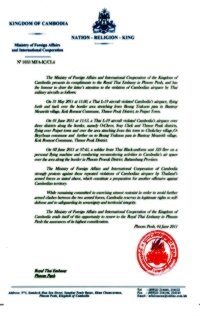
Perhaps the one that best gives an illustration of what they are is given by the note presented by the Cambodian Ministry of Foreign Affairs to Thailand in order to protest about “the violations of Cambodian airspace” by Thai fighter jets during three consecutive days … when the International Court of Justice just happened to be considering another complaint from Cambodia’s about Thailand’s “aggression” over Cambodian territory and sovereignty.

An example of a Diplomatic Protest Note






 Bishkek