Graffiti – revisited
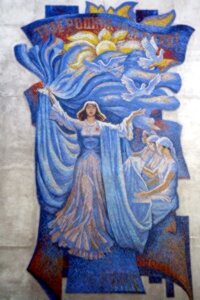
Mosaic adorning a former textiles factory
Back in December I wrote a postcard about Street Art – better known all over the world as Graffiti.
On that particular occasion I was concentrating on some of the more artistic trends – informal attempts that might be considered an equivalent to the mosaics that seem to have been a fashion for decorating and individualizing buildings around Bishkek during the soviet period. These are often colourful and provide a point of interest as one walks around the city.
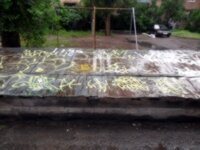
The first daubs
Some of the street art can be really impressive … unfortunately, not all of it is – and we have become victims of some random daubing in our yard.
The first daubs appeared a few weeks ago on the metal roof over the steps down to the service basement – where the water pipes enter the building.
The appeared over night and we have no idea who was responsible, although we asked all the young people in the immediate neighbourhood.
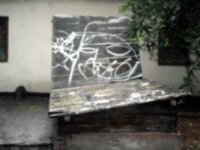
The most recent daubs
Then, a couple of nights ago, some more appeared. Once again they appeared over night and we have no idea of the identity of the so called “artist”, and our inquiries have, so far, “drawn a blank” – no pun intended.
Whereas the first daubs seemed to random squiggles and the odd obscenity – in English – this latest contribution consists of lines drawn in spray paint – that, I suppose, could resemble an attempt at abstract art … after all, it seems to have been an attempt to draw a cartoon face with a speech bubble … but my guess is that it is simply the product of one or two youths with nothing better to do.

Andrei in front of swirling curves
As it happens there have been some interesting attempts at producing “street art” here in Bishkek but most of them lack finish and appear to be pretty amateurish … A short while ago, Andrei and I came across an example and he asked to be photographed in front of it. Although I agreed to take the shot, I worried that someone might think that he was the erstwhile “graphic artist”.

Chad - who declared that "Kilroy was here" - or expressed despair: "Wot, no sugar!"
The trouble is that a lot of graffiti does nothing more than spoil the urban landscape. It exhibits no talent, no humour, no political or social comment – like the chads from the Second World War which declared that ”Kilroy was here” or expressed despair like “Wot, no sugar!” – and they are not even adverts or declarations of “fandom” in honour, for example, of “The King”.

Elvis from "Melbourne’s AFP crew"
I think I surprised my neighbours when we were talking about the latest addition to decorate our yard … they were full of indignation but I happened to comment on the apparent lack of any talent or “artistic value”.
I must admit that I strongly disapprove of the graffiti that disfigures many ancient sites … such as the inscriptions on the Burana Tower telling us that “Marat loves Zamira” or that “Class 6 from School No.10″ visited the site in “2010″.

The cave paintings of Lascaux
However, we have to accept that graffiti has a long and time honoured tradition … and that it can tell us a lot about life in times gone by. The cave drawings of Lascaux and the petroglyphs of Saimaluu Tash provide classic examples of this fact.
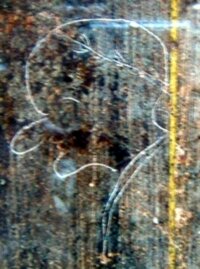
Caricature of a politician from Roman Pompeii
The other day I came across a series of interesting articles about the graffiti in Pompeii … including caricatures of politicians that we might recognize as a valid genre today.
It seems, however, that there was a host other, less savoury, examples of a graphically explicitly sexual nature … which we might also recognize as reminiscent of a modern genre. One article described them as “raunchy and absolutely hilarious” … citing examples to illustrate the point.
Personally, I think I could have forgiven our backyard artists if they had at least produced something other than childish scribbles … it doesn’t have to be realistic art but should exhibit some thought has gone into the creation, or talent – or both.





 Bishkek