In the footsteps of … Paul Pelliot
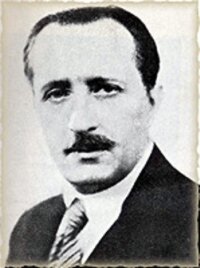
Paul Pelliot
Paul Pelliot may not exactly be a household name, but he is renowned as a Sinologist, (an expert in the Study of China and Chinese topics), an explorer and traveler. He spent most of his career as an expert on the Western part of China – bordering Central Asia.
He is famous for a number of things:
Born in Paris on 28th May, 1878, he was originally intending to take up a career in the French Diplomatic Corps and began studying Chinese. He went to Hanoi in 1900 as a research scholar and from there was dispatched to Beijing in order to obtain books for the Library of the École Française d’Extrême Orient. In Beijing he found himself caught up in the Boxer Rebellion, when the Foreign Legations were besieged by rebels for a month, (from 15th July to 15th August), and he served defending the French Mission, making a couple of forays outside the compound: one to capture an enemy standard and the other obtain some fresh fruit for the captives inside. He was awarded the Légion d’honneur for his escapades.
When he returned to Hanoi the next year, he became a Professor of Chinese at the School, making several more trips into China to obtain books.
In 1902 he made his mark academically with an account of the ancient Kingdom of Funan, which occupied the Mekong Delta between the First and the Sixth centuries AD when iot was superceded and absorbed by the Khemer, Zhenla – reaching its zenith in the Third century. No Funanese records have survived and much of wheat we know about the Kingdom comes from archaeological excavations. Pelliot, drawing on references in Chinese documents, however, was able to outline the history of the Kingdom, albeit from an exclusively Chinese point of view. It was, however, the first comprehensive account of the Kingdom.
He really made his name, however, in 1906 when he was chosen to lead an archaeological expedition to Chinese Turkestan, when he discovered a large number of ancient texts in Dunhuang.
Pelliot, Dr. Louis Vaillant, (an army medial officer), and Charles Nouette, (a photographer), left Paris on 17th June 1906 and headed off to Moscow. From there they took the Trans Caspian train to Tashkent and from there to the terminus at Andijan – 300 kilometers from the Chinese border. In Samarkand they were joined by Carl Gustav Mannerheim, a Finnish army officer serving in the Russian Army.
Although Mannerheim’s family descended from German forebears, he was a native Swedish speaker and was born in the village of Askainen, in the Grand Duchy of Finland, which at that time was part of the Russian Empire. Later in life, he was to go on to become the Marshall, (or President), of Finland.
Mannerheim had his own mission in Turkestan. The Tsar, Nicholas II, had commissioned him to gather intelligence on the state of affairs, (following the the reforms and modernization introduced by the Qing Dynasty), in China. It seems that Tsar Nicholas was thinking of a possible invasion of Western China. In short, he was a spy. In fact he has been called “the last Tsarist agent” in the Great Game being played out by the two Great Empires – Russia and Britain.
For Mannerheim, there were distinct advantages to joining forces with the expedition, giving him cover. There were advantages in the arrangement for Pelliot too. Apart from assistance sith freee passage on the Trans Caspian Railway, he also received twenty thousand francs, (although he apparently asked for just half of that), and an escort of five Cossacks who seem to have acted as assistants.
The French and the Russians had long been “allies” and both would have been happy to stymie the advance of the British Empire. Pelliot would probably have been well aware of the “global political situation”.
Having said that, however, by all accounts the two did not get on. There was competition between the two as to who was the leader of the expedition – and the two did not have a good relationship.
Having arrived in Andijan, the party traveled onto Osh by horseback and cart. They spent ten days in Osh, including a detour to the famous animal market in Uzgen.
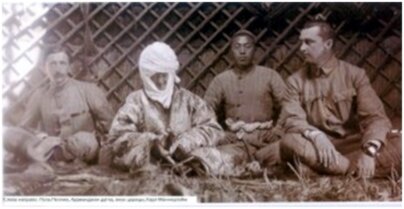
Pelliot, (on the left), and Kurmanjan Datka (in the center).
Then, they traveled South following the valley of the Gulcha River. About 30 kilometers from Osh near the town of Gulcha, they encountered Kurmanjan Datka and posed for a photograph with the “Queen of the Alai”, just one of some 1300 in the in the rich Mannerheim archive. In fact they took several photographs with her, including: “Kurmandjan Datka sitting in the tent next to the Mannerheim” and “Kurmandjan Datka riding a horse“. In one of them, Pelliot appears sitting at the left hand of the Queen – a position of honour, usually reserved by protocol for her viceroy.
Mannerheim’s diary gives a detailed account of the encounter, how they were met by Hassan Bey, Kurmanjan’s son, and ushered into a spacious and lavishly decorated yurt:
The floor was spread out carpets and a pair of bright silk quilts with pillows; laying at the entrance of an armful of fresh green grass and close to four beautiful saddles with a lot of them stacked on the soft, bright satin blankets.
Scenery near the back wall was completed with the bit and bridle head harness, ornate bronze and turquoise. In the center of the domed ceiling was tunduk – a round hole through which we could see the night sky. On the wall hung a large cloth bag with embroidery, we could see the two books, a mirror and other items. The ground was immediately covered with a traditional dastorkon. Good souls followed through gap in the door to serve a cup of tea which was immediately filled as soon as it was emptied.
Crossing over the Taldyk Pass into the Altai valley and then the Irkeshtam Pass into China. The trek took them twelve days.
Having crossed into China, the two parted company, (although they both stayed as guests of the Russian Consul General in Kashgar until the end of August).
Pelliot amazed everyone with his fluency in Chinese – just one of the thirteen languages he knew, (including: Mongolian, Turkic, Arabic, Persian, Tibetan, and Sanskrit). His was so successful that he even managed to obtain a yurt – which up until had been elusive and was considered “unobtainable”.
It was after he left Kashgar and arrived in Urumqi, that he was shown an ancient manuscript – one of the Dunhuang hoard. Recognizing the importance and value of the document he set off to see if he could find some more. However, the explorer, Sir Ariel Stein, had beaten him to it … and removed a fair selection of the scrolls found in the “Cave of a Thousand Buddhas“, which were to become the core of the collection in the British Museum. However, Stein couldn’t take all of the documents and had left a large number which Pelliot now set about examining. His knowledge of Chinese language, history and culture gave him a distinct advantage – as did his workrate – examining about a thousand documents a day during his three week stay, he was able to select over 7000 which were to prove to be even more important documents than those purchased by Stein. When they got back to France, these were to become the core of the Pelliot Collection in the Bibliothèque Nationale and the Musée Guimet of Paris.
Several of the documents were of particular importance in that they revealed the scope of influence of Manichean Christianity and of the city state of Sogdiana in the ancient world.
Not everyone was that impressed, however, and scholars began to cast doubt on his finds – claiming them to be forgeries. It’s now accepted, however, that these claims were based on professional jealousy.
From this period on he spent much of his professional life concentrating on “Inner Asia”, producing a phenomenal output of academic papers, collecting manuscripts, teaching and editing journals.
During the First World War, Pelliot served as the military attaché in Beijing – even participating on an expedition into Siberia.
By the time the Second World War came about, however, he was too old to be conscripted, but there are conflicted accounts about whether he joined the Resistance. Whether he did or not, he certainly managed to show his opposition to the Vichy government, on one famous occasion refusing to shake hands with a government minister, and ignoring regulations.
After the liberation of France he made a short visit to the United States. Shortly after his return, however, he died of cancer in Paris on 26th October, 1945.
Although he didn’t spend long in Kyrgyzstan, about a month, Pelliot was to make an important linguistic contribution in the historical record of the Kyrgyz. Over the years, since the second century BC, the people that we now know as the Kyrgyz have been referred to in Chinese documents by several different names, such as:
- Gekun, which appears in documents dating from the 2nd century BC
- Jiankun, which first appeared in the 1st century BC and was used for a period afterwards
- Qigu, which was used in the 6th century
- Hegu, also dating from the 6th century
- Jiegu, which appears in documents from the 6th to 8th century
Although there are obvious differences, they all have one thing in common – none of them end in “z”, (or “sz” which was, apparently, the Chinese equivalent of the Turkic “z”). It was only in the eighth century that this ending appeared. In 1920, Pelliot surmised that that in Middle Chinese, the ending was added as a transliteration from the Mongol language, which in turn suggests that the Chinese first became aware of the Kyrgyz through Mongol intermediaries.





 Bishkek