Bilimkana
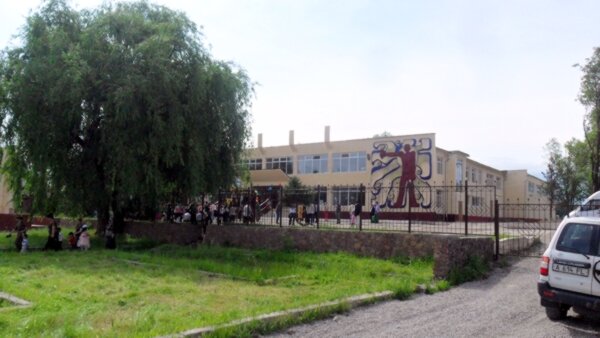
The new school
In Saturday’s postcard I mentioned that I had been invited to a ceremony at a school, Bilimkana, in Luxembourg, a village about 20 kilometers East of Bishkek.
It was a two fold celebration, to mark Posledniy zvonok, the last day of the school year and also the an opening ceremony. When I first heard about it, it seemed very odd to be celebrating the opening of the school transfer on the same day as marking the end of the school year – but there was a reason for that: the school was moving to a new building.
Everyone was dressed up in their finest and on their best behavior. There was a concert featuring children from the two schools – music, recitation and dancing … and on the whole the children were remarkably confident and un-self-conscious.
It was followed by a number of presentations, (some of them quite lengthy and detailed), and the obligatory buffet.
It’s a private school which was established two years ago and has about a hundred pupils. For them this was the start of the school holidays and so a happy day. Mind you, according to the headmistress, several of the children enjoy school so much that they have told their parents that they wish they could go Saturdays and Sundays as well … so I am not sure what they will make of the three month holiday that is before them.
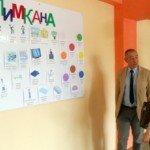
As well as a new building, the school will get a new name. It used to be called Bilim, (which is Kyrgyz for “knowledge”), but now it will be called Bilimkana. It is a small change, but it marks a big difference. As I understand it, the school was set up by one of the local citizens who wanted to provide a quality education for her children. She rented accommodation and hired staff, bought materials, recruited pupils and opened the school.
Bilimkana, on the other hand, is new non-profit foundation set up by a group of businessmen with the aim of providing a modern, liberal education for as many young people in Kyrgyzstan as possible. They want to establish a network of small village schools around the country – each one accommodating about 500 pupils. According to Tolon Toichubaev, the main driving force behind the venture, they aim to establish about 30 schools in the network in 2025 and plan opening two or three schools every year.
Their first school, the Shabdan school, in the Chon Kemin valley serving the various villages scattered throughout the valley. They purchased an old factory as a building and renovated it and the school opened its doors last September and currently has 70 pupils in the reception and First year.
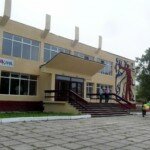
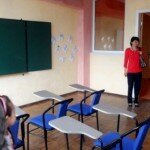
According to their plans, they were looking for a location for their next school … and Luxembourg seemed an ideal candidate. One reason for that was that a suitable building had come on to the market: the village Dom Cultura - Culture club. It has been closed for some time and was in need of renovation. The foundation bought the building and carried out the necessary repairs – widening the corridors and improving the lighting. Apparently, it’s not quite finished yet but already looks very impressive.
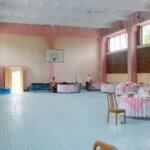
This also means that the village regains a facility as the school, (for example the auditorium and gymnasium), will be available once more for a variety of events.
There was, of course, one drawback … there already was a private school in the village. The two schools started talking to each other and decided that, rather than competing with each other, it made sense for them to cooperate … and in the end it was decided to merge the two establishments. A classic example of a win-win situation. The existing school gained support and resources from the foundation, which in turn is able to extend its network and develop the school according to its philosophy and aims.
This isn’t the end of the story … they are already making plans to open two more schools, in Talas and Kerben, in September … in three months time.
It’s a private school which means parents pay a fee. The fees aren’t as high as in some private schools – and although one of the functions of the state is to provide education, some parents are not only able to afford the fees but happy to pay them, that’s part of their investment in their children’s future … and, as Tolon put it in his speech, people value things more if the are paying for it. They also demand results which keeps the school “on its toes”.
The foundation wants the schools to be centers of excellence. The teach the standard Kyrgyz curriculum established by the Ministry, with Science lessons being delivered in Russian, the humanities in Kyrgyz and English being taught from the very first classes as well as information technology with, for example, free access to computers and the internet. Classes are small – about 15 pupils in a class – and there is a concentration on group work. An emphasis is also placed on creativity – arts and expressive arts so that children can “develop their own voices”. As a result, it’s also planned to turn each of the schools into a specialist center – in Shabdan, for example, concentrating on the arts and Theater Arts in Luxembourg.
It is hoped that the graduates from the schools will not only progress into higher education but also be able to gain places in some of the best universities both at home and abroad. (In the days of the Soviet Union, of course, students could gain places at a wide variety of institutions throughout the USSR and now that the Republics are all independent, that avenue is far more restricted than it used to be, so it hoped to “put the clock back” in this respect … in a positive way.)
The foundation, (funded by the businessmen, at least in the outset), will deal with capital expenses and the fees will be used to pay for running expenses; salaries, materials, food, transport and so on. They plan, for example, to add four more classrooms in the near future bringing the school up to a capacity of 18 classes.
It’s hoped that there will be other sources of finance forthcoming in due course so that it have a truly viable and sustainable future.
The teaching staff are obviously vital in achieving results. The foundation aims to concentrate on staff development … from the moment of interviewing prospective candidates for jobs, through running seminars and training session, and even contributing to teacher training courses. Contact has already been made with several other schools, (and not just here in Kyrgyzstan), so that the teachers can participate in obmen opita, exchange of experiences.
They are looking for experts in their own fields whether it be Mathematics, History, or whatever. When it comes to English teachers, they are looking for native English speakers to join the team – in Shabdan, Luxemboutg, Talas and Kerben … which, I think, might provide them with a few problems …






For more information about the school and foundation, contact Tom Langham at:
3 Litovskaya Street
Bishkek, 720012 – Kyrgyzstan
Telephone: +996 555 008932
Fax: +996 312 979205




 Bishkek