Raikan Shukurbekov
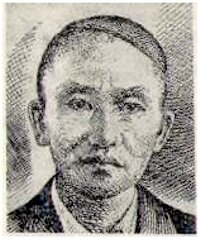
Raikan Shukurbekov
This year, we are celebrating the 100th anniversary of the birth of the Kyrgyz poet and playwright Raikan Shukurbekov. (Unfortunately, we’ve missed the actual anniversary which fell on 1st April … but today marks the anniversary of his death in 1964.)
Shukurbekov was born in the village of Ak Chii in what is now the Kirov district of Talas oblast, into the family of a sheep herder. His parents died when he was quite young and he was brought up in an orphanage where he learned to read and write.
In 1928, when he was 15, he was moved to Bishkek, (or Frunze, as it was then called), and later graduated from the Kyrgyz Teacher Training College. After that he began working at the Kyrgyz Drama Theater.
He began writing and his range covered poetry, fables, fairy tales, children’s stories as well as plays. He is particularly remembered for his humour and the warmth and the colour which which he portrayed his characters.
His repertoire written for the company of the Drama Theater included:
- Fight – in which he also played a leading role;
- Among the Graves and Idar - which were about the new collective farms which were being introduced in the 1930′s and the role they played in the life of the village;
- My Village – which was also about village life, young people and their attitude to work taking a critical look at liars and the lazy;
- Dzhapalak Dvhatpasov – a comedy influenced by Gogol’s “The Inspector General” in which he addresses the traditional feaudal attitude towards women and which made his as a successful playwright;
- Sharapat – which explored the writer’s relationship with his profession;
- Kanykei – based on characters from the Manas epic; and
- the play Poet of Hope (or Dream Bard)- which was based on the life of the great akyn, Toktogul Satylganbov.
A couple of his stories based on the events of 1916 were published – one in 1929 and another in 1936. His first play was staged in 1934.
His children’s books are noted for their immediacy and sense of humour.
As well as being a dramatist, he also wrote a wide range of poetry, many of them drawn on events of the day, and the “heroic affairs” of his contemporaries. During the Second World War, (or Great Patriotic War, as it is known here), he went to the front but was wounded and returned home as an invalid, some of his poems written at the time were later published to great acclaim.
Apparently he also wrote a number of popular songs.
He is also well known for his translations of a number of classics from world literature, (by authors such as Chekov, Gorky, Schiller and Moliere), into Kyrgyz. In turn, some of his work has been translated into both Russian and Polish.


 Bishkek