When I say Avrora – I mean Aurora … or vice versa
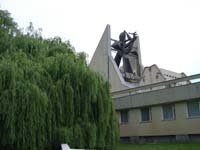
Avrora Sanatoria
On 24th May, 1900, a ship was launched from the Admiralty Shipyard in St. Petersburg, a two masted, three funneled cruiser that was to play that was to play a role in the October Revolution of 1917, and is now preserved as a museum in the same harbour where she was built: the Aurora.
Actually, in Russia, it was still 11th May – but in the rest of the world which had adopted the Gregorian calendar and abandoned the Julian calendar, it was the 24th ….
It is sometimes said that the Avrora Sanatoria on the Northern shores of Lake Issyk Kul, (about 260 kilometers from Bishkek in the village of Bolon Sogottu), is named after this ship … and that the design was intended to resemble it.
There is another version, however, that whilst recognizing that the building is modeled on a ship, identifies the prototype as The White Ship, in Chinghiz Aitmatov’s 1972 novel about an orphaned boy who dreams of becoming a fish so that he can join his father who, he believes, sails in the white ship on Issyk-Kul Lake.
(I always get confused about the name, because when it is written in Russian as Avrora – and everyone says Avrora – but when it is written in English it is translated as Aurora).
The sanatoria was built in 1979. It serves as a Presidential Residence – there is another in Cholpon Ata.
The Avrora is set in 47 hectares of parkland which is considered by many to be the best on the Issyk Kul coast. It has almost 150 rooms of different types, (single, twin apartments and suites) and also some VIP cottages. All of the rooms are on one side of the main six storey corpus and have a view of the lake and have a view of the lake. They are equipped with comfortable furniture, refrigerator, telephone and TV, tea set and an en-suite bathroom with bath or shower.
In the grounds there are facilities for basketball, volleyball, tennis courts, mini football, children’s playgrounds, a fitness room, an indoor swimming pool with water taken from the lake, sauna, billiards and also several cafés offering a range of cuisines, (European and Asian). There is a private beach about 5 minutes walk (300m) from the main building (in theory, at least, building regulations prohibit construction close to the shoreline), where boats, yachts, catamarans, scooters, water skis are available for hire – and it is even possible to have a go at parascending ,
The sanatoria was built in 1979.
They are quite insistent that it is a Sanatoria – and not a hotel or resort. I was once taken to task by one of the management for referring to it as a hotel … the difference being that a Sanatoria offers facilities for the treatment of certain medical conditions – whereas a hotel doesn’t. That’s not to say, however, that a large proportion of the guests are there for reasons other than treatment and consider it as a hotel or resort.
As a sanatoria it a wide of medical facilities served by a qualified medical staff and the cost of some of the treatments are included in the price. Treatments are available for a wide variety of diseases: complaints of the circulatory, digestive, musculoskeletal and nervous systems, skin, urological and gynecological diseases. Here guests can try mud baths and hydrotherapy (mineral, pearl, oxygen baths, “gynecological irrigation”);
… which caught my attention, being someone from Malvern in Worcestershire – which gained fame in Victorian Britain as a center of the “Water cure”.
There is also a “speleo mine”, (a special room lined with rock salt), which is good for the treatment of asthma and allergies.
They also have facilities for holding conferences and meeting: four conference rooms of different sizes -suitable for groups of anywhere between 10 and 200 people, and a business center with a variety of office equipment, (such as wireless internet, fax, scanner, projector, printers and photocopiers – and laptops for hire) and can arrange translation services, coffee breaks and meals.
Unlike many of the resorts and pensionats around Issyk Kul, Avrora works all year round … after all, it is a Sanatoria and not a “resort” and the prices tend to vary according to the time of year – being highest in July and August, the peak of the tourist season.
The price includes: accommodation, three meals a day, basic medical treatment under prescription.
Over the years there have been several suggestions that it is about to be privatized – but, so far, nothing has come of these and they remain simply rumours.
__________________________________________________________
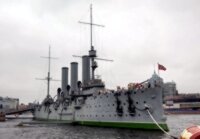
The Aurora at it's moorings in St. Petersburg
For the record: Originally built as one of three ships, work on laying down the hull for the Aurora began just under three years earlier, (on 23rd May, 1897, that is - according to the Julian Calendar … in the rest of the world it was the 5th June). Although she was launched in 1900, she actually didn’t enter service until 1903.
Her basic statistics were:
- displacement 6731 tons,
- 127 meters long and 16.8 meters wide
- armament: fourteen 152mm guns, (six inch guns) and later fitted out with six 76mm anti-aircraft guns
She was part of the Baltic fleet which was dispatched in 1905 to the Pacific Ocean during the Russo-Japanese War, after the Japanese had sent shock waves around the world by defeating the Russian Pacific fleet. The Baltic fleet didn’t have much luck in that it too was defeated. One of the Aurora’s sister ships was sunk in Port Arthur and another was interned in Saigon. The Aurora, itself, was interned for a short while in Manila, after the battle of Tsushima. She had acquitted herself well, defending many of the slower ships ion the fleet, and firing off at the enemy over 300 152mm shells and almost 1300 lower caliber shells – whilst taking 18 hits from the Japanese forces.
After the wear finished she returned to her home port and saw service as a training ship, which took her around the world – to the Atlantic and Indian Oceans, the Mediterranean and the shores of Africa, Thailand and Indonesia.
At the outbreak of the First World War, she served in the Baltic … arriving in Petrograd (St. Petersburg) for repairs in 1916 – which is how she happened to be there to play her role in the revolution. Some of her crew had joined the 1917 February Revolution and a revolutionary committee established. When, in October, the order came for the ship to set sail, the crew, (by now mostly supporters of Lenin’s Bolshevik faction), and this acted as a catalyst which sparked the Great Socialist Revolution which brought Lenin to power. At 9.45 p.m on that date, a blank shot from her forecastle gun signaled the start of the assault on the Winter Palace, which was to be the last episode of the October Revolution.
After the war, she was mothballed for a while before returning to her role as a training ship in 1923. During the Second World War she was moored in Leningrad and took part in the defence of the city – her heavy guns being dismantled and relocated to defend the southern approaches to the city, She was bombed by the Luftwaffe and eventually sunk.
She was raised in 19474, and after the war, repairs were carried out and she she took up a permanent anchorage on the River Neva, eventually being transformed into a museum ship … and one of Leningrad’s tourist attractions.


 Bishkek