It’s got nothing to do with philosophy – Kant.
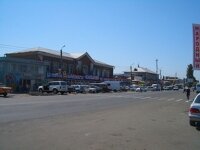
The main road passing through Kant
I am not a journalist but I appear to be a number of mailing list because I keep receiving a number of Press Releases. I got one yesterday from the Swiss Embassy here in Bishkek which began:
Kant, an industrial city of officially 22’000 inhabitants, is situated at 25 km east of the capital Bishkek. It is known locally for a brewery, a sugar factory and an air base. But it is also the first city in the Kyrgyz Republic where local water and wastewater services are operated by a private company. As a result, the water supply is available round the clock, unlike in other cities, even though Kant has not renovated the water infrastructure (owned by the city) since Soviet times.
Having told us that, the Press release continued:
But now the municipality can upgrade the pipes and reduce water losses, thanks to a loan and grant funding of €1.95 million from the EBRD and a grant fund of €5.7 million from the government of Switzerland within the framework of its economic cooperation and development activities. Additional grants for technical assistance are funded by the European Union and Finland.
The financing will allow Kant to renovate water supply services, which will resolve issues with water pressure in the summer, and to introduce a city-wide metering system. The project will also see the operator company, Marketing Service Ltd, introduce an environmental and social action plan.
Like most other people, when I first came here I thought that the name Kant was a reference to the German philosopher Immanuel Kant, an impression that was strengthened when I learned that the city and surrounding area was once home to a large German community – families from the Volga region that were relocated here far from the front during the Second World War, in 1941 – and German Mennonites. In fact that’s just a coincidence … the name actually comes from the fact that in the 1930s a sugar processing plant was built here. Kant is the Kyrgyz word for sugar.
For the record: most of the German population left in the 1990s following the collapse of the Soviet Union – when many of the existing factories closed – and reunification of Germany – which welcomed the repatriation of many ethnic Germans as a matter of policy
It lies in the plain of the Chui valley, at a an altitude of 742m above sea level, sitting astride the main road between Bishkek and the tourist zone of Lake Issyk Kul. That road is also the part of the main Bishkek-Torugart road – used by heavy juggernauts carrying goods from China, but most of those take the by-pass and don’t pass through the town center which retains its calm, provincial character. In fact most “visitors” tend to simply pass through – if they, too, don’t take the bypass – on their way to or from the lake.
These days, it is probably best known as the home of the Russian Air Force Base, (technically known as the 5th Air Army’s 999th Air Base), which was established in 2003 probably to provide a counterbalance to the United States base at Manas Airport just North of Bishkek following the 9/11 terrorist attacks on New York. When it was established it became the first Russian foreign air base since the breakup of the USSR in 1991.
The base, just 2 kilometers South of the city, was established on an existing airport with two concrete runways, (2700m long and 50m wide), at an altitude of 767m above sea level.
The airport was established in 1941 when the Soviets established a base and pilot training school here, based on one that had been evacuated from Odessa. During the Second World War, over 1500 pilots were trained at the school – seven of whom went on to be awarded the accolade of Hero of the Soviet Union.
The school also trained foreign pilots from 1956 onwards and almost 22000 trainees from 54 countries passed through the school until 1992 when it was effectively closed its doors, and was transformed into into a department of the Military Institute and transferred to Osh. Among its graduates were the former president of Egypt, Hosni Mubarak, and the late Syrian president Hafez al-Assad.
Nowadays, the base is home to about 400 Russian servicemen – but, according to one report, the completion of redevelopment this will probably rise to about 1000 complete with civilian specialists. The facilities are somewhat limited to servicing smaller, lighter aircraft and helicopters but redevelopment is underway that is likely to increase the scope of the aircraft that can be supported – as well as improving facilities for those stationed here. Apparently, the main craft based here are the Su-25, (known to NATO as Frogfoot), which is designed to provide close support for ground troops and Mi-8 helicopters. Although the main task of the base is supposed to be to give air support to operations of military units of the Collective Rapid Deployment Forces of the Collective Security Treaty Organization, (for example, in anti-terrorist operations), there has been some controversy over whether the aircraft that have been deployed are the most suitable for this purpose.
As with the base at Manas, the future of the base has from time to time been called into question … at one point even President Almazbek Atambaev called for it to be closed saying the “neither Russia nor Kyrgyzstan needs it.” Following discussions, which included negotiations over “rent”, it was decided to extend the lease for another 15 years – so it is likely to be here long after the Americans leave.
The town of Kant was established in 1934 – it was granted city status only in 1985. It is still quite a small city, only 786 acres. It serves as the regional center for the Issyk Ata rayon of the Chui oblast.
Over the years, the size of the population has stayed remarkably stable at around 20000 – (19000 in 1970 and 21500 in 2009 – peaking at 24000 in 1989), although the composition has changed somewhat. They live in just over 7000 households drawn from some 23 different nationalities, (these days, mainly Russians – which comprise the largest group – Kyrgyz, Kazakhs and Uzbeks … oh, yes, and a small nucleus of ethnic Germans), but is somewhat overshadowed by its larger neighbour – the capital, Bishkek – even though it is almost an hour away by Marshroute taxi – Minibus.
Kant is an industrial and service center. There are almost 300 companies registered as being located in the city, although more than half of them are dormant … but, having said that, there are a number of major industrial enterprises that work in the city.
- The biggest employer is the factory producing construction materials such as slate and cement.
- Agriculture and food processing is also important – with companies specializing in both Dairy and Meat produce, pasta production, a grain mill, bakeries and a brewery – the largest in the country – producing bottled beer, mineral water and soft drinks
- There is also a factory producing clothing and soft furnishings.
- Several important enterprises provide utilities for the local population, electricity, water supply and central heating.
The city has five schools that, as I understand it, still teach in Russian to cater for about 5000 students. There are a similar number of Kindergartens, two after-school facilities a music school and a “Palace of Culture”. The schools are quite small, most of them two storey building, and operate a two shift system – some classes in the morning and others in the afternoon. One of the schools specializes in vocational training. The students are encouraged to participate in sports, especially Volleyball, Basketball, Football and Kick boxing.
As in many other places in Kyrgyzstan, poverty is an issue – with many people receiving low wages. There is an active program of support and a credit union was set up about ten years ago to help alleviate the problem.
There is a train station in the city, on the main Bishkek-Balikchy line
Kant is twinned with Joopatowne in the US and Vidovna in Russia.
For the record:
The EBRD, (The European Bank for Reconstruction and Development), is owned by 64 countries and two intergovernmental institutions, and supports the development of market economies and democracies. In total, the EBRD has invested about €425 million in various sectors of the Kyrgyz economy and, in particular, it has supported water and wastewater projects in the Kyrgyz Republic, (in the cities of Bishkek, Osh, Jalalabad and Karabalta).
The Swiss government, provides assistance for the development of the Kyrgyz Republic and supports projects in areas such as health, private sector development, public sector reform, and infrastructure. As part of its development cooperation programme, it has invested more than CHF270 million since 1993 and, in particular, has co-financed three EBRD projects to improve the water sector in cities of the Kyrgyz Republic, providing over half of the total volume investments of €23 million.




 Bishkek