All that glistens …
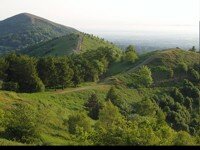
On the Malvern Hills
Not long ago on Facebook, I was intrigued to see some posts from one of my cousins who has just moved house … to Malvern - my home town. It struck me as an odd coincidence because, although we are related, he’s never actually lived there before, so it’s not as if he was returning to a childhood home.
The first weekend after the move, he and his family went for a walk on the famous Malvern Hills … he wrote about it glowing terms and posted some fine photographs on his Facebook page. It’s sometimes seems strange, but people living in Malvern often take the hills which so dominate the town for granted and rarely venture forth on their slopes, yet alone to the summit. I admit that I didn’t go onto the hills all that often, and now I think “what a wasted opportunity!”
To be fair … I have to admit that even here, in Kyrgyzstan, I don’t get out and about as much as I would like and so, even though the mountains are so near and within easy reach … I rarely get to visit places like Ala Archa, (just 40 kilometers from the center of Bishkek), unless I have a particular reason.
On one occasion, however, I was taken as a young child on school trip up the Malvern Hills … and I remember the teacher pointing to two little trenches and saying that this was once a Gold Mine. Now that caught my attention! She did point out that the mine was pretty ancient, pre-Roman and that it wasn’t a rich deposit … in fact it would cost more to extract the gold than it was worth on the open market. All the same, the news gave a new meaning and significance to the old saying “There’s Gold in them there hills!”
The cost of extracting the mineral from the ore varies according to the grade of the deposit. Some veins are rich having a high concentration, whilst others – such as that in my home town – relatively low concentration. I am told that there is plenty of gold ore lying around but because of its density most of the earth’s natural ore sank through the earth’s surface towards the magma core at the center planet in the early years of its formation. It appears that most of the gold mined throughout history actually arrived on the planet later on and was deposited by meteorites.
It’s been over the years for a variety of purposes … for coinage (of course), but also jewelry and other decorative purposes – such as gold leaf used for embossing, but also in electrical components and other industrial process, (taking account of its specific chemical and physical properties) and even in medicine and as a culinary ingredient!
You need a lot of ore to get a very little amount of gold. It depends on the concentration and the type of deposit, (what other minerals are with it), but in general terms, 5 or 6 tons are needed to extract just one Troy ounce, (or 30 grams), of Gold.
According to a recent article on the BBC website, in all of human history there has only been something like 171300 tonnes of gold mined in the whole of human history. Apparently there is some dispute over that figure, some scholars think it could be about just 155000 tonnes, whilst others think that it should be about two and half million tonnes. It’s also estimated that there is about 52000 tonnes left to be extracted from the ground.
Taking the 171300 tonnes figure as a guide, all that gold could fit into a cube with sides of about 20 meters. That doesn’t sound like much but at approximately six million dollars a ton, it represents USD10,135,500,000,000. It also represents something like 34,260,000,000 tons of ore – and the 52000 of reserves left to be mined represents about 1,040,000,000, tons of ore.
For the record: Gold is obviously an important element in Kyrgyzstan. The Kumtor Gold Mine, (in the Issyk Kul oblast – about 350 kilmeters from Bishkek), is notable for several reasons – for example, at 4000 meters above sea level, it’s the second highest gold mining operation in the world and it’s estimated to be the world’s seventh largest gold deposit … but also because it accounts for something like 12% of the Kyrgyz economy.
It started operation in 1997, after several years of exploratory work and negotiations. In fact, Soviet geologists were well aware of the existence of the deposit well before Independence, but the altitude and difficulty of exploration meant that it’s development was put on hold. It was only after Independence that the government of the fledgling state opened discussions with a Canadian mining company with a view to exploiting the deposit.
The Soviet geologists knew of other deposits as well … there were something like 170 proven deposits in the Republic, (one of the largest proven gold reserves in the world with something like 2000 tons of the precious metal … out of global reserve of 52000 tonnes!), making it the third republic in in the former USSR as a gold producer after Russia and Uzbekistan. Indeed, the Makmal mine near Kazarman in the Djalal Abad oblast, which used to produce about 15 tons of ore a year, was the Soviet Union’s largest gold mine.
Since then there have been more deposits discovered. There are currently about 40 deposits which are thought could be commercially viable, but new technology should make the extraction of the precious mineral even more viable from the smaller and less concentrated of the deposits that would once have been considered, (like Malvern), as uneconomic and not viable for exploitation.
Many of the deposits being studied and will hopefully soon come on stream are in the Talas and Chatkal regions. Jeroy, (Kyrgyzstan’s second largest deposit), Taldy Bulak and Andaash, Solton Sary and Kuran Dhzailiau.
Unfortunately, however, the development of the deposits has not been without difficulty … social and political as much as technical. The Kumtor mine has been dogged by claims of environmental infringements, (such as when a lorry carrying cyanide fell off a bridge spilling its load into the Barskoon river in 1998, questions over the tailing dumps where are remains from the mining process are placed and glacier retreat), industrial disputes, claims of corruption tied to the administration of both of Kyrgyzstan’s first two Presidents, renegotiation of the investment agreements, tax disputes and calls for the operating company to have its license revoked and for it to be nationalized.
In other parts of the country, other investors have also encountered problems, often with the local population, but also to do with licenses being revoked.
As a result, the government are having trouble attracting investors, even though the country was recently named as Mining Country of the Year, (beating Papua New Guinea, Myanmar and Australia for the award), at a conference in Hong Kong, (Mines and Money 2013), on the basis of reforms in the mining sector, investment attractiveness and the ease of doing business.
One of the most interesting things from the BBC article was the fact that all of that gold, well most of it anyway, is still in circulation today – melted down and recycled …
Although I have to admit that this assertion took me a bit by surprise. I wonder how much gold has been lost like when King John lost the Crown Jewels in the Wash? … if he actually did … or buried in tombs yet to be discovered like King Tutankhamun’s?, or the gold leaf plated on statues of the Buddha or temple roofs only to be lost by erosion? Still, I suppose that is just a drop in the ocean – or a small sliver off that cube.
However, that may be about to change … about 12% of the gold in use today is employed in sectors like the electronics industry where it is used in such small quantities in individual products that recovery and recycling may not economically viable.
All of a sudden, those 2000 tonnes of reserves secreted away in the Tien Shan mountains might well prove to be even more valuable in the future … if, that is, the price of gold doesn’t continue to plummet.
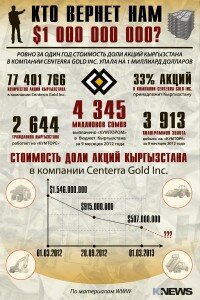
Value of Kyrgyzstan's shares in Centerra Gold
Today’s news that the price has plummeted to a new two year low, (25% down from it’s all time high of USD1800 an ounce in 2011), upon weak economic data emerging from China and concerns about the knock on effect on inflation, (meaning investors have less reason to hold gold to avoid a corresponding decline in the value of cash investments”), following the news that Cyprus intends to sell its gold reserves in order to cope its financial crisis, all highlights how volatile the value of those deposits really is.
I suppose that we, here in Kyrgyzstan, shouldn’t be too surprised. After all, we’ve seen the same sort of volatility in the value of the country’s stake in the Kumtor gold mine plummet as the Parliament, Government and prominent figures have mounted a sustained and relentless campaign against the operation and the concessions the company won from the original agreement under President Akiev and the reorganization under his successor, President Bakiev – as shown clearly in this inforgaphic from the news agency K-News, (which is in Russian – but the graph and figures probably speak for themselves).
All this will have an detrimental effect on Kyrgyzstan … not only on the potential value of the deposits but also on the value of any gold that is produced on the country’s current account balances, as the value of the ore that is ore that is extracted will also fall.
It adds yet more uncertainty to the context where prominent politicians are calling for the renouncement of the current agreement with Centerra, threatening mass rallies, (promising 10,000 protesters, “revolution” and the dissolution of parliament), claiming that “If the Canadian side does not agree to these terms, Kyrgyzstan is ready to attract new investors to develop Kumtor deposit or to work on its own.”
Which returns to the questions:
- how attractive are those deposits to a new investor in a volatile marketplace? and
- does Kyrgyzstan have the wherewithal, the financial resources, personnel with expertise and experience … and the time, to resolve the difficult issues in uncertain times ahead?
Whatever the future holds, even with volatile prices, Kyrgyzstan’s mineral reserves – and that’s not just gold – will be important factor and play a vital role in the potential for the future development of the country … but, sometimes, it feels like walking a tightrope.




 Bishkek