Borsh : Where’s the beetroot? … Wheres the Meat?
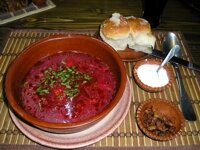
Borsh and and accoutrements
In a recent postcard, I wrote about how, on my first visit back home back in 1995, my mother was concerned that I was eating properly, (a typical motherly reaction), and I tried to put her mind at rest by cooking some specimen meals. One of those was Borsch … and as I proudly put the bowl down before her, she looked at it and asked: “What is it?” … and I replied Borscht … to which she responded, “Where’s the beetroot?”
As far as she was concerned Borsch was Beetroot Soup … and I have to admit that when I cooked it back in the UK – I had always thought of it as Beetroot soup. Whenever I had made Borsh at home – the recipes had always been for Beetroot soup.
To be honest, I didn’t try cooking it very often because the beetroot would turn everything it came into contact with – my hands, rubber gloves, kitchen utensils … everything – a deep shade red which seemed impossible to wash off – they only way to get rid of it was to wait and let it fade of its own accord. On the other hand, people like it and enjoyed it … and I suspect that enjoyment was heightened by their amusement that they had found an idiot who was prepared to “have a go” and the fact that they knew they wouldn’t do it themselves.
Here, Borscht is more like a watery stew – a meat soup with vegetables … oh, and yes, Beetroot is included as one of the ingredients … but not always!
If my mother asked “Where’s the Beetroot?”, Inna, (my Russian teacher), asked “where’s the meat?” During one of our lessons, she was astounded when, in answer to one of her questions I told her, that I had cooked Borsch. She smiled, obviously spotting an opportunity to test my basic communication skills, and asked me to describe how it was done – in Russian, of course. When I had finished struggling to describe how you had to peel and chop up the svekla, (beetroot), carrots, onions … and so on, adding salt and pepper and other herbs … boiling the mixture to create a stock and then serving with sour cream … she looked really confused and blurted out her question.
“Without meat,” she said, “it’s not Borsch, it’s Shchi.” Now, it was my turn to be confused, because I knew that, just as Borsch was beetroot soup, Shchi was cabbage soup … I couldn’t see the connection.
If that wasn’t bad enough, I then came across Green Borsch which is basically a sorrel soup … no meat – no beetroot. Over the years I have learned that, when faced with such inconsistencies and/or illogical contradictions, it’s best to just shrug your shoulders and ask: “Where are we?, where am I living?”
Boirsh is basically a Ukranian dish, wich is now popular throughtout Central and Eastern Europe … although it may have originated in the Ukraine, various versions have evolved in a these diverse communities. I used to think that it arrived in the UK from Poland, but I recently read an article which suggested that it had travelled across the Channel with Jewish migrants – and the alternative spelling of Borscht actually refelcts the Yiddish name for the dish.
Anyway, here’s a local recipe for Borsh … a Russian version of Borsh, that is:
Ingredients:
- 1 kg of beef
- 500 g of potatoes
- 300 g of fresh cabbage – although Saurkraut can be used – this tends to give the soup a more bitter, acid taste
- 400 g of Beetroot – but, to be honest, I have known some people miss this out
- 200 g of carrots
- 200 g of onion
- 3 table spoons of tomato paste
- 1 teaspoon of vinegar
- 2 or 3 cloves of garlic
- 2 or 3 Bay leaves
- Vegetable oil
- Salt, pepper and other herbs to taste
Method:
- Mix some vegetable oil and water and allow to stand for one and a half hours
- Chop the meat into bite sized chunks
- Add the meat to the oil and water bouillon
- Finely chop the onion
- Shred the carrot into medium sized pieces
- Finely shred the cabbage
- Chop the beetroot into small pieces and fry in some vegetable oil
- Add the vinegar and tomato past to the mix and stir for 5-7 minutes
- Fry the onion in vegetable oil
- Add the carrots to the fried onions and continue frying
- Cut the potatoes into cubes or long pieces (bricks?) and add to the hot bouillon
- When the bouillon is boiling, add the cabbage and heat over a medium heat for 5 minutes
- Add the beetroot to the bouillon and let it simmer for 10 minutes
- Add the onion and carrot
- Add the bay leaves, and seasoning … and finally the garlic through a garlic press
- Take from the heat and leave it to stand for 15 or 20 minutes
- Pour into bowls, add smetana, sour cream and garnish with herbs





 Bishkek