Catholicism in Kyrgyzstan
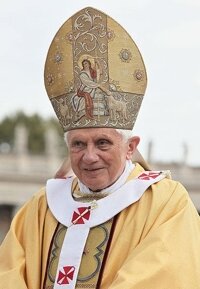
Pope Bendict ... showing that the Catholic Church can still shock the world
When the news broke last week that Pope Benedict had announced his resignation the thing that struck me as peculiarly odd was that I heard the news from twitter.
Don’t get me wrong, it wasn’t the fact that it was a tweet that alerted to the breaking news … twitter is a very useful tool in that respect, (as I was to discover later on – but that’s another story). Indeed, if he had wanted to really make his name as a modern go-ahead pontiff, then Pope Benedict could have posted the news himself on his newly established twitter account.
What struck me as interesting was that the tweet came from a Kyrgyz acquaintance who, as far as I know, has no affiliation or connection with the Catholic Church. Even so, the news emanating from Rome was deemed sufficiently important to broadcast to his 1000 or so followers.
There were some other aspects of the story that I found equally fascinating, for example:
- the fact that he is the first Pope to retire since Gregory XII in 1415, (and the first to do so voluntarily since Celestine V in 1294) … we are so used to the idea that “once a Pope, always a pope” … it’s a “job for life” …;
- the fact that he made the announcement in Latin … and most of the world’s press had to wait until official translations were prepared … although one news agency managed to scoop them all because the editor on duty just happened to understand Latin;
- the resignation was to take effect as from the end of the month – so, as under Kyrgyz law, he dutifully gave the requisite two weeks notice;
Anyway … it seemed an appropriate moment to take a brief look at the Catholic church here in Kyrgyzstan.
Although, officially, Kyrgyzstan is a secular country, most of the Kyrgyz consider themselves … nominally, at least … Muslims. When thinking of Christianity in the country, one automatically thinks of the Russian Orthodox Church.
In fact, there is a wide range of Christian denominations … and has been for many centuries given the evidence of the presence of Christians in the region that goes back into antiquity – especially the Nestorians and Manicheans. In Kyrgyzstan today there are also a number of evangelical churches, (such as the Baptists), that have appeared in the country, especially since Independence, as well as a number of groups that are sometimes referred to collectively as Christian Sects, (such as Jehovah’s Witnesses, Seventh Day Adventists and even the occasional Mormon).
There is a small Roman Catholic community in Kyrgyzstan, (numbering about 1500 believers), which doesn’t often get noticed in the press either here or abroad. It is served by a church in Bishkek, (which holds services in Russian and English), another in Djalal Abad and a third in Talas. Also, throughout the country there are some 30 congregations organised into three parishes, (based on the three churches), with up to about 30 members each, served by a team of clergy and some Franciscan sisters who visit the local “Mass Centers” or chapels – such as the one in Osh.
If we ignore the Silk Road travelers, Catholic communities as such have been in recorded Central Asia back into the 14th Century. Apparently, many of the Franciscan missionaries that came to Kyrgyzstan seem to have come via China. From 1918 until 1930, this area came under the parish established in Tashkent. The church suffered under the general Soviet persecutions of religious orders with the buildings confiscated or destroyed, the priests deported or executed. On the other hand, mass deportations under Stalin’s regime also brought many Catholics to the region from the Volga, Ukraine, Poland and the Baltic states.
The Church of St. Michael the Archangel in the capital, Bishkek, was the first non-European Catholic parish in the country to be registered under Soviet rule, in 1969. Some problems were encountered in the process as a result of its “direct subordination to a foreign centre” and its title of “missio“. As a result of substantial growth the church was soon enlarged.
The church, (based in a thirty year old, remodelled house), is located on Vasiljeva Street in the Northern outskirts of the city and although there are plans to construct a new church in the City Centre, it is not clear when this will be realized. A small congregation gather for Mass every evening and a larger number at the weekends.
Originally the Church was a part of the diocese of Vilnius, (in Lithuania), then in 1991 it was attached to the Apostolic Administration for Central Asia based in Karaganda, (in Kazakhstan). Since 1997 the Bishkek parish has had the status of “missio sui juris” under the Jesuits, and its main priest holds a rank equivalent to a bishop. The mission was actually elevated to the status of an Apostolic Administration in 2006 and a the country’s first Bishop was appointed.
The church is active in a wide variety of charitable activities which range from running a rehabilitation camp on the shores of Lake Issyk Kul, working with young children and prison visiting.
The Vatican maintains diplomatic relations with Kyrgyzstan.
Most local Catholics are ethnic Germans or Poles whose families survived the repressions of the Stalinist period. According to one of the priests, they represent “the main store of Catholic faith,” in the country, especially the grandmothers, “who kept the Catholic faith alive.” Apparently most of the parishioners are women.
The Church have their own website, (with pages in English, Russian, German and Polish), as does the church in Djalal Abad





 Bishkek
A gallery of photographs taken at the Catholic Church in Bishkek can be found here:
http://kloop.kg/blog/kloop_galleries/religii-ky-rgy-zstana-katolicheskaya-tserkov/