The Kokand Khanate
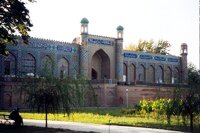
The Khan's Palace in Kokand
It was on February 19th, 1876, (that is, according to the Julian Calendar – so it was March 3rd on the Gregorian Calendar), that Tsar Alexander II declared that he had been forced to “yield to the wishes of the Kokandi people to become Russian subjects”, annexing the territories of the Khanate, (which was declared to have been “abolished”), which were duly incorporated into the Russian Empire as part of the Fergana Province of Russian Turkestan”.
Earlier, in the eighteenth century, a power vacuum vacuum in Transoxiana led to the rise of three independent Khanates in Transoxiana, (or what is now mainly Uzbekistan): Bukhara, Khiva and Kokand. The three were to prove ruthless rivals, constantly at war with each other.
Kokand was a younger city than its counterparts – indeed it was probably little more than a prosperous village (built on trade and being a religious center) in 1709 (or 1710), when the Minglar Uzbeks declared their independence from the Khanate of Bukhara and so established the Kokand Khanate in the western part of the Ferghana valley. The new Emir built for himself a stong citadel in his capital, which was enlarged by both his son and grandson.
Despite having declared their independence from Bukhara, the new new Khans were were soon forced to become a protectorate of China and between 1774 and 1798 they paid tribute to the Qing dynasty in Beijing. (This could be important at some point in the future because this sometimes is quoted as evidence in support of Chinese claims over the Ferghana valley, although there are no particular, official, territorial claims made by the Chinese in their discussions in other border disputes.)
The great grandson of the first Emir, Alim, expanded the Khanate in a ruthless and efficient manner. Hiring an army of Tajik mercenary army, he conquered the western half of the Ferghana Valley, and both Khujand, and Tashkent. Alim was assassinated in 1809, some suggest by his brother Omar, (who then succeeded to the throne). Omar was a poet and fostered both cultural and religious life, whilst at the same time expanding the Khanate to take in Turkestan (in modern-day Kazakhstan) and building a series of Fortresses to defend against the Steppe nomads. He reigned until 1821 when his son, Mohammed Ali (Madali Khan) ascended to the throne at the age of 12.
It was during the reign of Omar’s son, Mohammed Ali, (or Madali Khan) that the Khanate of Kokand reached its greatest territorial extent and influence. Kokand’s importance was even recognized by the players in the “Great Game” with both Russian and Britain sending envoys to the court. However Madali Khan “excelled at cruelty and debauchery” and this gave Bukhara a justification for invading Kokand in 1842 … and cost him his life.
Preferring their own cruel and debauched despots over outsiders, the people of Kokand soon rebelled, and installed Madali Khan’s cousin, Shir Ali, on the throne. Two decades of bitter civil war, ethnic conflict and incursions by both Bukhara and Russia weakened, The Russians had been extending their influence from 1850 onwards, eventually taking Tashkent in 1865 and Khujand 1867. The Khanate was reduced to the valley from which it originally sprang.
(Shortly before the fall of Tashkent, Kokand’s most famous son, Yakub Beg, former lord of Tashkent, was sent by the then ruler of Kokand, Alimqul, to Kashgar, then in rebellion against the Chinese. As Alimqul was killed in 1865, and Tashkent was lost, many soldiers fled to join Yakub Beg, helping him establish his dominion, a “decade of terror”, throughout the Tarim Basin until 1877.)
In 1868, a commercial treaty had turned Kokand into a Russian vassal state. The now powerless Emir spent his energies improving his lavish palace, at the expense of his subjects who were oppressively taxed to enable him to finance the project. The Russians left much of the native system, including the peculiarly ruthless and oppressive system of punishment, and concentrated mainly on trade until insurrections forced him into exile and provoked the Russian annexation.
During the closing years of the Khanate’s existence, while the Emir was busy building his new palace, Western visitors were impressed by the city which was still a religious center, second only to Bukhara in the region. With a population of just 80,000 people there were some 600 mosques and 15 madrasahs.
One author suggests that the subjects of these kingdoms, (both the settled sarts in the towns and farms in the lowlands and the steppes, and also the nomads wandering with their livestock in the mountains), may have considered themselves as subjects of an Emir, but not necessarily as citizens of a “state” – a Kokandian, as it were. This was certainly true of the of the Kyrgyz who seemed to rebel against their overlords at almost any opportunity.
The city of Kokand is about 100 kilometers from Fergahana at the Western end of the Ferghana valley. It lies at an altitude of 405 meters above sea level, occupying about 65 square kilometers and has a population of about 180,000.
The name of the town is variously defined as “city of the boar” or “city of winds”.
It is not known who founded the city, or when, although it is known that in the 1st century BC, a number of small settlements existed here, which formed the basis of the lager town. The first written references to the town date from the 10th century.
The Silk Road played an important part in the development of the town – and large caravans stopped here en route to/from India and China. It is known that the town was destroyed by the Mongols as they swept through the region in the 13th Century.
Although a young town compared to some of it’s neighbours, the modern town grew up around a fort, constructed in 1732 – and in 1740 it became the capital of the powerful Kokand Khanate in the 18th and 19th centuries. The Khanate stretched throughout the Ferghana valley and North to Tashkent and the Kazakh steppes – and South covering parts of Tadjikistan and even into what is now China. It played a role in the machinations of the “Great Game”.
At one time the city was recognized as a great center of learning with numerous madrasahs and mosques and it served as the religious center of the Ferghana valley. It later went into decline, losing much of its territory.
In 1918 it served as capital for a short-lived “Muslim Provincial Government of Autonomous Turkestan” – which led to the sacking of the town by the forces of the Tashkent Soviet.
Sights in the city include:
- Khundayar Khan’s palace – covering over 4 hectares and constructed by craftsmen from all over Central Asia. At it’s height the complex comprised some 7 smaller palaces containing 119 separate rooms, all surrounded by a pair of 3m. high walls – but now only 2 courtyards and 19 rooms remain – decorated with bright colours, geometric patters and quotations from the Koran - and a large mosque;
- the Juma Mosque constructed by the Khan Umarhana in 1800 – supported by 98 wooden columns, with a 22m. high minaret topped by a dome;
- Khamza Museum; the Narbutabev and Dasturkhanchi madrassahs;
- the “Royal” cemetery containing several mausoleums of some the 29 Kokand rulers such as Dahma and Shahom, and Modori – the mother of one of the Khans – which is a fine example of islamic architecture with a classical blue tiled dome;
- The Norbutabi and Emir Medresses. The Norbutabi medrassah was one the largest in Kokand, and since Independence it has reopened and now has about 80 students enrolled;
- a number of Russian buildings dating from the turn of the 20th century and
- the Kaidarov workshop.
Although there is an airport – there are few places that offer accommodation and one of the companies with which we work in Uzbekistan says simply that “there are no hotels in Kokand”.




 Bishkek
Most Kyrgyz tribes outside Ferghana “voluntarily joined” at least a decade earlier. Founding date for Russian Naryn 1868