School reports
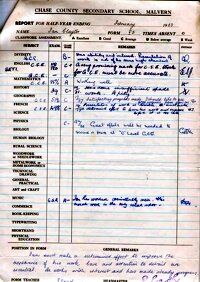
One of my school reports with a veritable mix of grades
Some time ago, I was talking to the kids about their progress at school. I am pleased to say that they seem to be doing quite well, regularly receiving grades of 4 and 5.
It took a while, however, for me to get used to this system that is used over here.
Most of the marks they receive are based on a five-point grading system, which can be used for individual pieces of work or as an overall grade for a term’s work. My first thought on hearing about this was that it was similar to our A to E five point grading system … but there are some differences:
- A pyatorchka – 5 - is given for excellence;
- chetiriye – 4 – indicates good work;
- troika – 3 – is a sign of satisfactory work … but where the student “could do better”;
- dvoika – 2 – is “unsatisfactory” … and seems to be used mainly to indicate that they were present but were unable to answer question or had failed to complete a task
- odinokcha – 1 – doesn’t ever seem to be used and seems to considered basically considered as sarcasm … they were present … at least in body if not in mind or spirit.
For the record: There is also a grade NB - ne bil – which means that someone was absent, for example for an examination or “control” test which usually means that the student gets the chance to take if at a different time in the future.
Also, in addition to a single final grade, certificates or diplomas also carry a list of all the subjects studied including the number of “academic hours” classes occupied.
In some of those subjects, there may not have been a final examination or grade, and so a simple record of sdal , (pass, completed or done), may be recorded.
Back in Britain I worked in schools which operated different systems which can summarized like this:
| A | Excellent | Very above average | In the top 10% of the class |
| B | Good | Above Average | In the next 20% |
| C | Satisfactory | Average | In the middle 40% of the class |
| D | Poor | Below Average | In the next 20% |
| E | Very Poor | Very below average | In the bottom 10% of the class |
Personally, I found the “average” less than satisfactory … it didn’t really say anything definite about the work, effort and achievement the pupil had achieved.
The final system caused me all sorts of problems in one particular class … especially as everyone duly ignored it – even though it was printed everywhere, not just in the instructions on how to complete reports. I happened to be teaching the top Mathematics group in the year and both parents and pupils who were used to seeing “straight A’s” were shocked at suddenly seeing B’s, C’s D’s and even E’s … ”How is it possible?,” one parent asked me, “you musty be a very bad teacher for my daughter to go from an A to a B”. No matter how I tried to explain the system and the fact that all the teachers were supposed to be doing this … I got nowhere. The school authorities, (Headmaster, Head of Department, etc.), weren’t much help and basically told me to ignore the instructions in the future … which I did; they didn’t even to consider changing the policy – just ignoring it! Even though it “went against the grain” – I took their advice!
We often had to give two or three grades:
- One was for performance in an Examination based upon the final result, but as this is just a snapshot representing performance in a one-off moment of time which didn’t always reflect how they had worked throughout the term,
- so a Coursework grade was sometimes given to indicate how well how performed in classwork throughout the period covered by the report and
- an Effort grade may also have been awarded that recognized that even though may not achieve high marks, they made a real attempt to come to grips with the subject.
When examination scores, average marks, class positions and comments were added, everyone, (the pupils, parents and colleagues), all had a mass of data to build a comprehensive picture of the child’s performance and progress.
There was a tendency for grade inflation to occur. Whereas “good grades” can be give a boost to self esteem and be an incentive, receiving “poor grades” can be discouraging and work as a disincentive to students. As a result there was a subconscious tendency for teachers to be generous and give a more “encouraging” grade – especially where it was a “borderline” case.
Although, technically the E grade was available, very few teachers actually gave them – except when they really wanted to emphasize that someone really was not working or were underachieving. In order to overcome this dilemma, and to add some form of additional graduation, we would sometimes add a supplementary + or- to indicate almost reaching a particular level, or slightly exceeding it … effectively giving 15 different grades … until, that is, someone found even this too limiting and decided to add the “double plus” or “double minus” as in B++

Peppermint Patty
One of my favourite stories about coursework grades involves Peppermint Patty from the Peanuts cartoon strip drawn for many years by Charles M. Schultz. She is an easygoing “tomboy”, well meaning but not exactly “gifted” (… for a long while she would refer to Snoopy as “the funny looking kid with the big nose”), and regularly got a D- grade … except in the one story when her “coat hanger sculpture” received a Z-. ”That’s not a grade!“, she exclaimed, “that’s sarcasm!“
Anyway … the kids asked me if I got 5‘s when I was at school and I said “occasionally”. ”Only occasionally?” was their stunned response … wasn’t I a “straight A” student? ”No, far from it.” Did I ever get a dvoika? “Yes, occasionally – but I probably deserved it”.
Now, as it happens, I have my school reports here … I had needed copies of my diplomas and certificates in order to obtain a “license” to work here and had then all posted out to me. So, I went and fished them out and we spent an interesting, (if not always pleasant), going through them.
I tried to explain to them that not everyone can get A’s, (5′s), all the time in every subject … I am not very good, for example, at languages so a B for an examination or coursework grade in French represented a substantial achievement … for me, whereas a C in Mathematics was not something of which I could be proud.
I tried to explain that I wasn’t too worried if they occasionally got a dvoika in a test provided their Effort grade was an A or a B, (a 5 – Excellent – or a 4 – Good).
Anyway, this was some time ago and I was reminded of it because one of my “facebook friends”, (a former pupil who had tracked me down a few years ago and “added” me), recently posted some excerpts from his old school reports that he had come across when his father died and they had to go through all his papers.
I quite enjoy reading his posts which cover a wide variety of topics and are often tinged with a healthy sense of sarcasm and humour. He speaks plainly and directly which can be refreshing – even if I don’t always agree with everything he says … or wish he had said it in a slightly different way.
As he put it, reading these documents, that probably hadn’t seen the light of day for over twenty years, “made me remember what a pain I must have been.” I think that might be overstating the case … he was definitely an individual with a strong character and could be difficult – but he was a teenager and most teenagers can be difficult at times.
He selected ten of the comments which he considered his “top ten” and posted them … and included comments like:
- “He is wasting his and my time. A very capable boy who does as little work as possible. His pathetic attitude is reflected in his lack of coursework”;
- “He often surprises with what he does know and at other times with what he doesn’t”;
- “I hope his better, more serious side wins”;
- “His subject teachers’ comments are less than favourable, pointing to his inconsistency, silly behaviour and apparent need to irritate his teachers”;
- “His nonchalant attitude is thwarting his progress”;
- “Moody behaviour does not lead to interesting class discussions”;
- “He is quite temperamental and challenges authority”;
- “He is very untidy and occasionally steps out of line”;
- “His teachers are sometimes irritated by his irrational moods” and
- “He has not done himself justice and has at times attempted to distract others as well”
I have to admit that one of them is mine! … not one of the more damning ones, (or so I would like to think) … and it left me wondering if being included in this particular “Top Ten” was something to be proud of, or not.
Most teachers, when writing report comments, don’t think that they are writing for posterity. If they did then they would not include tried and tested (but banal) one liners like “Could do better” or even a single word like “Good”, “Fair”, “Interested” or “Satisfactory”, (I got a surprising number of each of those on my reports).
School reports were, (and I presume still are), a chore that has to be completed in a fairly short space of time. Trying to find something individual and pertinent to say about each child which summarizes their standard of work, achievements and efforts, yet alone give pointers to areas where attention is needed to ensure further progress, and all in a very limited space, can be difficult.
Some pithy comments actually tell quite a story. One that I particularly remember was: “I have never known the presence, or absence, of a pupil have so much effect on a class.” Another, “I cannot comment on this boy because I have never seen him.”
Anyway, this post sent me looking for my school reports once more. Looking back over them, there is quite a lot about being untidy and having poor presentation; about the considerable variability in the standard of work; and having ability which is not realized.
The comment which I consider to be my personal “favourite”, however, was short and simple – but, at the same time, to the point and direct: “Ian works well, when he can’t avoid it.”







 Bishkek