A couple of geeks …
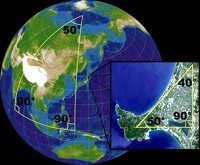
Just how many degrees are there in a triangle?
December is here … so I suppose it is time to deck with boughs of Holly … and so on. Actually December is quite a busy month will all sorts of special days to commemorate this or that … today, for example, happens to be World AIDS day and also the anniversary of last year’s inauguration of our current President, Almazbek Sharshenovich Atambaev.
December also happens to have the birthdays of two of my favourite Mathematicians: Janos Bolyai. (December 15th), and Nikolai Lobachevsky, (December 1st – that is … today!).
Now, I understand that for most people the idea of having “favourite mathematicians” might seem a little “nerdy” or “geeky” … but as I understand it, those two words are also getting a bit of a makeover and are no longer seen as persona non grata. As it happens, these two particular mathematicians were not only both nerds and geeks … they took centuries of Mathematical orthodoxy and stood it on its head … changing the way in which we look at the world.
The great Greek mathematician Euclid wrote his Elements, a thirteen volume collection of definitions, postulates (axioms), propositions (theorems and constructions) and mathematical proofs – which is best known for its treatment of Geometry. It is estimated to be second only to the Bible in the number of different editions that have been printed.
There was, however, one problem in Euclid’s Elements that made people feel uneasy – the fifth postulate that said:
If a straight line falls on two straight lines in such a manner that the interior angles on the same side are together less than two right angles, then the straight lines, if produced indefinitely, meet on that side on which are the angles less than the two right angles.
If that sounds like gobbledegook … basically it just simply means that parallel lines never meet … they go on forever and ever, always the same distance apart … and from this it follows that the angles in a triangle always adds up to 180°. Euclid stated this, but couldn’t prove it … which was to be a bit of a problem because, although it it true most of the time … it’s not always true and that is where the genius of Bolyai and Lobachevsky (and a number of others such as Bernhard Riemann) come in. They realised that it IS indeed true when the parallel lines are drawn on a flat plane like on a piece of paper – but it is NOT necessarily true if they are drawn on the surface of a different three dimensional object – like a sphere or a globe.
The funny thing is that even Euclid wrote books about spherical geometry … so he could have, should have?, realized this … but for centuries his fifth postulate ruled the day and it took “geeks” like Bolyai and Lobachevsky to discovery of a consistent alternative geometry that helped to free mathematicians to study abstract concepts irrespective of any possible connection with the physical world.
Sometimes it is necessary to take a step back and look at the world in a new way, from a new perspective … in order to see something that was in plain view right before your eyes for some time already! …
Now, perhaps you can see why these two are amongst my favourite mathematicians … and I haven’t yet got round to telling you anything of their stories …
There is a tradition or culture of counterfactual philosophy which can be summed up in the question “what if …?” as in “what if the three angles in a triangle don’t add up to 180°?, what would be the consequences?” Sometimes you end up with a “consistent alternative” … but not always.
Well, here in Kyrgyzstan, the situation seems to be volatile, (in more ways than one), and in a constant state of flux with the rules are constantly changing … well, at least it makes for living “in interesting times”. As one of my friends, (a Russian who grew up here in Kyrgyzstan), was fond of saying: “America may be the land of opportunity, but in Kyrgyzstan anything can happen – and probably will!”.
There is always a fair amount of analysis and speculation along the lines of “what if…?” No matter how hard you try to “cover all the angles”, however, it is surprising how “things rarely ever seem to go according to plan” and and all the expectations and predictions are thrown into disarray by the unexpected and unforseen circumstances that crop up.
Take one example … last year a teachers strike was narrowly averted by announcements of a new pay scheme which would increase the level of salaries. All well and good, but this was to be achieved by tweaking the pay structure and introducing special “bonuses” or allowances. What has resulted is a situation where the pay rates are higher … but hours for individual teachers have been cut and most seem to be receiving exactly the same this year as they were last.
The salary bill apparently comes to something like 12 billion soms a year … and when we remember that the budget doesn’t have enough cash in the coffers, that might have something to do with what looks like an attempt to economize.
On Friday, the Education Ministry announced plans top raise teachers’ salaries by 25% on the current levels of between 40 to 50 som … that’s about one US dollar … and hour. He admitted the expenditures in the education system are growing, but also noted that the quality of education does not satisfy society. Perhaps that’s the reason the number of children not attending school seems to grow from year to year … about 29000 out of 120000 … Mind you, I seem to remember similar arguments back in the UK when I was a teacher.
“Typically, the problem is social in nature: children have no clothes, school supplies, documents required for admission to a school. Often the parents are turning a blind eye to the fact that their children do not learn, they have to use child labour in the household, in agricultural work and at home.” the Ministersaid in a conference.
Another example is the attempt to limit the size of vehicles on Kyrgyz Roads. In the Soviet period the roads were designed and constructed to accommodate vehicles of a typical weight for that time … but many of the 35000 vehicles carrying goods from China each year, are much bigger and have a detrimental effect on the state of the carriageway. The main trunk routes are now undergoing a complete, expensive and lengthy reconstruction. So, a move was proposed to limit the size of goods vehicles allowed on Kyrgyzstan’s highways by law, effective requiring that Chinese vehicles be stopped at a (as yet non existent) terminal on the border with the cargo being transferred to smaller, Kyrgyz, vehicles … which someone with a cynical mind might construe as being a more important driving force behind the measure.
It’s [proved top be a controversial measure with protests from the Chinese Transportation lobby … and when it came to the all important vote in the Parliament the bill was eventually, narrowly rejected by a vote of 35 to 37. Somehow, I don’t think we have heard the last of this.
A third example is the constantly improving internet services available in the country. With wi-fi zones appearing throughout the capital and reports of impressive speeds – albeit at rather high prices … (a connection providing a speed of 6 Mbps, Unlimited data transfer, using Cable/ADSL costs about USD125 a month – in Tashkent it is supposed to be twice whilst in Almaty the cost is USD29.90, Dushanbe USD35 and in Astana, USD42.5). However, I ought to add that prices have been falling of late. A lot of people access the internet through their mobile phones … and we have almost saturation penetration of the mobile market … and mobile phone costs in Bishkek are amongst the cheapest in the region. Some of the “twittering” classes, however, are beginning to give to frustration about how the coverage and level of service (e.g. speed), is variable and pleading that perhaps we don’t the latest technological standards – just decent, reliable 3G coverage.
This week, of course, the biggest news event has been the elections to the local municipal authorities in Bishkek,25 cities and villages across the country, (one report said 46 and another said 415 … perhaps that can give you an idea of why it is sometimes very difficult to have a clear idea of what is going on). If Kyrgyzstan had a reputation as an “island of democracy” in Central Asia, then that reputation may have suffered somewhat from a mauling as a result of problems and the eventual potential rift that threatened to bring down the government (… yet again!).
Some problems became apparent fairly early on, with complaints about the polling stations being too crowded … not with voters, (although, at 48.1%, the voter turnout in Bishkek seemed to me to be quite good – compared to the local elections back in Britain … the figures were 31.5% in Bishkek ,47% in the Chui oblast, 57.5% in Osh, 53.7% in Jalal Abad, 53.7% in Naryn, 51.4% in Talas and 56.6% in Issyk-Kul), but election observers. I suspect that the Central Election Commission was hoping that this would be the sum total of the difficulties that were going to emerge … but if that was the case, then they were to be severely disappointed as more and more problems began to unfold as the day progressed.
As the news of irregularities emerged, one of the Vice Prime Ministers opined that “No serious violations were disclosed during the voting,” and, “violations won’t seriously influence voting results”. Perhaps that was another case of wishful thinking. Mind you, they did go on to say that “actions would be undertaken regarding each violation”.
One of the party leaders came to the Vice PM’s support saying that violations that had occurred “were not mass not centralized”. He went on to claim that the elections were “relatively free, honest and competitive compared to the previous elections”, and that, “people trusted the real decentralization of power”. The slogan – all power to the councils! – had been realized in practice. The local councils had obtained a mandate to form local government bodies, including the election of heads of rural municipalities, governors of districts, mayors, to decide staffing issues and to determine financial and economic programs”
The results contained surprises for everyone … Different parties had achieved good results, including those that were currently in the opposition at a national level. This was cited as evidence that “administrative resource” had not been used to thwart the expression of the will of the people and had not controlled the course of elections. Mind you, he seemed to accept that the use of official resources by those in power had been used by various parties to some degree.
That position seemed a little difficult to maintain as news of ballot stuffing, bribery of voters, (with alcohol in one case which is being investigated – and, apparently, there are stories of other incentives being proffered), and bussing voters from one polling station to another, (hence multiple votes … this was filmed and broadcast on the internet and picked up from there by the TV news programmes).
In Bishkek alone there were over 200 complaints … although most of them hadn’t been confirmed. In all some 29 offences were registered during the elections: 13 in Bishkek, and in the oblasts there were 2 in Issyk-Kul, 3 in Naryn, 3 in Talas, 4 in Osh, 3 in Djalal Abad province and 1 in Batken. Sixteen were registered as criminal cases to be investigated by the law enforcement bodies with the others being referred to the Election Commission.
Recounts were ordered in 39 polling stations: 14 of them here in Bishkek. If more than 30% of votes are recognized as being invalid, then the results may be invalidated.
Even before election day, several parties said that they were prepared for protest actions in the event of the election being manipulated … and one party has asked the Prosecutors Office to investigate the affair and take appropriate action. The leader of the Majority Coalition in Parliament announced that some members of his party were calling for the party to withdraw from the coalition in protest at the way the elections were conducted … so the “new” government looked as if it was under threat. There were all sorts of speculation as to who would come together in order to form a new government … but in the end, the deputies decided to stick with the status quo.
Although most of the attention has centred on the events in the capital, the controversy ranges much wider than just Bishkek; for example, the representatives of 8 political parties demanded the cancellation results in Djalal Abad.
Well, our attention may have been concentrated on these events, but other things have been happening …
Returning to the world of education for a moment … there is a simmering row over the lack of Nursery education provision provided by Kindergartens and the relatively small number of children who attend them. In theory there are 1200 Kindergartens scatted around the country – most of them run by the local authorities … but there are almost a quarter of them which are run as private enterprises. At least, that is … in theory. More than a third of the buildings have been privatized or converted into offices for the Tax Authorities, the Prosecutors Office, Police Stations, medical facilities, used by universities and some are even used as store houses. About 50 of them are not used at all … and are in a critical state of repair.
Electricity consumption is increasing – this year we’ve used 15% more than last year. In theory that shouldn’t be a problem … we are a country rich in hydro electric potential, but, as I said last week, we have been experiencing problems as a result in increased demand due to cold weather and the need for much of the distribution network to be repaired and updated. The new power stations and power transmission line aren’t due to come into operation until 2014 so the authorities are having to look at various measures to try and resolve the issues. |As well as the use of power cuts, there is a suggestion to issue limits, with much higher tariffs for those who exceed their quota… it has been decided to stop exporting electricity to neighbouring countries, which will have the added advantage of helping to preserve the water levels held in the Toktogul reservoir. There are even suggestions that Russia may consider helping Kyrgyzstan and Tajikistan in creating Nuclear power.
As a sign of the times, even Manas Airport, apparently, found itself without electricity one day during the week. I am not sure what happened to their generators … or to the facilities of the American Transit Centre. Manas was also in the news during the week when someone compared the wifi facilities to those found in European airports – specifically Heathrow … and said that Manas was better (!). I am fairly confident, however, that the toilet facilities in Heathrow would be better than those in Manas … except that this week there was astonishment when someone posted a photograph showing the clean and sparkling facilities … it didn’t look at all like Central Asia …
The other sdtory about Manas was an interview with the American Commanding Officer of the Transit Center. He pointed out that there were over two thousand people working at the base, about 1500 Americans and 700 local employees. Although plans are under way to make provision for transporting goods and personnel to and from Afghanistan post 2014, he could have disturbed a hornets nest by saying that Kyrgyzstan is “used to US presence”, implying (or at least, so some people thought), that there may yet be attempts to seek an extension to the lease. Publicly, however, everyone seems to agree that the deadline is 2014 and after that it will be a civilian hub.
There were a couple of interesting “surveys” published during the week. In two of them Kyrgzstan managed to find itself in third place … the first was the Gallup Survey about how emotional people are in different countries. It seems that people in the Philippines are the most emotional in the 150 countries surveyed … whilst Singapore had the least emotion people on the planet. Kyrgyzstan wasn’t far behind … in third place. That surprised me because I wouldn’t have thought of the Kyrgyz as being unemotional – rather the opposite.
The second was not really a “survey” in the same sense – but a publication called Global Spots reviewed destinations around the world that would be worth a visit in 2013 … and Kyrgyzstan came in … in third place – mainly as a result of the new visa policy which makes it easier to travel here and opens this once remote and little known region to a wider group of people.
News from further abroad caught my this week – an item on the BBC website reporting that on Monday, 26th November, they recorded a day without any violent crime: not a single murder, shooting, stabbing or other incident of violent crime was reported for a whole day. In fact, the city that was once known as the “Murder Capital of the World, the city’s murder rate is almost a quarter lower than last year, (366 compared to 427), and is on target to hit its lowest point since 1960 – and that is despite a surge in the number of murders in July. Apparently, however, there has been a 9% increase in “larceny”, which the police blame on a spate of smartphone thefts.
The Prosecutor General of Kyrgyzstan says that the crime rate has also reduced here … According to official figures, there were 21471 crimes reported in the first 9 months of the year which is almost 10% less than for the same period last year. Whilst not as impressive as New Yorks statistic for murder, it is still quite encouraging … although I doubt if that will be of much comfort to those who have become victims of crime – like we have, the office being broken into twice in two months. Fortunately, there was nobody hurt and although the losses on the first occasion were not exactly insignificant … on the second we basically lost a couple of computer monitors and suffered some damage to a window.
I wonder how they have recorded the attack on a group of Russian geologists working for a Gold Mining Company down in the Batken oblast … it was surprising in many respects, not just because the Kyrgyz are apparently not given over to being emotional, but also because it happened in Batken which is one of the poorest regions in the country, and that it was directed towards a Russian enterprise.
I could carry on and discuss a number of other issues that have arisen during the week, but I’ll stop with a reference to another story from further abroad: the fact that Britain is preparing to face what could be the coldest winter in a century … Oddly enough, last week, when I wrote about stormy weather and I even toyed with the idea of giving it the title “Storm of the Century”. Unseasonal temperatures or -5°C were expected … with the prospect of dropping as far as -20°C in the near future.
Well, winter has definitely arrived here in Bishkek as well. I’m not sure that we are heading for a “once in a century” winter records; temperatures of -20°C are not exactly uncommon, (in fact we’ve been down in the mid-teens on several days already this year and in Naryn it has been known to drop to -40°C) and -5°C is pretty much “run of the mill” for winter.
The cold spell led to the initial; spate of power cuts … and the snow that we’ve had may be slushy during the day but quickly freezes overnight. During the day you have to be careful not to walk too close to buildings in case snow falls from the roof. Actually, it is not the snow that is the main risk … it’s the long icicles that form from the freeze-thaw cycle. People often forget about that danger – but the icy footpaths are another story … in Bishkek last week there were 139 injuries connected to the ice.
In the mountainous areas avalanches are expected and the Ministry of Emergency Situations is busy making preparations to deal with them … In fact, I was supposed to be going up to Naryn this weekend, but because of the number of meetings that are scheduled in the build up to New Year, (and the work that involves), I have had to postpone it … which is just as well because the road through the gorge from the Dolon Pass down to Nary is prone to avalanches … and I could easily have got caught up in one, or stuck up in Naryn, if one fell at the most inopportune moment.
Oh, yes … and one more thing:
Happy Birthday, Lobachevsky!
_______________________________________
Postcard from Bishkek: the weekly postcard that I send out as an email also gets posted on the website ianbek.kg each week – and there are other postcards which don’t get sent out. This week, for example, there has been the following postcards:
- An encounter with Begenas Sartov - to mark the publication of an English translation of the first Science Fiction written in Kyrgyz
- Tengri - giving new meaning to the phrase “The old religion” – Tengrism is the old religion of the Kyrgyz nomads which is making a comeback
- Uzgen - One of the cities of the ancient trade routes known as the Great Silk Road Road 27/11/12
- Napkins, beer glasses and toilets – some observations from a traveller about the “little things” that need attention if tourism is really to take off in Kyrgyzstan
- Isanov and Isanova - Nasirdin Isanov was the first Prime Minister of Kyrgyzstan following Independence, and Isanova Street in Bishkek is named in his honour
- I know I should know this … - to Mark Computer Security Day
It is now possible to follow me on Facebook, (where I have specific pages for Celestial Mountains and ianbek … and also links.kg and Kyrgyz Diary), and on twitter, (@Bishkekpostcard and @celestialMTC ).





 Bishkek