Napkins, beer glasses and toilets
I had a visitor over the weekend, who has been coming to Central Asia as a consultant over several years … when he has not been on missions to other parts of the world. (Let’s call him John Smith for want of a better name.)
In all that time John has been running a private campaign to try and “raise standards”. Sometimes, he tells me, it feels like a never ending battle but every now and again there is a little sign of progress.
He has three main issues which he constantly raises:
- the use of Napkins as opposed to paper serviettes;
- the provision beer glasses which should be provided cold … not warm as if they have just been washed;
- and finally there is the question of Toilets.
In particular, John says, the level of service should be concomitant with the nature of the establishment and the prices charged. People don’t mind paying for good facilities and service – but they object to being led to believe that they are going to get one level, and charged accordingly, but in reality receive something that is not in keeping with the “promises made”.
“How can Kyrgyzstan hope to develop its tourism industry,” he asked me, “unless it pays attention to simple little things like these and gets them right?”
And in many cases, he feels, they are simple, little, things that do not require a lot of outlay or effort but can make the difference between a satisfying and a disappointing experience. Failing to attend to them is like “spoiling the ship for a ha’pennyworth of tar.”
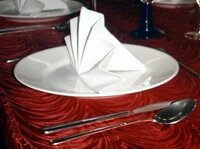
Linen napkins - a touch of "luxury"
The first issue John feels strongly about is the question of Napkins
Nearly everywhere, cafés and restaurants place racks of paper serviettes on the table; Knives and forks may be brought to diners wrapped in paper serviettes and usually paper serviettes are freely dispensed. Of course, they come in different qualities, colour and thickness, with those at the top of the range being far superior to those at the other end of the scale.
Unfortunately, however, some establishments seem to economise by, not only buying the cheaper variety, (small single ply), of paper serviette … but then cutting them in half before placing them on the table.
He argues that there is nothing wrong with paper serviettes – they can be very useful, but it is a case of “horses for courses“. They are very convenient, especially for certain occasions such as picnics or for a festive gathering such as at Christmas or New Year, but even the top quality paper napkins are still basically throw away convenience items and not appropriate for a restaurant that claims to be among the top tier of a city’s eating establishments – charging top dollar prices, (including service charges), having gone to the additional effort of providing décor, a comfortable atmosphere, aiming for good service as well as excellent cuisine. To get the real feel of comfort, enjoyment and value for money, there is nothing better than a linen napkin.
He tells of a Central Asian restaurant, not in Bishkek he assures me, where there was a summer patio as well as a dining hall and the menu announced that there was a 20% service charge. It was a fairly plush establishment and the prices on the menu were already quite high, but the addition of a 20% service charge seemed to make them a little extravagant. He called for the manager and asked why the charge was so high – as in most restaurants it is just 10 or 15 percent; what did he get for his 25%? Now, I have written about “service charges” before and they basically pay the wages of the staff. Here, the menu price is literally the price of the meal, and the salary of the chef, assistant cooks and even the dishwasher, the waiters (and waitresses), barman, administrator and even the cloakroom attendant are paid out of the funds received from the service charges.
I think the manager made a mistake because, apparently, he referred to outstanding service and the comfortable surroundings, to which my friend replied “I expect good service and pleasant surroundings as a matter of course … I shouldn’t have to pay extra for it … and certainly not that much.” He went on to point out that they purported to be a top class restaurant, but only gave clients paper serviettes … the same paper serviettes that any café might use; the same paper serviettes that might be used by street vendors in places like Cambodia where he would pay only a fraction of the cost that was on their menu.
To make matters worse, he said, there was patio as well as the regular dining room … and he happened to be sitting on the patio; in the dining room there were linen napkins, but on the patio they were only given paper napkins.
As is always the case, of course, there are some advantages and disadvantages to using linen napkins. As well as providing a little element of luxury, they are more expensive than paper serviettes … however they are re-usable, and not disposable … which in turn that also means that they have to be laundered … (there is nothing more annoying than picking up a linen napkin and discovering that it has simply been refolded and put back on the table for the next clients) … which requires more “effort” and is yet more expense. He feels, however, that it is worth the additional work and expense and will quickly pay for itself with increased customer satisfaction leading to increased business.
He tells me that he takes the credit that in several of the restaurants that he frequents around Central Asia have introduced linen napkins. At first, he says, they looked askance and grinned as if to say “who is this idiot?” … but as he returned and reiterated the request time and again, they began to take notice and, one by one, began to introduce paper napkins to their clients.
I am not sure how much this innovation can really be credited to his influence and “one man campaign” … but I can say that I have noticed that several of the restaurants he used to frequent here in Bishkek have indeed adopted the use of linen napkins.
(To be fair, most of them actually provide both paper serviettes and linen napkins … and many people don’t touch the linen ones, preferring the disposable, absorbent tissues … which are in many ways more hygienic anyway …)
To be absolutely frank, I am not exactly sure to what extent John can take credit for this innovation … it may have happened totally independently … but there has definitely been an improvement in this respect over the years.
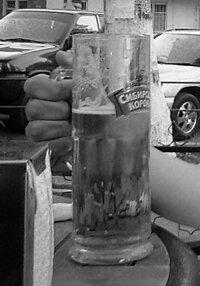
Cheers!
The second issue is beer glasses.
He enjoys a glass of beer and, especially in the summer, a nice cold refreshing beer. There is nothing more off putting, he says, than a warm glass of beer. That always struck me as odd because the Brits used to be known in Europe for their prediction for warm ale. Real ale in Britain used to sold, (for example, when I was working as a barman in my student years), out of wooden casks usually stored in the cellar. Although, in theory, the cellar was cooler than in the bar itself, the draught beer was always warmer than that from the pressurized keg which often passed through a refrigeration unit.
Whereas in Britain beer would be sold by the pint or half pint, (the equivalent of 500 or 300 millilitres), by contrast, in parts of Northern Australia they actually serve beer by the quarter pint, because the ambient temperature is so warm that the beer would no longer be cold by the time you came to finish a half pint glass.
My friend makes a point of asking if the beer is cold before ordering one … and, if there is no draught beer available, he has been known to ask how long the bottle or can has been in the fridge … even going to the extent, if he is suspicious, of asking to feel the can or bottle in order to check that it really is cold enough.
On several occasions I have seen him get really upset because, although the beer itself was cold, it was poured into a freshly washed glass … which was still warm from having been washed. As a result he would often ask that a glass be put into the fridge – or even into the freezer – so that he could be sure that his second glass of beer would be poured into a cold glass.
Over the years I have seen several bars where, as soon as the staff him walking in through the door, they have rushed to check that their are bottles/cans of his favoured beers in the fridge, they have put glasses into the freezer. In some places, he claims, they started putting the glasses into the freezer in anticipation of his visit and other clients saw this and asked for the same service.
Now, it is almost de rigueur in many establishments.
To be absolutely frank, I am not exactly sure to what extent John can take credit for this innovation … it may have happened totally independently … but there has definitely been an improvement in this respect over the years.
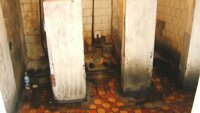
Asian style pit toilet
Finally there is the question of Toilets – especially in establishments which members of the public are likely to frequent such as cafés and restaurants. It is generally accepted that there has to be a toilet available, but the standards applied to them can vary considerably.
Of course, the facilities should be clean and hygienic, but unfortunately many are fairly basic and resemble road side facilities, (perhaps at remote locations, far from settlements, where sanitation provision such as piped running water and connections to a central sewerage system may not available … not to mention the lack of personnel available for regular supervision, replenishment of supplies such as soap or toilet paper … and cleaning). Public catering establishments in city, however, should not suffer from these lacks … water supplies are provided, there is a central sewerage provision and there should be staff available who could keep an eye on the “little room”, checking that it is clean and fully stocked with the necessary supplies.
The décor should also be in keeping with the nature of the establishment – perhaps tiled rather than just painted brick or wooden panels separating cubicles, so that they can be easily wiped down and cleaned.
Unfortunately, where towels are provided they are sometimes dirty and are definitely not inviting use. Some establishments have installed electric hand dryers but a problem with the electricity supply or a breakdown in the heating element can render them practically useless. Most establishments do provide paper towels and that is welcome … but the bin into which used paper towels are supposed to be thrown can be just as unappealing – perhaps just an old cardboard box.
One of the things that really upsets him, however, is when the facilities are “squat” toilets … As a European John finds these difficult and uncomfortable to use. I don’t think this is actually one of the criteria he uses when selecting which café or restaurant to frequent … but it is a factor. Over the weekend we went to one particular establishment which he had never visited on his many previous trips to Bishkek … and he seemed to like the place … until, that is, he felt the need to answer “the call of nature”. Looking a little anxious he asked me, “Is it a an Asian toilet or a European one?” I had to admit that I didn’t know … I can’t remember having used the facilities before – and if I had, then it had been a long, long time ago. Having failed to relieve his anxiety, he stood and went to relieve his body, muttering, “I may have to go back to the hotel.” As it happens, he was able to avail himself of the facilities even though it was an Asian style of toilet … because it had been spotlessly clean. All the same, for him it helped to spoil what was otherwise an enjoyable lunch in pleasant surroundings and a relaxing atmosphere.
After we had paid the bill and were ready to leave, one of the other members of the company, (who happens to be a restaurateur himself), asked the waiter if he could see the administrator. The waiter looked worried … what had he done wrong?, what complaint could we possibly have? His mind was put at ease when he overheard the comment that the establishment was wonderful, the food extremely tasty, the waiter excellent, (I could swear that I heard a sigh of relief and saw a smile beam across his face), but … one of our company, an Englishman, (at that point I started to get a little nervous, because they know that I am English), had one criticism. He felt very uncomfortable in the toilet and wanted to suggest that when they undertake any renovations they consider installing a European style pedestal toilet.
It was interesting to see and hear this piece of advice being passed on. Just a year ago, the toilets in his own establishment had been of the Asian style squat variety … and it was on the basis of John’s comments about the shortcomings of this type of facility that, when he began decorating and renovating his own café, he chose to change over to a European style toilet … and, he says, people have commented on the “improvement”.
To be absolutely frank, I am not exactly sure to what extent John can take credit for this innovation … it may have happened totally independently … but there has definitely been an improvement in this respect over the years.
Indeed, he is not the only person to have been upset about the state of toilets in Kyrgyzstan. They have been a thorny issue here for some time. The former Japanese Ambassador was so upset about the state of toilets in the country that he started his own campaign, raising the issue at any and every opportunity. At first, people laughed – out of embarrassment rather than humour, but over the course of time that response became a smile … then a shamefaced looking away. Other people took up the cause and we started to hear about the need to provide decent “public” toilets and it became a requirement that, in order to get permission to build even a petrol station, then toilets had to be provided … and some of the more modern roadside petrol stations built by the larger companies have incorporated even Western style facilities … albeit, perhaps, under lock and key and not always meticulously cleaned … but, at least, it is a sign of progress.





 Bishkek