World Day Against the Death Penalty
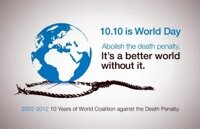
WDADP
Today is the World Day Against the Death Penalty.
The first such day was launched in 2003 by the World Coalition Against the Death Penalty, which unites various organizations from all over the world, (international non-governmental organisations, (NGOs), bar associations, unions and local governments).
The death penalty, (otherwise known by the less emotive term Capital Punishment), involves the execution of a person by judicial process as a punishment for an offence.
The coalition was established by the participants of the first international Congress against the death penalty which was held in Strasbourg in 2001 the idea behind it was to encourage the establishment of national organisations and to coordinate activities and lobbying efforts in countries that still maintain capital punishment in its legislation.
This year’s World Day focuses on the progress made in the past 10 years … and on challenges ahead. Since the first WDADP there has been a large increase in the number of countries that have officially abolished the death penalty or eliminated the use of the death penalty in practice:
- 141 countries are abolitionist in law or in practice;
- 97 countries have abolished the death penalty for all crimes;
- 36 countries have abolished the death penalty in practice;
- 8 countries have abolished the death penalty for what may be termed “ordinary” crimes.
According to Amnesty International, 21 countries recorded executions in 2011, compared to 31 countries 10 years ago. Even the USA, which has in the past made extensive use of the death penalty, has shown progress as individual states have abolished or limited its use. Many other countries have also abolished the use of capital punishment in the past decade, including: Albania, Argentina, Armenia, Bhutan, Burundi, Cook Islands, Gabon, Greece, Kyrgyzstan, Latvia, Mexico, the Philippines, Rwanda, Samoa, Senegal, Togo, Turkey and Uzbekistan.
However, the coalition considers that further work needs to be done to build on the progress that has already been made, particularly in:
- Promoting national legislation abolishing the death penalty.
- Increasing the number of ratifications of the Second Optional Protocol to the International Covenant on Civil and Political Rights, (ICCPR), aiming at the abolition of the death penalty.
- Supporting international standards calling for the abolition or restricted use of the death penalty.
- Supporting adoption of the 2012 UN General Assembly Resolution on a moratorium.
(In December 2012, the UN General Assembly will vote on a fourth resolution on a moratorium on the use of the death penalty).
In the Soviet Union there were a number of offences which were subject to a death sentence. Some of the former republics of the USSR, including Kyrgyzstan, have decided to abolish its use. However, this hasn’t been without a certain amount of controversy.
In Kyrgyzstan’s case, the decision to abandon the use of death penalty was formally made in 2007, although the sentence had not been imposed in any case for a decade – a moratorium on its use having been declared in 1998. The 189 convicts on “death row” had their sentences commuted to “life imprisonment” and according to human rights groups, there are about 200 prisoners currently serving life sentences .
However, accession to the Second Optional Protocol to the ICCPR, (which should have been the final step in the process of abolition), was delayed as a debate ensued in the parliament and wider society as to whether a return this ultimate form of punishment should be considered. Strictly speaking, The Second Optional Protocol requires signatories to ban the use of capital punishment, but as Kyrgyzstan had already done so, signing up to the protocol should not have been a contentious issue.
In 2008, a number of prominent politicians, including the Chairman of the National Security Committee and the State Secretary at the time, floated the ideas of reinstating the penalty … and even that executions should be carried out in public. Arguments in favour of the reintroduction cited the need to crack down on crime and the cost of maintaining “life” prisoners and one politician claimed that public opinion was “80 or 90 per cent in favour of reinstatement”.
On the other hand, the parliamentary committee for international affairs had supported ratification of the UN protocol. Amongst the counter arguments on the other side of the debate were that the experience of other countries clearly showed that having the death penalty did nothing to cut the crime rate – it was ineffective as a means of crime prevention of as a deterrent; the proposals to reinstate (and to even hold public executions – “the practice in medieval times and under fascism”), tarnished the country’s reputation was likely to “push the country over into the abyss of lawlessness and obscurantism”.
Amongst other arguments advanced from the international community was that innocent people can be convicted not only as a result of the judicial error, but also as a result of unfair trial.
As it happens, as the ombudsman and some of the opposition politicians suggested, it is likely that the remarks which sparked the debate were simply “a trial balloon to test public opinion” and in the end, Kyrgyzstan acceded to the protocol on 2nd December 2010.


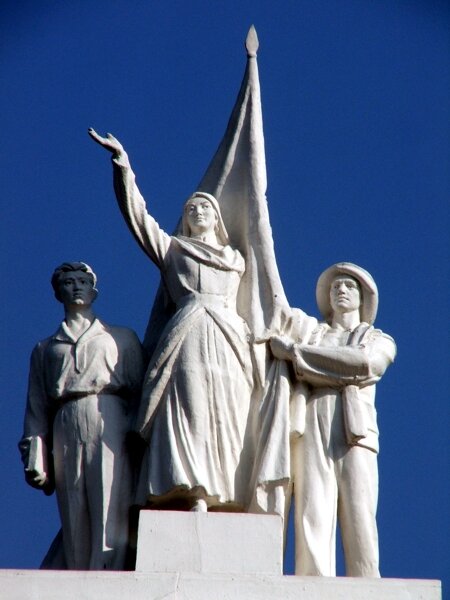


 Bishkek