One passport or two …
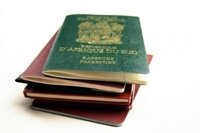
Choose your passport ...
I am an ex-pat, a British citizen who happens to live and work in Bishkek, the capital of the Kyrgyz Republic, where I am the General Director of a couple of companies which run a tour company and a couple of hotels. I have lived here since 1995 although, as I have written elsewhere, I originally came just for one year to help a friend set up an office.
I am often asked when I meet somebody new about where I come from and how long I have been here … mention of Britain usually elicits comments about football, the Beatles, David Beckham and Margaret Thatcher; whereas reference to seventeen years makes people gasp and joke about my being “half-Kyrgyz, already”.
That’s not true, of course … but I do have a Kyrgyz document which, as another “joke”, we refer to as my Kyrgyz Passport. It is not a passport as such but a “Residence Permit” – a Veed na zhitilistvo. To all intents and purposes it serves as a local passport – it can be used as my identity document for when I need one – to sign important documents, make official declarations or submissions, travel by plane to other cities in the Republic, and so on. It records my registered address here in Kyrgyzstan, (my propiska), my marital status, (single), and even my social security and tax identification numbers. It also takes the place of a visa and a work permit.
When I applied for the Residence Permit, I was actually asked if I wanted to apply for Kyrgyz Citizenship. I … politely … turned it down.
I am not sure if, all other things being equal, I might be interested in applying for a Kyrgyz Passport … it might bring certain advantages: granting me additional rights when it comes to owning property; granting me rights to vote in elections; possibly increasing employment opportunities and increasing my entitlement to social programs, (education, health care pensions) and it would make it easier to travel to certain countries – such as to Kazakhstan and to Russia.
Having said that, having dual nationality can also bring certain disadvantages: I could not rely on the British Embassy assisting me if I should come into some form of conflict with the Kyrgyz authorities,(there are distinct limits on what assistance a consul may offer, in the best but in the case of dual nationality, they can do nothing to support or intervene in respect of the someone’s second nationality … ); there may be tax implications, (although, as it happens, as a resident of Kyrgyzstan, I am already liable to pay Kyrgyz taxes on any income derived anywhere in the world – not just that which is earned here or remitted to Kyrgyzstan); I may become liable for military service here, (although, at my advanced age, I don’t think that is likely to be an issue); as well as a number of other possible implications.
There was, however, one major reason which was critical in my decision to decline the suggestion of applying for a Kyrgyz passport and becoming a Kyrgyz Citizen … to do so, I would have been required to surrender my British Passport … and I wasn’t happy to do that.
Although, like many other countries, Britain is quite happy for someone to hold dual nationality and have two different passports … Kyrgyzstan does not. Indeed there has been some considerable controversy when allegations emerge about some politician, official or prominent personality, that they have a foreign passport – usually Kazakh, but sometimes Russian.
In fact there is some concession that allows Kyrgyz citizens to also have Russian Passports, but that is very much an exception and, to be honest, I am not sure how it works in practice.
Although there would be no way that British diplomatic assistance could help me here in Kyrgyzstan, Without my British passport, there would be no way in which they could come to my aid anywhere in the world. Although my newly acquired Kyrgyz passport might make travel easier in some parts of the world, without my British one it would be more difficult to travel in other parts – for example in Europe.
Even without a British passport … there would always be the question of allegiance – and the suspicion that, as someone with dual nationality, I might have divided loyalties.
The question of divided loyalties was a real dilemma for Theodore Roosevelt, who is famous for his campaign at the beginning of the twentieth century against the divided loyalties of “hyphenated Americans”, (German-Americans, Italian-Americans and so forth), and his insistence that there should be only one acceptable form of “hyphenated American”: American-Americans.
In this he was reflecting a commonly held, (although not universally held), opinion of his day. Over half a century beforehand, the American historian and diplomat George Bancroft had maintained that it was not possible for a person to “belong to two countries”, (reminiscent of the biblical injunction that a man “cannot be a servant of two masters”).
In the 1930′s the League of Nations apparently maintained that everyone had a right to a nationality – and to only one nationality. At the same time, in the Soviet Union, Josef Stalin decreed that all foreigners in the Union had to either receive Soviet passports or return home … Alexander Dubcek’s father who had come as a volunteer with the Czech Interhelper group decided to return home … he may have been a socialist – but he was first and foremost a Czech.
In today’s “global village”, however, many countries, (apparently more than half of all the countries in the world), are been willing to accept the idea of people having more than one nationality; according to the Economist, “Armenia, Ghana, the Philippines, Kenya, Uganda and South Korea are all recent reformers. Haiti and Tanzania have new laws in preparation. Even Denmark, which places strict restrictions on citizenship, is mulling a change.” Some countries seem to be so intent on welcoming new citizens that they elicit allegations of simply “selling” passports.
There are, however, a few exceptions such as in the Netherlands where rules are being tightened, for a variety of reasons, but often on ideological grounds.
Some politicians, for example, consider that holding dual citizenship poses a threat to national cohesiveness, (sharing a common identity and culture), and hence the sense of national pride and loyalty which the state can expect and demand from its citizens. Similarly, some countries require that applicants for the citizenship have first to pass some test of knowledge or language ability in order to have citizenship conferred on them.
For the record, there are also arguments that acquiring a second citizenship enables someone to benefit from all the advantages conferred by the accepting state without having to contribute, and that dual nationality makes it harder to control certain aspects such as tax avoidance.
So much for the practicalities … but there is also a philosophical issue. Although I am happy to consider that Kyrgyzstan is now my home, I feel a little uncertainty about what it would mean to be “Kyrgyz”. Even if we were able to resolve the question of having two passports … is it possible for me to “belong” and be a full Kyrgyz citizen without being an ethnic Kyrgyz?
There are several different concepts and competing theories about status and nature of citizenship, nationality, subject, resident, domicile … and so forth. Some are defined according to where one lives, others to where one’s loyalty and responsibilities lie; to where one can trace their origins, their ethnicity or where one was born and brought up.
Britain, The United States and The Soviet Union have tended to be assimilative communities … like the Roman Empire they represent Civic entities rather than Ethnic ones – resulting in a multi-ethnic societies. Some countries, on the other hand, base their citizenship on a concept of ethnic cohesiveness. (Every Jew, for example, is entitled to become a citizen of Israel, no matter where they were born or grew up.) Citizenship, “membership of the state,
Here in Kyrgyzstan there has been a debate in recent years on the concept of the “Titular Nation”. This is Kyrgyzstan – which means Land of the Kyrgyz … the name of the country implies that it, (the territory, the land), belongs to the group of people called “the Kyrgyz”.
I think it is a fair question to ask: “Who are these people?” Is it just the people who belong to the ethnic group known as the Kyrgyz … (wherever they happen to have been born, raised or currently live in the world?, as in the case of Israel) … or should it include the people who were born in the territory of what is now Kyrgyzstan (irrespective of whether they are ethnic Russian, Uzbeks … or, for that matter, Brits, as is the case in America and Britain) … and what about the people who have applied for citizenship as part of the process of “naturalization” for whatever reason … (maybe that have married a Kyrgyz, been adopted by a Kyrgyz, or decided to retire here, or …).
There is a difference of approach in defining the different concepts and theories: one is inclusive, (concentrating on individuals and seeking to unite different people into groupings), whereas the other is exclusive, (concentrating on the groupings and seeking to define who can belong). Although it looks like a “opposite sides of the coin” scenario, it seems to me that they are not necessarily mutually exclusive options. Both approaches have their advantages, their uses and validity, and it seems to me that it is a question of striking a balance between them.
It is not a “free for all” … and neither should it be.
There are, for example, already some limits to the rights of citizenship in different societies. Not just anyone can be elected as President of the United States … not even every American citizen can be elected to the post. There are criteria to meet. Likewise, Here in Kyrgyzstan, there are criteria to meet it is a requirement in order to hold certain offices that the incumbent must not only be a Kyrgyz citizen, within certain ages, who has lived in the country for a certain period of time, and who is fluent in the Kyrgyz language.
All of these, (citizenship, age, residence, language), are factors or features that help to define who we are and the groups to which we belong. There are other factors as well, such as: gender, ethnicity, family, and religion, not forgetting political beliefs and other interests.
A recent survey, published in March this year, asked how people identified themselves by different characteristics: by Gender, age, citizenship, nationality (or ethnicity), religion or what … I was surprised that the number of respondents that claimed to consider their citizenship above that of nationality: Citizenship (82.6%), family, (67.2%), gender, (47%), ethnicity, (32%), and religion, (19.3%). Although I found this encouraging, I can’t say that this fits in with my experience … many people say to me, “I am not Kyrgyz, I am Russian”, or Ukrainian … or whatever and I usually reply “if you have a Kyrgyz passport then you are Kyrgyz … you may not be ethnically Kyrgyz, but you are Kyrgyz all the same … and this is your home.”
There is a debate that flares up from time to time about whether or not to eliminate “Nationality” from the Kyrgyz Passport. Personally, I think that the effect of such a measure should be positive, although take some considerable time to achieve.




 Bishkek