WMHDAY
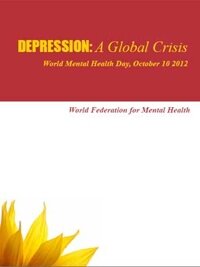
Depression: A Global Crisis - the theme for this year's World Mental Health Day : Click the image for the WFMH report prepared for WMHDAY 2012
Yesterday was another one of those days … as well as being the International Day against the Death Penalty, October 10th is also World Mental Health Day,(or WMHDAY).
WMHDAY was first celebrated twenty years ago, in 1992, at the initiative of the World Federation for Mental Health, (WFMH - a global mental health organization with members and contacts in more than 150 countries). The aim of the day is to raise public awareness about mental health issues, promoting an open discussion of mental disorders, and investments in the prevention, promotion and treatment services.
Now, I maybe simply exposing my own prejudices and misunderstandings, but quite honestly, the topic of Mental Health doesn’t really seem to be one that demands a huge amount of kudos. We all know it is an issue … but hope that if we ignore it then it will go away.
According to the World Health Organization, the term “Mental Health” refers “to the promotion of well-being, the prevention of mental disorders, and the treatment and rehabilitation of people affected by mental disorders”.
To be honest, the record of provision for patients in Kyrgyzstan who suffer from mental health problems leaves a fair bit to be desired. A report issued jointly by the World Health Organization, (WHO), together with the Ministry of Health in 2008 painted a fairly positive picture …
- a mental health policy, plan and specific legislature existed;
- financing for mental health care was provided, at the level of 4% of the budget for health care – with provision for primary care, hospital provision, (including provision for “out patient” services);
- three psychiatric hospitals existed, complete with out patient facilities, provision in outpatients departments in other centres and also in day treatment centres;
- the State guaranteed patients with mental disorders free treatment and care in psychiatric hospitals, including free access to essential psychotropic medicines;
- there were acknowledged shortages of staff, supervisory oversight and limited provision for treating children and adolescents and the number of beds was being reduced;
- the state provision was supported by over twenty voluntary organizations;
However, a report almost a decade ago, in 2003, whilst it recognised the existence of a national programme for mental health, spoke of the “dreadful conditions” experienced by patients: being poorly fed; housed in overcrowded conditions with a lack of qualified medical staff. It went further, saying that their rights being systematically violated: patients being incarcerated without written consent; use of physical restraints; being used as a labour force.
The main concern seemed to be the lack of adequate funding in the budget – citing provision of just one tenth of what doctors said was required.
The report also made reference to a tendency that the incidence of mental illness was increasing, specifically referring to the number of patients diagnosed with schizophrenia in the republic.
A press report issued in early 2010 suggested that little had changed. It repeated many of the charges of the 2003 report, but added that “patients kill themselves to escape mistreatment” and also patients that “repeatedly suffered from physical and sexual abuse”.
Since the events later in the year 2010, however, the question of mental health seem to have received greater attention … and support from the international community … especially in terms of helping children and communities cope with the traumas arising from their experiences.
As is usual for these designated days supported by UN agencies, a theme is chosen on which events around the world will be focused. This year the theme for the day is “Depression: A Global Crisis”.
Because of it’s use in everyday language, the word “depression” can easily be misunderstood. It is not simply a case of feeling a little “down in the dumps”. Depression is, unfortunately, a fairly common condition, affecting more than 350 million people of all ages, in all communities, and is a significant contributor to the global burden of disease.
There is a clinical understanding of the term as “mental disorder”, which is, characterized by a sense of sadness, a loss of interest or pleasure, feelings of guilt or low self-esteem or self-worth, disturbed sleep or appetite, feelings of tiredness, and poor concentration. It can be a long-lasting or a recurrent condition, which substantially impairs a person’s ability to function at work or school and to cope with daily life.
When mild, people can be treated without medicines but when depression is moderate or severe they may need medication and professional talking treatments. At its most severe, depression can lead to suicide.
Depression is a disorder that can be reliably diagnosed and treated by non-specialists as part of primary health care. Specialist care is needed for a small proportion of individuals with complicated depression or those who do not respond to initial treatment.
Although there are known effective treatments for depression, access to such treatment is a problem in most countries and in some countries fewer than 10% of those who need it are able to receive treatment.
In theory at least, depression can be easily diagnosed and effectively treated but that requires adequate funding and facilities … something which is unfortunately lacking in a situation where the state experiences problems in providing basic facilities and provisions.







 Bishkek