Any man’s death diminishes me …
One of this year's WSPD icons
I am a bit late with today’s postcard … World Suicide Prevention Day was September 10th and although I thought at the time about writing something to note the day – I decided that there wasn’t enough information to warrant a post … and so, in the end, I wrote about Kasym Tyntystanov who was born on that day in 1901.
Unfortunately, the situation has changed in this respect and hence I decided to write a belated postcard on the theme …
For the record: World Suicide Prevention Day, (WSPD), is observed annually on 10 September, with the aim of raising awareness of the prevalence of suicides, (), and in order to develop a worldwide commitment and action to prevent them. The International Association for Suicide Prevention, (IASP), together with the World Health Organization, (WHO), and the World Federation for Mental Health, organize various activities around the world – in 2011, in an estimated 40 countries – to mark the occasion.
The statistics are grim:
- It is estimated that there are about one million suicides committed every year around the globe – that is:
-
- about 3000 a day or
- one every 40 seconds … and
- is a number is expected to increase by 50% by the year 2020 … and
- according to WHO, for every successful suicide there are 20, or more, other attempts – that is
-
- “one every three seconds”
- suicide is the “most common cause of death for people aged 15 – 24″
- it is the 13th leading cause of death worldwide
-
- more people die from suicide than from murder and war;
- according to WHO, suicide accounts for nearly half of all violent deaths in the world
- “more people kill themselves than die in all wars, terrorist acts and interpersonal violence combined.”
- suicide has overtaken car crashes as the leading cause of injury related deaths in the United States – the number of deaths from vehicle accidents fell by 25% in the last decade, whilst the number of suicides has increased by 15%
- Japan has for more than a decade had over 30000 suicides a year
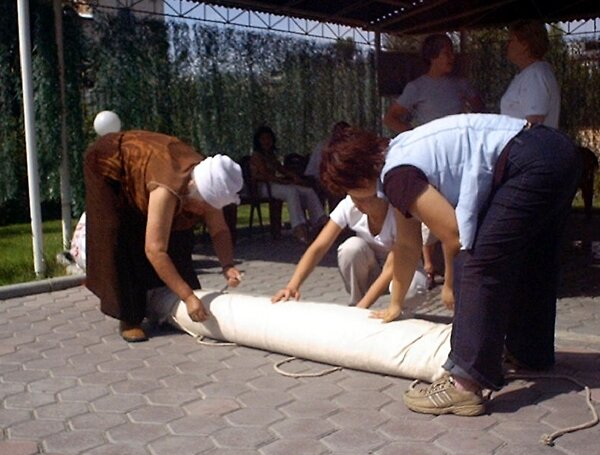
During the last year we have seen a couple of high profile suicides in Kyrgyzstan – perhaps the most widely reported concerned a teenage girl who had been “kidnapped” by her husband and made into a reluctant bride. Ala Kachuu is supposedly a time honoured tradition and it is considered shameful to reject your “fate” once the groom’s mother has placed the scarf over your head … so that the bride may well feel trapped with and no way out … except …
A couple of days ago, a particularly sad and depressing article in Bishkek’s largest circulation newspaper, Vecherniye Bishkek, (Evening Bishkek), caught my eye … “Let it not come in November“. It began with the bland statement: “The number of suicides in the country is growing,” and added both among and adolescents.
Once again, the statistics are grim:
- Since the beginning of the year there have been 84 teenage suicides
-
- 48 boys
- 36 girls
- 14 from the regions of Chui, Djalal Abad, Issyk Kul, Osh
-
- (… it didn’t say where the other 70 came from … which raised the question – were they all from Bishkek?)
- In 2011 there were 73 cases of suicide
- In September alone, 10 children took their own lives.
Apparently the peak number of suicides is usually in the dead of Winter, in February – ironically, the shortest month of the year – followed by another surge in November.
The article went on to consider several themes such as the need to talk to children … even about difficult issues and not simply brush them aside … and also to listen to them. The children feel that they have no-one they can turn to and are faced with a wide variety of pressures, stresses and strains – and because the nature of society is changing, often these are quite different from the ones their parents experienced and grew up with.
This communication is important within the family, but also in school and society generally. This can be difficult because, as children get older they often mature and “push away” from their parents who, in turn, “lose emotional contact” with them. In schools there may be no specially trained staff to act as psychologists or counsellors – or if there are, then they tend to be on the administration staff and children don’t seem to trust them. Sometimes, even, the staff are under their own pressures and are not always prepared for the challenges presented by what may appear as “difficult children”.
The article went on to note that, although there was an Urban Centre in Bishkek which employed specialist psychologists, it was based in a drug treatment clinic and very few people know about it. Limited provision though this is, it is at least something, but for those living in the regions there were no such facilities … .
There was a second article, or box, where various people were asked for their opinions on the topic. Among the general comments reported were:
- that the reason for increase in suicides, (among both adults and children), lies in the present state of the country; The school – a mini-state within the state – in which rackets flourish, cheating, fighting – even stabbings … added to the indifference of others;
- the media, (television and radio), can offer the message that we can take our future into our own hands;
- some people blame computers, but in the past they blamed books – suicide is one of the facts of life and has always been with us;
When people were asked what can be done to help prevent children from taking this tragic step … the responses included:
- when it seems that everything is bad, they should go to the gym and exercise until exhausted … besides the exercise, it will produce a sense of pleasure and achievement. We need to create more opportunities for sport … ;
- we need to convince our children that we love them, and to show that it is not just talk;
- we need to be attentive to each other and watch for signs that there are problems and respond to them;
In the recent past I have seen a growing number of stories on the internet relating to young people who have committed suicide as a result of being tormented for being gay and it has been interesting to see the response of the community – and not just the gay or LGBT community – who have overwhelmingly responded to try and curb this phenomenon - for example the widely publicised ”It Gets Better“ campaign.
Although I am sure it has had a positive effect and helped many individuals, I am not convinced that the campaign is enough – as it attacks the symptoms and not the root cause of the problem. (I note that, sadly, there have also been cases where a youth has recorded a youtube message for the campaign only to succumb a short while later.)
It is however a real and positive attempt to face up to and address the situation … and the statistics show that it is sadly needed. Although, if we agree with John Donne that “Any man’s death diminishes me,” then I suppose the statistics don’t really matter … ” because I am involved in Mankind; And therefore never send to know for whom the bell tolls; it tolls for thee.”





 Bishkek