Dubovniy Park – Oak Park
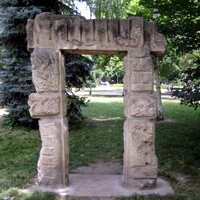
One of the exhibits in the Open Air Sculpture Museum - in Oak Park
In 1890, Alexei Fetisov, botanist who came to Pishkek, (nowadays called Bishkek), from Saint Petersburg in 1879, (having been invited by the then Governor of Semirechiye, General Kolpankovsky), established a remarkable achievement. He succeeded in creating a plantation of you Oak trees in the city centre, on a site which was dominated by a the generally unsuitable soil: clay loam.
Despite the disparaging criticism and sceptical predictions of his colleagues, over the next fifty years the young saplings spread their roots and extended their crowns to become large sprawling trees which became one of the city centre’s parks: Dubovniy Park, (or Oak Park).
The park is a island of calm within the bustling city centre and proves attractive to residents and visitors alike, as a peaceful place to walk or simply relax, sitting on benches or in cafes. It is sometimes referred to as the “lungs” of the city …
In the period before the Bolshevik revolution of 1917, the park was ringed by the houses of wealthy citizens, but only one of which remains to this day: Terentiev’s House on the corner of Prospect Erkindik and Abdumomunova Street; the two storey white house which now houses the Committee for the State Language.
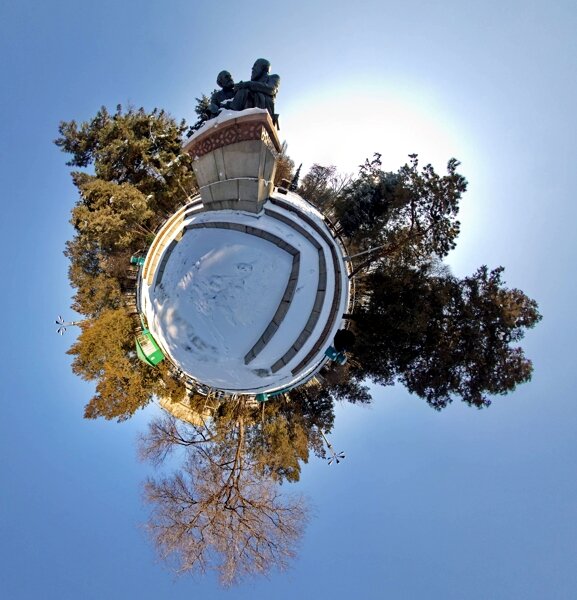
In the centre of the park is the Red Guard’s Memorial, an obelsik of red granite erected in 1960 in place of a simple wooden marker. It stands over the common grave of the Bolshevik revolutionaries who fell during the 1918 Counter Revolution uprising at Belovodsk, who were interred on New Years’ Day, 1919. Although he survived, the revolutionaries’ leader Yakov Logvinenko, later joined then when he eventually passed away in 1933. The obelisk is flanked by four canons, originally cast in St Petersburg for the tomb of Pishkek’s first Mayor, Ilya Terentiev, but which disappeared shortly after the revolution before being rediscovered and commandeered for this memorial. At the foot of the obelisk is an eternal flame – which unfortunately, does sometimes get extinguished – usually due to economies imposed – which usually leads to some considerable controversy.
Next to the monument is the Russian Drama Theatre. It is named in honour of Chinghiz Aitmatov, the famous Kyrgyz author, although it used to be named in honour of the Soviet actress Nadejda Krupskaya. Before the October Revolution of 1917, there was no professional Kyrgyz theatre. Popular entertainment was provided by the traditional manaschi, akyns and musicians such as komuzists. It was in 1926, with the creation of the Kyrgyz Musical-Dramatic Studio, that professional dramatic entertainment can be said to have been established. On the basis of the Studio, in 1930, the Kyrgyz State Theatre was established. In 1935 the company of the Russian Drama Theatre was established and the following year that of the Kyrgyz Theatre, (which is located in the Old Square). The first performance was “Capital”, a play about the construction of the Moscow Metro, and it was followed by a premiere. The companies often perform premieres of new plays, especially by local authors – such as Chinghiz Aitmatov, but they also include in the repertoires a wide range of classics, including Chekhov and Shakespeare.
The current building was erected in 1972. It stands on the site of the Edison Cinema which was built in 1914, (which was later renamed the Progress and the the Cholpon Cinema), and a previous theatre constructed in 1929. The cinema al;most certainly played a prominent role in the mass demonstrations of December 1918 when the Bolsheviks seized power in the city.
After the revolution, the park was enlarged beyond Fetisov’s original boundaries with the annexation of the lands belonging to the Nikolaievskiy church and now lies between Ala Too Square and Tynystanova Street, Pushkin Street, (behind Dom Druzhba) and Abdumomunova.
The Church still stands but is no longer a place of worship. It is not certain when the church was built, but it was sometime before 1885. The door which faces West towards the Historical Museum and Central Square, used to look out over Soldiers Field which extended from the Old Central Square up to Prospect Chui. In 1935, the traditional onion domes were removed and the church became the State Picture Gallery which would later become the Museum of Fine Arts – when the building was handed over to the Union of Artists to use as a gallery.
Throughout the park there are examples of sculpture which form the city’s Open Air Sculpture Museum. It was established in 1984 to commemorate the 60th anniversary of the Kyrgyz SSR. Examples of sculpture on the theme “Peace and Labour” were collected from all over the USSR for display in the park. Although the original collection included works in stone metal and wood, the metal exhibits – including a famous bust of Yuri Gagarin – have disappeared, (basically stolen for their scrap value).





 Bishkek