Polysyndeton
I wouldn’t blame anyone for asking “Poly-what????”.
I came across this word as a result of a discussion with one of our staff about his learning English. As it happens, I think that he speaks English quite well but he disagrees with me on this, and in the end I suggested that what he really lacked was not proficiency in English but confidence.
I tried to assure him that unless he wanted to be a professional interpreter or translator, on whose work lives and livelihoods might depend, the most important thing was not that he should know the language faultlessly, (all the rules of the grammar, spellings, and so forth), but rather that he was able to use the language in order to communicate – so that he was able to understand what other people were trying to say and that they, in turn, could understand him.
For one thing, I said, it was almost impossible to be faultless in English. Indeed, whenever I saw a CV where someone claimed that they had a “perfect” knowledge of English, I would be sorely tempted to discard that CV as it implied that they didn’t really have a “perfect” knowledge of what the word “perfect” really meant. Even I make mistakes in my use of language, I said. This elicited a smile … as if to ask: who was I kidding. I pointed out that simply being a native English speaker did not necessarily mean that I didn’t make mistakes.
Indeed I used to have a member of staff, (who now lives in America), who used to correct me on my English. That elicited another smile! In response, and in my self-defence, I pointed out that she was a graduate of linguistics and so she had a professional pride and interest in the intricacies of language which most people, including me, don’t have. Most of us use language as a tool, not as a subject to be studied.
English, “as she is spoken”, is a very diverse language and the same sentence can often be interpreted in different ways. The classic example which I use to illustrate this point is “Thank you very much.” It can be an expression of gratitude, or spoken in such a way as to mean exactly the opposite … a sarcastic recognition that you anything but grateful for what you have received.
On the whole, Russian is a very rule bound and precise language and children learn complicated tables, and can be observed muttering questions to themselves, (Kto?, Shto?, Kavo?, Chevo?, Kamoo? Chemoo? … Who? What?), before committing themselves to a particular set of words. A small difference can result in quite different meanings or interpretations. I remember translating “I am cold” literally as “Ya holodniy” and being greeted with bemused looks until someone took me to one side and said: ”In Russian you can’t say ‘I am cold’ … you have to say ‘To me it is cold’, or Menya holodno.”
How many rules of grammar do we learn as children only to discover that they are not “cast in stone” and that there are always “exceptions”. At school we learned the following spelling rule, “I before E, except after C … except for the exceptions!”.
I actually saw a different version of that on Russian TV the other day … in what I suppose could be described as a Russian version of Sesame Street … which was performed as a Rap song:
if there is no letter C … put the I before the E …
if the letter C you spy … put the E before the I …
… unless it sounds like lie AY
Hmmmmm .....
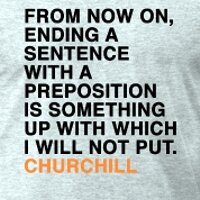
Another rule we learned was that a preposition was something you shouldn’t end a sentence with … and although I know that there is no basis for this in English, (the rule comes from Latin), I still feel uncomfortable with it and want to say that a preposition is something with which you shouldn’t end a sentence.
Yet another nonsensical rule was that you shouldn’t have two “and”s in a sentence. Lot’s of people break this “rule” and perhaps Ernest Hemingway is the best known example, and I remember that when I was a teacher one of my favourite “Mars Bar Puzzles” was to come up with a perfectly valid, meaningful and grammatically correct sentence with five consecutive “and”s: “… and and and and and …”. Most of the time everyone gave up … and groaned when I gave told them about the owner of a Fish and Chip shop who had had his sign repainted and was complaining to the painter that: “… there isn’t enough space between the words Fish and and and and and Chips.”
Even when written like that it is not immediately obvious and a little punctuation helps: … there isn’t enough space between the words “Fish” and “and”, and “and” and ”Chips”.
If five “and”s are difficult, consider eight “buffalo”s, (as in ”Buffalo buffalo Buffalo buffalo buffalo buffalo Buffalo buffalo“) or eleven “had”s, as in (“James while John had had had had had had had had had had had a better effect on the teacher“).
As for the example with eleven “had”s – consider the following scenario and try reading it with the help of a little punctuation: “There are two students, called ames and John, who are required by an English test to describe a man who, in the past, had suffered from a cold. John writes
The man had a cold” which the teacher marks as being incorrect, while James writes the correct “The man had had a cold.” Since James’ answer was right, it had had a better effect on the teacher. The sentence can be understood more clearly by adding punctuation and emphasis:
James, while John had had “had”, had had “had had”; “had had” had had a better effect on the teacher.
The key to understanding the “buffalo” example rests in the fact that the word is used in three different ways: as the name of Buffalo – the name of the capital of New York State, buffalo – the name of an animal, a bison and buffalo – a verb meaning to bully or intimidate. The use of commas can help to make the meaning clearer: Buffalo buffalo, Buffalo buffalo buffalo, buffalo Buffalo buffalo.
OK … if that is still as clear as mud, consider it like this: “Buffalo bison, buffalo bison bully, bully Buffalo bison”.
All right, perhaps we need to add a few more words by means of explanation: Buffalo bison – can be understood as bison from Buffalo … so we now have: “bison from Buffalo, bison from Buffalo bully, bully bison from Buffalo” …
OK , how about adding a few more connecting words by way of explanation:
bison from Buffalo, that other bison from Buffalo bully, bully other bison from Buffalo.
The “buffalo” example is more complex and requires substituting words like values into an algebraic formula, but I hope that the three examples help to show how punctuation can affect our understanding of a sentence.
The classic examples used to illustrate the importance of punctuation on the meaning of a sentence are:
- “The panda eats shoots and leaves” – as opposed to “the panda eats, shoots and leaves“;
- “Woman, without her man, is nothing” – as opposed to “woman: without her, man is nothing“.
Now all of that may be interesting … or not, as the case may be … and it seemed an appropriate theme for today for today: Punctuation Day, but let’s be honest … not many people are going to feel comfortable with all of the details … but my whole point is that the details are not the important thing … it’s if we are able to communicate effectively – to make ourselves understood.





 Bishkek