Kasym Bayalinov
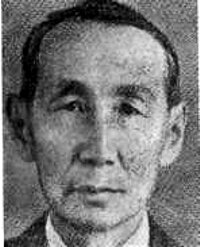
Kasym Bayalinov
It is 120 years since the birth of one of Kyrgyzstan’s most influential early Kyrgyz writers” Kasym Bayalinov, (who was also known as Kasymaliev, Kasïmalï and numerous other variations of his first name).
The literature of the nomadic Kyrgyz was embodied in the the oral traditions; the epics and folktales handed down from generation to generation over many centuries. This traditional folklore provided a rich mine of material to quarried by poets and authors as written literature developed and blossomed, whether in terms of poetry, prose, pamphlet, play, essay, children’s story or translation of foreign works, and this both supported and was supported by the growth in literacy during the Soviet period.
The first Kyrgyz novel to appear was Sydybekov’s Keng Suu, (Broad River), in 1937/8, but it had been preceeded a decade earlier by Bayalinov’s short story Azhar, (Good looking – or Handsome), which had been published in 1927.
Bayalinov was born on 25th September, 1902, near Kotmaldy (on the river Kok Moinok) in Issyk-Kul, into a peasant family. His parents died when he was still quite young and he was raised by relatives.
During the events of 1916, Urkun, together with so many other refugees, he and his family fled to China. After the Great October Revolution the following year, he was able to return homeland, but found it to be “rotten to the kulaks in it”.
For the record: in communist lore, kulaks were rich peasants who exploited other peasants, (that is, profiteering from the efforts of others), and who were often outlawed, deprived of civil rights and had their proerty confiscated,
A year later, he left Kochkorka, and walked to Tokmak where he was able to find employment variously as a day labourer, a messenger at the pharmacy, a groom, and an assistant chef at the army barracks. In 1919, he joined the ranks of the Young Communist League, and travelled to study on a six month course in the Party School. A year later, he returned to study in Tashkent once more, this time on another six month’s teacher training course, and later continuing his studies in Almaty (from 1921 to 1925) and in Moscow, (from 1929 to 1933, at the All-Union Communist Institute).
On his return to the Naryn region following his first course of study in Tashkent, he worked in the Komsomol Committee, (basically, the Young Vommunists organization). In 1925, he became the Editor of the Kyrgyz section of a Moscow based publication, serving for two, to year stints as their Chief Editor. He also worked on other magazines, including regional magazines and the influential, “Soviet Kyrgyzstan”, and during the late 1940′s as a Research Fellow of the Kyrgyz Academy of Sciences.
From 1955 onwards, however, he dedicated himself to “free creative work”.
His publications began in 1922 with some of his poems in Kazakh and Tatar. In 1926 he published his classic novel “Azhar“, which is often classified as “the first realistic work Kyrgyz prose”, and which has been translated and published in several languages. Other novels, novellas and short stories, included: ”Murat” (1929); ”On the shores of Lake Issyk-Kul” (“Kel boyunda“, 1952), and ”The Brotherhood” (“Boordoshtor,” 1962).
He was also the author of numerous feature articles and essays which examined topical issues.
His works were often included in anthologies and were taught in educational institutions from secondary schools to university.
His works have been published in Russian, Azerbaijani, Uzbek, Kazakh, Tatar, Moldavian, English, French, German, Czech and other languages, and he was one of the first professional Kyrgyz translators, acquaint Kyrgyz readers with the works of Pushkin, Lermontov, Tolstoy, Gorky and others
Having become a member of the Communist Party of the Soviet Union in 1925, he was elected a member of the Writers’ Union in 1939. Amongst the various awards that he was granted were: two Orders of the Red Banner; Order of the October Revolution; the “Badge of Honour”; Medals. “For Valiant Labor in the Great Patriotic War of 1941-1945″, ”Valiant Labour”, and in commemoration of the centenary of Lenin’s birth, as well as “Diplomas of the Supreme Soviet of the Kyrgyz SSR and being named People’s Writer of Kyrgyzstan in 1968. He also served on the Supreme Soviet of the Kyrgyzz SSR, and as a member of the Frunze City Soviet of People’s Deputies.
He died on 3rd September, 1979, just short of his 67th birthday.
Here in Central Bishkek, next to Museum of Fine Arts and between the Russian Drama Theatre and the Theatre of Opera and Ballet, is the National Library for Children and Young People which is named after Kasym Bayalinov. It has recently been renovated and is used to host a number of events. (Until it was renamed, it was known as the Chernyshevsky Republican Library)






 Bishkek