Dividing the nation
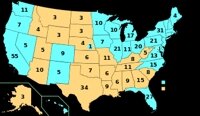
A divided nation?
I came across an interesting news report where one of the candidates in this year’s upcoming Presidential election in the United States was complaining about his opponents campaign as being built on “anger and divisiveness”.
Now, I appreciate that the comment was really about how the campaign was being conducted but a couple of other thoughts occurred to me …
Although the reference to anger was pointed and strong, (reflecting the particular social issues which have emerged in campaigning to date – such as the “legitimate rape” row), on the other hand, it’s not the first time that this or that issue is said to have divided the nation; consider the controversy over tax cuts, healthcare, abortion, gay marriage, segregation, state’s rights or even slavery … and, anyway, it is the very nature of elections that they are divisive; dividing people into camps of supporters for one cause or another.
The American Presidential election is not a straight forward popularity contest. It’s possible to win the Presidency but obtain less than 50% of the vote … (because there is no “run off” second round between the leading two candidates, like there is in France and here in Kyrgyzstan, where the eventual winner is bound to obtain a majority of the votes) … indeed it’s possible for someone to win the popular vote in America but still come in second, (it’s happened four times, so far).
Although it is a Presidential election, it should be noted that since 1824, (the first time there was a “general election” held amongst the population), what the people have actually been electing, (even if they have cast their vote for their preferred candidate), have been delegates to a special meeting, (called an electoral college), where each state is allocated certain number of delegates – but which is not necessarily based on the number of votes cast for each of the candidates. It is this electoral college which actually elects the President … and it’s in the college where the successful candidate has to win more than half of the votes.
In the first election in which the general population were given a vote, the 1824 election, the winner of the popular vote was Andrew Jackson, who received a clear margin of more than 10% over his leading rival, John Quincy Adams. There were four contestants, however and the division of delegates to the electoral college was such that it produced a stalemate with Jackson failing to win a sufficient number – resulting in the question being passed to the Congress … where Adams was able to muster enough supporters to pip Jackson to the post.
Indeed, amongst the 47 elections since 1824 various other anomalies have been thrown up by the American system, such as:
- The four results where the successful candidate actually received less votes in the general election than one of their opponents, (1824, 1876, 1888 and 2000);
- In four cases, (1880, 1884, 1960 and 1968), the successful candidate squeaked in by a margin of less than 1% of the popular vote over their nearest rival
- The 1876 election was probably the closest – and by all accounts one of the “dirtiest” and most problematical – presidential election, with Hayes winning by 185 electoral college votes to Tilden’s 184 – even though Tilden received a quarter of a million more votes in the popular vote and actually registered more than 50% of the popular vote … the only time a person has won more than 50% and NOT been elected President.
- If we ignore the 1824 election, (when Adams received barely 31% of the votes cast), the successful candidate received between 40% and 60% of the popular vote.
- Although in 29 of the 47 elections, the eventual winner took more than 50% of the popular vote, there were still 18 occasions, (that’s about 40% of the time), when they received fewer than 50% of the votes cast, (that is, there were more votes cast for their opponents than were cast for them);
- In 1880, with a majority of just over 9000 in the popular vote, (out of just under nine million votes cast – i.e. 0.09%), James Garfield received 58% of the vote in the electoral college.
- In 1920 and 1924, Harding and Coolidge achieved winning margins of over 25% over their rivals in the popular vote which was more or less doubled when converted into electoral college votes;
- On six occasions, the winning candidate took more than 90% of the votes in the electoral college, although no one has ever achieved more than 61.05% of the popular vote. (For the record: There were also two occasions when George Washington was elected unanimously – but he never had to undergo the indignity of a general election).
- The biggest margins in the electoral college, (assuming we don’t count the unanimous votes accorded to George Washington), was 97% given to Franklin D. Roosevelt, even though he only got just over 60% of the popular vote.
- Richard Nixon and Ronald Regan were also given electoral college margins of over 90%, each for their second terms of office, even though they also only achieved about 60% of the popular vote.
- The largest share of the popular vote was won by Lyndon Johnson in 1964, (61.05%), giving him a lead of 22.5% over his nearest rival and 81% in the electoral college.
- In 1984, Walter Mondale achieved 40.56% of the popular vote, but gained just 13 of the votes (2.5%) available in the electoral college. (For the record: although he was competing with more candidates … that’s more than the 39.65% which got Abraham Lincoln elected in 1860 – giving him 59% of the college)
For the record: Barrack Obama was elected President in 2008 with 68% of the electoral college votes, although he only managed to obtain only 53% of the poplar vote.
There are other factors that have to be borne in mind which affect the results, some general but others which have an specific impact in a particular case.
It also has to be noted, for example, that there are many people who don’t vote for one reason or another. The turnover figure can help analysts in some respects when they try to ascertain if the politicians are really representative of the opinion and feelings in the country … but there are also many people who are not included in the calculation of this figure … who cannot vote because they are not registered for one reason or another.
I am not saying, however, that the electoral college system is bad in itself … despite the fact that it produced such results … I am arguing that the country is, indeed, divided … one could almost say deeply divided.
As it happens, I think that it could be argued that the electoral college system actually helps – in that, (with the exception of 1876), it has tended to produce a bigger winning margin for the successful candidate than they gained in the popular vote. It makes it look as if they have won more comfortably and have more support.
The fact remains, however, that the country is divided … one could almost say: deeply divided.
I should also point out that the British system, (based on a “first past the post” system for electing representatives from a local constituency to a Parliament which the government has to persuade to support its programmes in the lobbies), also produces some strange results.
It may be true that people tend naturally to divide into two blocks on most issues, or as W. S. Gilbert put it in Iolanthe:
… every boy and every gal
That’s born into the world alive
Is either a little Liberal
Or else a little Conservative!
What’s more, those “little Liberals” and “little Conservatives” often tend to be fairly evenly matched in terms of numbers. However, it is rare in Britain for the party which forms the government after a general election to have a received a majority of popular vote in that election. Since the Second World War, for example, no party has won more than 50% of the vote although they have often won a landslide in the House of Commons. The current coalition of the Conservative and Liberal Democratic parties is the first government to be based on a majority of the popular vote since the 1931 General election.
For the record: Margaret Thatcher, who was perhaps one of the iconic and divisive Prime Ministers that we have had in the UK, won the election in 1979 on 43.9% of the popular vote – but just 35.6% of the electorate.
In fact, any electoral system is going to have it’s quirks and produce anomalies … and, it has been said that the only system that avoids any such problems is a Dictatorship!
I should also point out that, here in Kyrgyzstan, life is even more complicated because we don’t have just two major parties or blocks of votes. Although it is true that people do often talk about there being two “camps”, or blocks, (North versus South), I think that is too simplistic.
The parliament is elected on a form of Proportional Representation and currently has five parties, all of which are more or less evenly matched … and it could easily have been six parties if one of them hadn’t been excluded on a technicality. In fact there could have been even more parties in the parliament – some 57 contested the parliamentary elections, but as there was a threshold of 5% of the votes cast in order to be allocated seats.
As it happens, a political analyst thinks that after the performance of the current deputies, for example the constant squabbling and positioning, could lead to a realignment of the parties with some of them merging to create new power blocks … he thinks maybe three major blocks: based on the North of the country, the South …. and Talas.


 Bishkek