Celebrating Man’s Best Friend
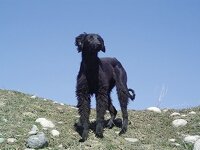
Taigan - the Kyrgyz Borzoi
26th August has been National Dog Day since 2004, but in recent years it has been marked in Australia, Canada , Italy, New Zealand, Spain and the United Kingdom, as well as in the United States where the idea originated.
Now, if the British are widely known as “animal lovers”, this is not necessarily thought of as a trait, a typical characteristic, of Americans. That is not to say or even suggest that Americans don’t care for animals, just that the British are thought to go loopy, or soft in the head, when it comes to a furry and feathered friends.
The RSPCA, (The Royal Society for the Prevention of Cruelty to Animals), for example, is a charity that lives off private donations, receiving no state funding, but has an annual budget of well over a hundred million pounds. Even though the income of some other charities makes that look like small change, it still seems pretty impressive – especially when seen from a country like Kyrgyzstan.
As it happens, the idea for a National Dog Day came to Colleen Paige, who started the whole ball rolling, because she felt that the work of Search and Rescue Dogs went largely unrecognized. What’s more, this represented just the tip of the iceberg in that many other animals did not enjoy such a “high profile” or positive image and were, likewise, neglected, (or even worse badly treated), and were in need of care and attention.
Search and Rescue Dogs are working dogs, just like Guide Dogs for the blind, Sniffer Dogs used by the Police and Customs services to detect drugs or explosives, Sheep dogs or Hunting dogs (such as the Taigan or Kyrgyz Borzoi) or Guard Dogs. Some dogs are even used to help detect illnesses such as cancer or sense when people are about to suffer an epileptic seizure.
Here in Kyrgyzstan the local Dog teams of the police, military and security services train together with dog handlers from the canine unit at the Manas Transit Center, (there are even some videos of their training posted on the youtube web site). Earlier this year it was announced that the law enforcement agencies of Kyrgyzstan introduce 80 trained dogs into service each year. The training is to be provided by the Dog Training Center of the Customs Service but “graduates”, (both the dogs themselves and their handlers), will be provided for all the law enforcement agencies of Kyrgyzstan. The training takes an average of four months and as of July, the kennels had trained just 19 dogs, but the target is to work towards 80 dogs a year.
For most domestic dogs, (pets, that is), their “work” is not so dramatic but perhaps just as important; to be a companion.
There are other animals who may have been pets or working dogs at one time but have been abandoned, (or worse), and can be seen roaming the streets – often in packs.
Here in Kyrgyzstan, such “wild dogs” are sometimes blamed for attacks on wildlife and even on people – and, in a country where rabies does exist, is a real concern.
There are periodic reports of campaigns to cull them … to shoot them. Earlier this year it was reported that there was a target of something like 10,000 animals, (cats as well as dogs), to be culled in Bishkek alone. In the face of criticism from local “animal lovers”, even the mayor had to take time out to explain that he would prefer a more humane approach, but Kyrgzystan doesn’t have the facilities nor the finances to support one.
As it happens, there is an animal shelter, a privately run one, but it is not located in Bishkek but in the nearby village/town of Sokuluk. It was started by a couple, Natalie and her husband Alexander, who turned their house and small plot of land into Kyrgyzstan’s first animal shelter.
They called the centre Alice after one of three dogs which were given to them some seven years ago. These animals had probably been purchased with a view to breeding them but the original owners hadn’t realized what a commitment that involved. The animals had been kept in a garage and their health had suffered accordingly. Alice gave birth to a litter of five puppies, but three died almost straight away and Alice and the two survivors had to be nursed back to health.
The centre takes in waifs and strays; some are simply found, others are brought to them or simply abandoned outside – this seems to be a common occurrence with many people emigrating and unable to take their pets with them. They live in the house with Natalie and Alexander, who also have taken on a team of seven volunteers to help run the centre, look after the animals and help to find homes for the “orphans”.
Perhaps, however, the most poignant account that I have come across regarding the fate of “man’s best friend” here in Kyrgyzstan, is that given by Dennis Keen. Dennis was here in Kyrgyzstan as a Fullbright scholar doing research into Berkutchi, traditional eagle hunters, and in this post he tells of his trip to a valley in the South of the country looking for these elusive keepers of tradition … and how, when he failed to find any, was asked if he would like meet some Taiganchi instead … Taiganchi are breeders of the traditional hunting dogs favoured by Kyrgyz nomads, the Taigan or Kyrgyz borzoi.





 Bishkek