Taigan – the Kyrgyz Borzoi
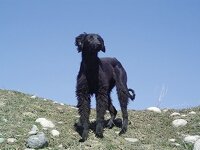
Taigan - the Kyrgyz Borzoi
Apparently, today, (August 26th), is National Dog Day. I have absolutely no idea how National Dog Day came about, but it seems to be an attempt some Americans, (Colleen Paige is listed as the founder of National Dog Day on their website), “to help galvanize the public to recognize the number of dogs that need to be rescued each year, and acknowledges family dogs and dogs that work selflessly each day to save lives, keep us safe and bring comfort.”
It may have started in America, but this year it seems to have gone international with events being planned to commemorate the day in the United Kingdom, Italy, New Zealand, Australia, Spain and Canada. Not in Kyrgyzstan, apparently, but, even so, I thought it an opportune moment to write something about the Taigan.
The Taigan – or Kyrgyz Borzoi – is a rare breed of dog. This breed is embedded in the history of the Kyrgyz people, accompanying the nomadic herdsman and hunters
Although the breed is not officially recognized by the FCI for international showing – there are a number of dedicated breeders and it possible to enter them in competitions in Russia and the Baltic states.
The Borzoi: As the name implies – it is a form of Borzoi. The origin of the Borzoi breed is not known, although it is believed that the breed has existed in Russia since the sixteenth century. It is probably descended from greyhound types and other breeds kept for hunting and herding. The breed name is derived from the Russian words ‘Borzaja Sobaka’ which means ‘a dog as fast as the wind’.
A tall dignified and elegant hound, the Borzoi was used by the Russian royal family and other nobility for it’s speed and power for hunting wolves, hare, sable and fox. Hunting and coursing was carried out until the Revolution in 1917 when all hounds were slaughtered by the Bolsheviks.
Originally working animals, they were to become show champions – and later were prized as loyal and affectionate companion. Although, not always obedient, often wary of strangers, dignified and aloof – the breed values human company and accepts children.
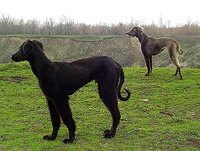
A couple - standing alert
The Taigan: The breed is a part of the group of eastern sight hounds: hunting dogs which rely on their sight to locate prey, combined with a keen sense of smell.
An adult will measure between 50 and 70cms (males: 60 to 70cms – females: 55 to 65 cms.) and weigh between 120and 175kg, (55-80lbs). With a long, thick, (and sometimes wavy) coat and “feathering” on the ears, thighs, tail, shoulder and front legs it strikes in impressive pose. The head is tapered and lean, with large oval eyes, (usually hazel in colour), slanting eyelids and small triangular ears which hang down in a pendant style; a long, narrow muzzle, leading to a black nose. The head is attached to the body by a lean and slightly arched neck. The top-line of the back is level. The chest is deep, but not broad. The back is straight and well arched. The front legs are usually long and muscular and the hind legs are muscular, with stifles and hocks slightly bent. The feet are long, “hare like” and the tail is usually thin, ending in a spiral twist. The usual colouring is White, black or grey – but fawn and spotted dogs are als possible.
The Taigan moves swiftly, (in Kyrgyz the word means “catch up”) is agile, and typically is energetic and “free-spirited”.
It was well suited to hunting in the steppes and mountains which extend throughout Kyrgyzstan, and the Taigan was always highly valued as a hunting dog and companion. However as the need for hunting for food diminished, so too did the need for the Taigan and the breed went into decline. Some estimates put the breed numbers at barely 300 and, unfortunately, decreasing.
Although Taigan are now rarely used for hunting, they are still regarded as precious. In Kyrgyzstan nobody sells a Taigan. They are only presented as gifts to relatives and friends. (President Akaev presented two to the King of Norway on an official visit).



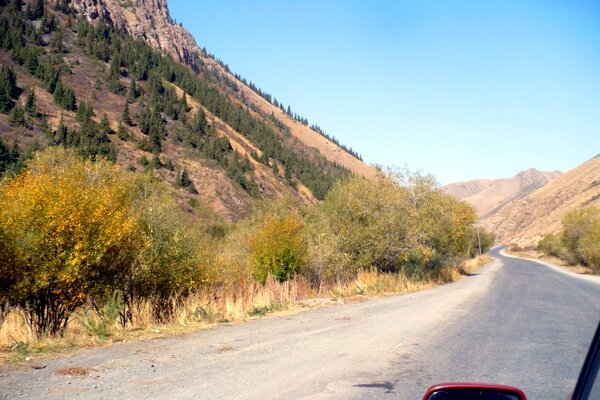


 Bishkek