The Kazakhs
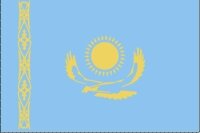
Kazakh flag
President Nazarbaev of Kazakhstan is paying his first official state visit to Kyrgyzstan … and I thought I would take the opportunity to take a brief look at our neighbours.
At five times the size of France and half the size of the USA, there can be no dispute … Kazakhstan is a large country – the second largest in the Commonwealth of Independent States and roughly the equivalent size as that of Western Europe.
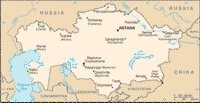
Kazakhstan
It shares borders with the Russian Federation to the north and west, Turkmenistan and Uzbekistan to the southwest, Kyrgyzstan to the south and China to the southeast.
Ninety per cent of the country is made up of steppe grassland, the sand massifs of the Kara Kum and the vast desert of Kizilkum. The mountains of the Tien Shan and the Altai, in the southeast, form a great natural frontier with tens of thousands of lakes and rivers.
International borders pass through the Aral and Caspian Seas and Lake Balkhash is the country’s largest lake.
Archaeological excavations indicate that the south of Kazakhstan was inhabited by man as early as the Palaeolithic Era and tribes were breeding cattle and producing bronze ware by the middle of the second millennium BC. It sits across some of the Northern routes which formed the network of trading routes known as the Silk Road.
In June 1997, the capital was moved from Almaty in the far South of the country to a newly and specially constructed Astana, (which is based on a former Cossack fortress), located 750 miles to the north.
Kazakhstan inherited a nuclear arsenal from the former Soviet Union, (which has been dismantled and shipped to Russia) and the Baikonur Space Center. The country has huge, and largely unexploited, oil and gas fields, which some think may match those of Kuwait in volume.
For this visit, President Nazarbaev was invited by his Kyrgyz counterpart, Almazbek Atambaev, during a his recent state visit to Kazakhstan. Whilst he is here, the Kazakh President will open the “Days of Kazakhstan’s Culture in Kyrgyzstan” that will last for a month and cover “almost all regions of Kyrgyzstan”.
The two countries are seeking to extend bilateral cooperation in such areas as energy, agriculture, transport and communications, mining and processing industries as well as tourism. Cross border trade is already approaching a billion dollars. According to official statistics, Kazakh companies have invested another billion dollars into the Kyrgyz economy since independence and Kazakh Banks and Construction companies, as well as resorts on the shores of Lake Issyk Kul, already play an important role in the Kyrgyz economy … (the portfolio of some Kazakh banks are even more impressie than many of the local banks) … and that role is likely to be even greater as and when Kyrgzstan joins the Customs Union.
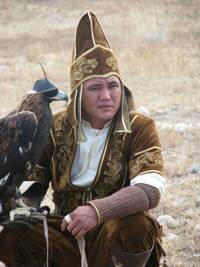
A Kazakh eagle hunter in traditional costume
In the past President Nazarbaev has stated that “Kyrgyzstan is our ally and strategic partner”, that the two countries share good neighbourly and fraternal relations and that, “Kazakhstan supports the course taken by Kyrgyzstan to improve all the political processes taking place in the country”. In support of this statement he cited the donation of considerable funds for projects following the events in Southern Kyrgyzstan in June 2010.
It has to be said, however, that sometimes the good relationships seem to suffer a little stress and strain. The once open border along the course of the Chui river is now marked by barbed wire and tall observation towers; following the events of April 2010, many of the once busy border posts remained closed … some for more than a year; travellers sometimes experience difficulties and lengthy delays on the border; Kyrgyz vehicles are sometimes subject to extensive checks by various authorities; the Kazakhs keep threatening to pull out of the Central Asian Electricity Distribution Network, which would send the other members into a state of chaos; there are problems over the supply of Gas and Coal from Kazakhstan … and so on.
It has to be acknowledged, however, that the Kyrgyz and the Kazakhs are indeed closely related and, as President Nazarbaev commented put it, “Our people are brothers really.” It is true that they share a nomadic culture – but whereas the Kyrgyz wander the mountainous countryside of the Tien Shan, the Kazakh wandered the steppes. Some people say that the name Kazakh means “steppe wanderer” – although other sources suggest a different interpretation: “free warrior”. It has been said that whereas the Kazakhs were nomads that travelled horizontally, the Kyrgyz were nomads that travelled vertically.
To make things a little more coplicated, at one time the Kazakhs were known as the Kyrgyz, and the present day Kyrgyz were known as the Kara-Kyrgyz … which can lead to a great deal of confusion when reading historical accounts.
The Kazakhs trace their origins back to the 15th century, when rebellious tribes broke away from Uzbekistan and settled in the territory of current day Kazakhstan.
Due to their proximity to Russia – and extensive contact with Russians over the years, they are probably the most Russified of all the Central Asian peoples. Most adopt Russian (western style) dress except for special occasions when they wear clothes which appear close to Kyrgyz costume.
The small Kazakh community – about 1% of Kyrgyzstan’s population – lives mostly close to the border with Kazakhstan: in Talas, Kara Balta, Karkara and Karakol. The wider Kazakh community is becoming increasing involved in investing in the Kyrgyz economy.


 Bishkek