Historical Statue at risk
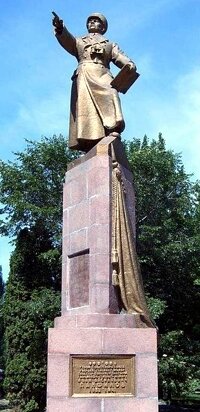
Manuilova's statue of Panfilov in Bishkek
It would be hard to find people of a certain age here in Bishkek who didn’t know the name of Ivan Vasilyevich Panfilov and the story of the heroism and sacrifice shown by him and s7 of his brigade during the defence 0f Moscow in the face of the advancing German armies in November 1941.
According to the official Soviet military history, (or hagiography), on November 14, 1941 at Dubosekovo station near Volokolamsk – a small village outside Moscow – Major General Ivan Vasiliyevich Panfilov and his men hurriedly dug in across the Volokolamsk Highway, near the railway junction. Like they comrades across the entire front, they were determined to halt the advance and, if possible, repulse the invader. It is said that the Political Commissar attached to the unit, Vasiliy Klochkov, urged the men on by saying: “Russia is huge, but there is nowhere to retreat. Moscow is behind us”. The phrase later became a rallying cry for the soldiers of the Red Army.
The unit stood their ground against the advancing German tanks. Some reports say there were 30 tanks – others as many as 50. During a four-hour battle, it was claimed that eighteen German tanks were destroyed. Most of the unit, including the Major General, himself, were killed in the action. According to Soviet tradition, the stand made by Panfilov and his men became one of the Red Army’s epic acts of mass heroism. Almost all died, but they did not let the enemy pass.
Within days the news of the event was known throughout the Soviet Union, mainly thanks to the news reports written by Vasiliy Koroteev in the newspaper Krasnaya Zvezda, (Red Star).
For the record: Not to belittle or discredit the sacrifice of the guardsmen … or the fact that they helped to stop the advance on Moscow, but we now know that the story was not quite as straight forward as generations of Soviet schoolchildren were taught. It turns out that certain of the details were subject to “news management” and hype. It could be that some of these details were lost in the confusion often referred to as the “fog of war” whilst others were clearly intended as elements of propaganda. The number of dissenters who wanted to surrender, for example, was reduced by Korreev from two to one, because “two would-be deserters were too many”. Although one of the articles which appeared in January 1942 claimed to be an account given by one of the guardsmen who lay in hospital dying of his wounds, it appears that six of the “twenty eight” actually survived and surfaced later on.
Panfilov and his guardsmen were honoured in many different ways – villages were renamed in the honour; as were streets, schools and factories. Many different monuments were erected, most notably in Volokolamsk, Moscow and Almaty. In Bishkek, there is both a statue and a bust dedicated to Ivan Vasilyevich.
Seventy years ago, and less than a year after the engagement took place, the statue of the General was erected at the entrance to what is now Panfilov Park, behind the present day White House. The Park used to be called Red Star Park because of the layout of the footpaths laid down by Fetisov in the the nineteenth century, but only a few days after the news of the battle emerged the city councilors decided to rename the park in his honour.
Plans were also put in motion to erect a statue at the gates of the park. It was not only to be the first monument erected to the Panfilov, apparently it was the only wartime monument erected in the whole of the Soviet Union. It was no easy task as, being wartime, all raw materials were required for the war effort. The sculptress Olga Manuilova, working in collaboration with her husband and two other local artists, G. Frihhara and M. Einstein, created the final work out of cement mixed with metal; shavings.
The statue was unveiled in a formal ceremony, at noon on 7th November, 1942, (a public holiday to commemorate the Anniversary of the October Revolution in 1917, when the Soviets came to power), following the traditional parade. It was attended by the general’s widow, Marina Ivanovna with her children, representatives of city workers and soldiers from the local garrison. A band played the Internationale, and a gun salute was fired as the cloth over the statue was removed.
In the seventy years that the statue has stood, suffering the ravages of the weather, (rain, snow, sun and wind), as well as repair work which, apparently, wasn’t always as good as it should have been, caused cracks to appear – and it seems that some details may also have been lost. The concrete pedestal on which the sculpture stands, also shows signs of chips and cracks. A recent newspaper report suggested that the statue was in danger of being irreparably destroyed.
In recent years, however, the Council of the Organization of War Veterans, Labor, Armed Forces and Law Enforcement Officials in Bishkek have been campaigning for the preservation of this unique structure. Having addressed all the of country’s prime ministers, but with limited results. The municipality allocated 50000 soms for repair work, which allowed for a surface restoration. Then, in February, 2012, they wrote to the present Prime Minister, Omurbek Babanov, who instructed the Defence Ministry to take appropriate action.
There has been a campaign to have the monument cast it in bronze. Unfortunately, it is estimated that this will cost one and a half million soms, and the Ministry of Defence pleaded that they didn’t have the necessary funds.


 Bishkek