A country the Brits have never invaded …
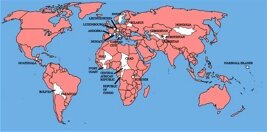
Pink - countries invaded by the British
Back in the 1960’s there was a television series about Invaders from outer space … David Vincent, an architect, accidentally learns of a alien invasion that is already secretly under way and, episode by episode, he travels from place to place attempting to foil the aliens’ various plots and to warn a sceptical populace of the danger.
If Vincent was facing invaders from another world … it seems that much of the earth has already been subject to invasion from one particular group of people …
Back in the 1960’s I was still at school and we had maps of the world which showed countries of the world in a bright array of colours. The colour pink tended to indicate countries that had a connection with Britain – Countries of the commonwealth and the remaining colonies, all that remained of the once extensive British Empire.
Earlier this week I saw another version of the map which was virtually entirely coloured pink … there were just 22 spaces left white – countries apparently never invaded by the British!.
The list of twenty two countries where we have never “invaded” was intriguing:
- Andorra, Belarus, Liechtenstein, Luxembourg, Monaco, Sweden and Vatican City in Europe
- Bolivia, Guatemala, Paraguay in the Americas
- Burundi, Central African Republic, Chad. The Republic of Congo, The Ivory Coast, Mali and Sao Tome and Principe in Africa
- Marshall Islands in the Pacific
- Mongolia, Tajikistan, Uzbekistan …
… oh, yes, … and Kyrgyzstan!
The cover of the book ... featured in a Daily Mail article
The map was in an article reporting a new study contained in a newly published book by Stuart Laycock, the result of two years research: All the Countries We’ve Ever Invaded: And the Few We Never Got Round To.
In some ways, the term “invaded” may be a bit of an exaggeration, a misnomer, in that the criterion for used for colouring a country pink was that Britain was found to have established some military presence in the country – albeit brief and transitory – either by force, threat or negotiation … or in return for payment … and also incursions by “individuals”, (pirates, privateers or armed explorers), who, whilst they were not official representatives of the country, were acting with the approval and connivance of the British government.
As an aside: I am not sure, however, how “military presence” was defined … because there has been a British presence here in Kyrgyzstan … as part of training missions.
According to the report, Stuart Laycock says that he was “absolutely staggered” when he finally completed the list. He is not even certain that it is complete … for example, he thinks that there might well have been an incursion in Mongolia although he could not find specific evidence to place the British military mission any closer than 50 miles from the border.
The two main articles that I saw were basically the same and seem to be have been based on a press release, but the comments on them and in different “internet forums” provided some interesting reading and although many of them were flippant or looked at invasions of Britain over the years … others raised many interesting points. When, for example, were Kazakhstan and Turkmenistan “invaded”?
During the First World War, there were small forces based in the Transcaucasus and Central Asia; such as the British troops that were stationed in Tbilisi and Dunsterforce at the Battle for Baku on the Caspian Sea, attempting to defend the strategically important oil wells of Azerbaijan from the approaching Turkish forces … and small parties of troops in Turkmenistan – who were most notably blamed for the fate of the 26 Baku Commissars. According to Soviet accounts, the British were fairly active in trying to stir up anti Bolshevik sentiment – and there is more than just a grain of truth in this given the accounts of Bailey (for example in his Mission to Tashkent) and others … although I am not so sure about the claims of support given to the Basmachi. The troops under Teague-Jones were active in Turkmenistan … and Lieutenant Colonel Redl had instructions to cross the border and destroy the strategically important Trans Caspian Railway in the event that it might fall into German or Turkish hands … the terminus at Krasnovodsk was still well and truly in Turkmentistan … so I have to admit that I am, therefore, somewhat confused about Kazakhstan … and there is that reference to being fifty miles from the Mongolian border … but I presume he has some results from his research to back up these claims … and I’ll obviously have to see if I can hold of a copy of his book to find out exactly what incidents he is referring to.
In terms of Kyrgyzstan … apart from the British troops being involved in training missions, I am fairly sure that Laycock is right that there hasn’t been any deployment here in Kyrgyzstan, not even at the Manas Transit Centre – even when it was the Ganci Base as was home to coalition forces from Australia, Denmark, France, Italy, New Zealand, Norway, South Korea, Spain, the Netherlands, Romania, as well as the United States.
Perhaps the closest we can claim to a British “military” presence would the exploits of people like Bailey or the two British emissaries who found themselves being entertained by Kurmandjan Datka in December 1885. There is an account of the encounter in the book, “Tsarina of the Mountains Kurmanjan and her times“. The account gives very little details of the encounter although it does give their names as Mullah Abdul Madjid and Lodja Akhmed Khan, (who is also referred to as Sir Arthur). It also states that Madjid had a beard and Sir Arthur a moustache and that they were on a mission to the Emir of Bukhara.
During the audience with the Queen of the Alai, they go into a huddle and, after their consultations with each other, decided to come clean that they were emissaries of another Great Queen, over the Sea, who would be willing to enter into an alliance with her. Kurtmandjan Datka replied that she had heard of India and Queen Victoria, was flattered by and thanked the emissaries for their felicitations and goodwill … but Uncle Nicholas, (The Tsar), was closer.
To be honest, I don’t think have seen the story anywhere else … although the text does add that “the English agent, mullah Abdul Madjid, published a report on their trip to Kokand.” (sic – Yes, Kokand) on his return to Calcutta and that in it “he described their reception by Kurmanjan-datka”.
Now, I don’t suppose that this encounter can be counted as “an invasion” but I can’t help speculating that although she almost certainly made the right decision at that time … Britain was experiencing more than enough problems in Afghanistan and even in protecting her interests in Kashgar … if Kurmandjan Datka had accepted the emissaries’ offer … then who can tell how the history of this part of the world might have panned out – and maybe that list of countries that the Brits have never invaded would have been even shorter.





 Bishkek