Dandelion and Burdock
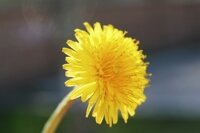
The Bright yellow Dandelion flower
Over the years I have often been asked about cultural differences that I have noticed between life in Britain and here in Kyrgyzstan. It is one of a bank of questions that people ask: How long have I been here?, What brought me here in the first place?, What kept me here? – Why did I stay?, What do I miss from the UK?, What changes have I seen over the years? … and so on.
Sometimes, being asked the same questions over and over again, I try to “ring the changes” and think of new and different answers, and the mischievous part of me tries to think of unusual angles. So, the other day, in answer to the usual question I was pleased when I managed to draw perplexed looks when I replied “Dandelion and Burdock”
Dandelion is the common name given to the Taraxacum family of flowering plants, (strictly speaking it’s a genus of the Asteraceae. family), which are found as worldwide. The name is derived from the French dent-de-lion, (meaning “lion’s tooth”).
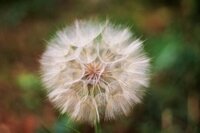
A Dandelion "clock"
In the West we treat them as weeds, that is an plant growing where it is neither valued nor wanted and often considered a nuisance. Back in the UK we used to loathe these plants. The distinctive flat crenelated green leaves would sprout erupt from our lawns, sprouting the hollow tubular stems that seeped a milky white fluid and topped with the bright yellow flowers. These flower heads would mature into spherical “clocks” which contain many single-seeded fruits called achenes, each of which is attached to a pappus of fine hairs, which are dispersed by the wind over long distances. It was a childhood game to take one in hand and see how many times one had to blow to clear the stem of all the seeds.
We would try to eliminate the weeds from the lawn – but no matter how hard you tried you always seemed to be fighting a loosing battle. If you tried to dig them out, then if you left the tiniest sliver of a root in the ground then new growth would erupt. You could buy special weed killer to pour on the leaves which would eat away at the stem and down into the roots – but the gardeners that I knew thought that this “cure” was almost as bad as the “illness” itself.
Here, on the other hand, Podsnezhniki, as it is known locally, is welcomed. I remember the shock I felt when I saw it carpeting the flower beds in the main square and around the main government buildings. It is grows everywhere without any special planting or care, and it thought of as a beautiful plant providing bright displays, in much the same way as the rampant and uncontrollable Gorse on the hillsides of my youth is a treasured decorative shrud surroung government buildings in Canberra, (Australia).
As it happens, Dandelion is a plant with many beneficial properties. It’s deep reaching tap root will bring up many nutrients to the benefit of shallower rooting plants; it adds minerals and nitrogen to the soil; it attracts many pollinating insects and it is even known to give of gasses which aid fruits to ripen. The plant is edible, (although it might induce allergic reactions in some people), and has many culinary uses, rich in some vitamins, (A, C and K), and minerals, (such as calcium potassium, iron and manganese). Although the leaves may be bitter they are sometimes used in salads and the roasted roots are used to create a “caffeine free” coffee. It has been used over the centuries as a folk, herbal medicine.
It is also one of the main ingredients in Dandelion and Burdock, a traditional soft drink which has been made in Britain from medieval times and is one of the bases for root beer. I well remember buying bottles of “pop” – Vimto, Orangade, (the Fanta or Miranda of my youth), Lemonade, (which is nothing like the lemonade which is available here, but closer to the present day Sprite or 7-Up), and Dandelion and Burdock.
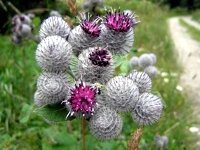
Burdock Thistle
Which brings me to the second ingredient – Burdock, a Thistle. The prickly heads, (burrs), open out with bright mauve flower,. They are caught easily onto clothing and fur, (and, as such, were the original inspiration for velcro), which was important for seed dispersal.
Like the Dandelion the plant is edible, although the roots resemble that of Deadly Nightshade so some caution is needed. The roots can be used as a vegetable and immature stalks resemble artichoke.
As with Dandelion, it has a place in traditional medicine and herbalists prize it as a diuretic and for use in treating burns.
The Thistle is, of course, the national flower of Scotland, but it grows here as well. It is sometimes found in the city but it doesn’t really adapt well to city life, and Chertopolokh, (as it is known here), thrives better in some of the alpine valleys such as Issyk Ata. I am sure, however, that it and where it does grow in the city it wouldn’t meet the same fate as that met by a Thistle growing in my garden in London. One summers day an Australian visitor was looking around and admiring the results of my handiwork and offered to help. Little did I suspect what was to happen when I accepted the offer, but when he came to the Thistle, so ingrained was the view that it was a weed that, without thinking, he simply grabbed hold of it and pulled …
Here, although there is a growing trend to try cultivate pristine show gardens, fortunately it is still in its infancy and the overall tendency is to allow plants to grow, blossom and beautify the urban landscape in a “natural” patchwork rather than a contrived planned and perfectly executed plan, where the grass has been “combed” so that there isn’t a blade out of place.




 Bishkek
This made me laugh. You managed to find a totally plausible transition to talk an entire article about a subject that is not really Kyrgyzstan translated
I enjoyed the article anyway.
Thanks, Richard – I am glad if I made you laugh and that you enjoyed the postcard.
I am not sure that I agree with you when you say that he post was not really related to Kyrgyzstan. The whole point behind the post was the different attitudes towards these two plants, between the Kyrgyz and the English – what they Kyrgyz value as a beautiful flower and celebrate as an example of biodiversity, we see as a nuisance and a pest – even if they do have some benefits.