A slip of the pen
Andrei likes to joke that he’s English … and these days I respond that he is “so infatuated with England that he is mimicking the Queen of England by having two birthdays – a “real” one and an “official” birthday” … and it’s all down to a slip of the pen on his passport.
As a foreigner, I am expected to carry my passport – or a document which confirms my identity – with me at all times, even when there isn’t a “passport regime” – which is when it is required that absolutely everyone carries an identity document with them.
This can be very frustrating – but the threat of being arrested, albeit a rare occurrence, is actually very real. Once I had to deal with a case where a friend, who happened to be an Indian citizen, was detained because he was only carrying a photocopy of his passport – “that’s not a document,” one of the police officers screamed at him, “it’s a piece of paper!”
On another occasion, I remember the chill that shuddered down my spine when walking across the main Ala Too square with a pair of Englishmen to visit the British Honorary Consul in order to report the loss of their passports, and I heard a policeman call to us: “Grazhdan!“, Citizen! I knew instantly that he wanted to see our passports, and although we could explain why they didn’t have their precious documents with them, I envisaged hours of waiting in interview rooms whilst they went through the somewhat complicated story … I reached for my passport and opened a conversation in “passable” Russian, and, fortunately, they seemed happy with that.
Although I understand that there is a need to make some distinctions between Kyrgyz citizens and foreigners in the country either as visitors or residents. personally, I think there’s a contradiction here with the basic principle that everyone is equal before the law – and shouldn’t be discriminated against on grounds of nationality, sex, religion, etc. I wouldn’t mind if everyone was required to carry an identification document, or if it was simply recommended that foreigners carry one … but that’s another matter.
There is a “joke” or saying that a man without a passport is just that, a muschina - a man, but a man with a passport is a “chelovek” – a person. The implication is that the first is just a body whereas the second has rights and priviledges … oh, yes, and also duties and responsibilities.
Here you need to produce your passport at all sorts of times, on all sorts of occasions. When getting married, for example – well, that’s understandable … but it’s necessary whenever you sign a contract of any sort. You even have to produce it in order to receive to a VAT invoice.
It will be clear, then, that a passport is a vital document. Everyone has one from the age of 16 … it is the main form of identification.
It is not like in the United States where a passport is mainly a travel document used for international travel and less half of the population has one and where there Social Security Card or a Driver’s License is the main proof of identity used by people. It is like that back in the United Kingdom as well, or at least it was some seventeen years ago when I last lived there. When we needed to prove our identity, for example when signing contracts, then we could produce a Birth Certificate, a Driving License, bank statements or utility bills addresses to us at our home address. A passport is a useful document, but usually there are other documents, or pieces of paper that will suffice just as well.
When the first passports were introduced to replace the old Soviet Union documents, they were filled in by hand with separate pages for use within the country – the “Internal” passport – and a “Granpassport” page for use when it was being used for international travel. The passport includes a stamp for registration where the owner lives, notes as if the holder is married or has children … as well as social security registration.
Later, new design was introduced with the “Internal” passport replaced by a credit card style plastic card and a separate booklet style document for the Granpassport.
Now, over the years there has been quite a lot of controversy about Kyrgyz Passports … poor printing, the fact that it is outsourced to a private company … and spelling mistakes.
That last one is all the more surprising bearing in mind that a great importance attached to getting things right on forms, applications, and so on. There are often specimens of completed forms or standard letters displayed on the notice boards that line the walls of various government offices – all with the prescription that they have to be completed “byez osheebok” – “without mistakes”. One mistake and you have to rewrite the whole lot on a new form. Normally, “tip-ex”, (or correcting fluid), is not accepted.
Recently, our accountant went to hand in a tax report. Fortunately, before she got to the front of the queue, she was looking at the form and discovered a small mistake … the form was in triplicate – that means there were three copies, but it wasn’t NCR (“no carbon required”) paper so there were three separate copies, all written out by hand, and she saw that they had different figures on them. There was only one figure different … when she was copying the information from the first copy onto the second, she had missed out one digit … and then copied the incorrect figure onto the third copy. It seems to me that it should be easy enough to correct, but no … she had to return to the office and re-write the two “spoiled” forms.
As it happens I know several people who have discovered mistakes on their passports … in one case two brothers had their passports returned – each with different surnames … or, at least, the surnames were spelled differently. Another involved a Kyrgyz woman who married a foreigner, and when she had a new passport issued, her new, (foreign), surname was spelled completely wrong.
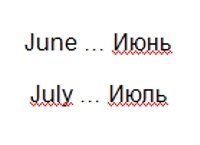
One letter difference
In Andrei’s case, however, the problem wasn’t with his surname … but with the Date of Birth. He was born on 18th July, but the passport says 18th June … in Russian, there is just one letter different in the names of the two months. To be fair … the clerk issuing the passport did not make the mistake … it was already there on the birth certificate but had gone unnoticed … until last week, that is. Someone was looking at the document and, in a throwaway line, wished him a “Happy Birthday” for Monday … “What do you mean?”, he asked, “it’s not until next month …”
It was only then that, on a close inspection, that the error – a difference in just a single letter – was discovered.
I’m not sure what we can do about it now … but in the meantime Andrei has the benefit of enjoying two birthdays a year.
So, “Happy Birthday, Andrei!”


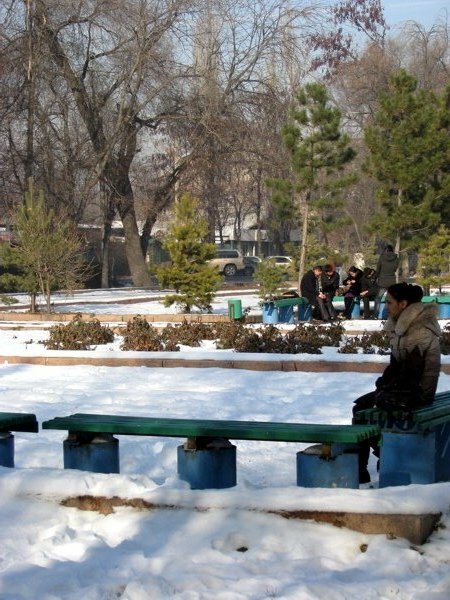


 Bishkek