Horse meat.
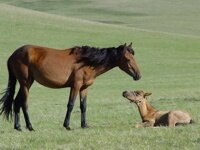
Horses in the Jailoo
When there a budget crisis in the United States last winter, part of the package deal agreed to help keep the government afloat whilst the politicians wrangled over a more comprehensive and lasting deal involved lifting a five year old ban on funding slaghterhouse inspections. Oh, not any such inspections … just those which involved the slaughter of horses for human consumption. As a result, horse meat was likely to find itself reappearing on butchers’ slabs and dining room plates across the States.
Despite the fact that some pundits suggested that slaughterhouses could start producing horsemeat steaks within a month, I doubt that it was going to be a particularly popular move and my first impressions when I saw the news was something like, “how esoteric, how quixotic”.
I knew, for example, that in America, (as in most of the English speaking world), horse meat has never been particularly popular as a form of meat and was rarely consumed. It could well be that the English, (in particular), have a special affection for their horses which discourages them from eating them, and some people seem to associate this with identifying them as the equivalent “pets” in the same way as we would object to eating dog or cat meat. Personally, however,I think it is more to do with the fact that the horse is bred for “work” rather than for food. Otherwise it is hard to see why they don’t have the same objection when it comes eating the flesh of other animals, (such as cows, sheep, pigs and hens). Interestingly, whereas we have several words to describe meat from cows, (beef, veal), sheep, (mutton, lamb) or pigs, (pork, bacon, gammon, ham), we don’t have any such words for meat from horses.
Is seems as in America the objection to eating horse meat seems to be mainly emotional, although the arguments advanced seem to concern mainly the conditions in which the animals are slaughtered, (animal welfare), hygiene and drug control.
As it happens, horse meat was consumed in some parts of Britain well into the twentieth century, but it was always seen as a cheap meat or as being prescribed for “health” reasons. In other parts of Europe they have not always been so reticent about the meat. One of the objections which apparently kept many of the Scandinavians from adopting Christianity was that the Catholic church required them to give up the delicacy. In Germany, Italy, and France, horse meat has often consumed – and is still consumed, albeit though the volume of consumption seems t be declining.

Chevaline - the French specialist Horse Butcher
I first came across hose meat many years ago, when I was school teacher and accompanying a school trip to France. We had a minor crisis on one occasion when we discovered that the rather delicious goulash that we had just been served was, in fact, made from horse meat … well, that was the rumour that went round amongst the children The trouble was that, during the day we had been walking around the town and seen the local Chevaline, the specialist horse butcher’s shop, and as a result when the rather tasty but “stew” was placed before the children their minds went into overdrive and nothing the Chef or we could say could would persuade them otherwise … “Well, you would say that, wouldn’t you?” was the only response we got when we and the Chef tried to deny the accusation. (The Chef was adamant in maintaining that he was well aware that the English didn’t eat horse meat and wouldn’t have dreamed of serving it … but, who can say for certain?)
It is often said that horse meat is a feature of the Kyrgyz diet. The Wikipedia article on Kyrgyz Cuisine, for example, states: “Among the most popular meat dishes are horse-meat sausages, roasted sheep’s liver, beshbarmak, which is a dish containing boiled meat with thin noodles, and various other delicacies made from horse meat.” There may some truth in this, but horse meat is actually quite expensive and so is reserved for special occasions – such as weddings and funerals.
Kyrgyzstan is apparently in fifth place when it comes to the production of horse meat with 25000 tons produced in 2009, behind Mexico, (78,000), Argentina, (57,000), Kazakhstan, (55,000) and Mong0lia, (38000) … and, surprisingly, just ahead of Australia (with 24,000). According to the Food and Agriculture Organization’s statistics, the amount of land utilised in rearing horses has almost doubled since independence
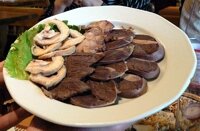
A platter of horse meat served at a restaurant . The horse meat was served cold. There are three types on the platter: tripe on the left, roasted in the middle, and sausage on the right. The roasted meat tasted no different than roast beef.
One of the favourite delicacies made from horse meat is Chuk chuk – or Kazy – a form of sausage.
Chuk chuk:
Ingredients for preparing two chuk chuks: 1 kg meat taken from horse ribs, 2 pieces of small intestine, according to taste: salt, black pepper, garlic.
The meat taken from the horse ribs is cut into thin pieces 30 cm long – salted, and peppered. After that garlic is added to the meat – (garlic grown in shallow soil is preferred). This meat should stand for twenty-four hours. It is then put into the small intestine; both ends are tied – like a sausage, and then joined together. The chouchouk is then boiled in water over a small fire for two hours. While boiling, the chuk chuk should be pricked to let out any air trapped inside. This will stop the chuk chuk from splitting.



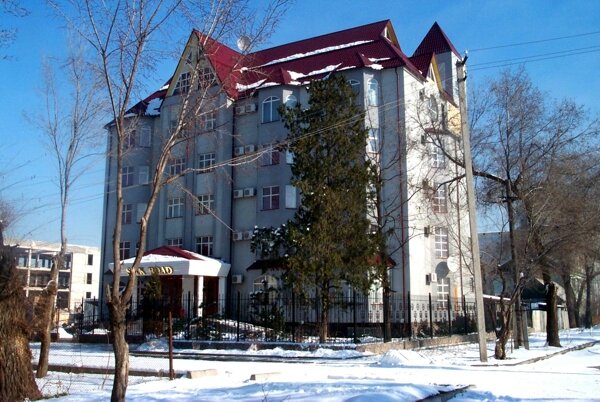


 Bishkek