The Mynah Bird
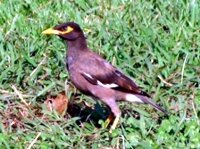
The Common Mynah, (Acridotheres tristis)
The other day I came across a page on a blog that I often visit which, for some reason, I had never seen before. The blog is written by an American who seems to be based in Tokmok, and this page was about Birds she had seen whilst here. On it, she says: “The best part about seeing new birds here is finding out they’re birds I’ve read about, but never seen before, like mynahs, hoopoes, and rooks.”
That surprised me bit as back in the UK, rooks are fairly common. On the other hand, I had to admit to myself that the other two, at least, sounded more exotic.
I am not quite sure when and where I first came across the phrase “Mynah Bird”. I have racked my brains and can’t help thinking that there is some literary or musical connections, but I can’t place it. When I went to see the photograph that she had posted I realized straight away that I do know when I first came across a Mynah Bird itself – it was here in Kyrgyzstan.
It is hard to miss … with it’s distinctive colouring. The feathers of the main body are chocolate brown, but the head, neck, wings and tail are black, with white patches along the wings and tail … and yellow around the beak and the eyes.
A member of the Starling family, the bird is actually quite common here and the Acridotheres tristis is called, (in both English and Russian), the Common Mynah – although it is also called the Indian Mynah giving away its apparent origins in Southern Asia.
Although it originally seems to have been a woodland species, it has adapted well to urban environments and so can be found in both urban settlements and rural fields. They are often to be seen in pairs, and are usually very territorial.
Indeed, just before I came inside to write this postcard, I stood and watched a pair gamboling and playing in the yard behind my apartment building.
If the cats are around then the birds may well flutter, screeching, from branch to branch in order to try and distract the feline threats from their nests which contain their fledgling young. Although Mynah birds are sometimes kept as song birds, their calls includes croaks, squawks, chirps, clicks and whistles, and it screeches warnings to its mate or other birds in cases of predators in proximity or when its about to take off flying.
Before sleeping in communal roosts, Mynas may congregate around sunset and “sing” in unison, (it is referred to as “communal noise”), and birds will often fluff their feathers and bob their heads whilst singing.
Mynah birds can often be seen walking along the ground, (with occasional hops), as they forage for food, especially grasshoppers, which is where the generic Latin name, Acridotheres, comes from; it which means “grasshopper hunter”. On the other hand, the Common Mynah is, like other starlings, omnivorous and it will feed on all sorts of insects, spiders, crustaceans, reptiles, small mammals, seeds, grain, fruits and even discarded waste left by humans.
Although originating in Central and Southern Asia, the Mynah bird has been introduced into many new environments and has been so successful in adapting to tits new homes that the International Union for the Conservation of Nature, (IUCN), have declared it as one of only three birds and the third most invasive species, (introduced species which have a detrimental impact on the native wildlife and environment), in its list of 100 worst invasive species, (sometimes posing a threat to native birds; sometimes decimating the population of pollinating insects and sometimes contributing to the spread of weeds). It can be seen as such a threat that there are campaigns, (for example: here and here), for controlling them as pests.


 Bishkek