Balykchi – Gateway to Issyk Kul
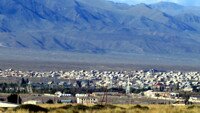
Balykchi
Situated at the extreme Western end of Lake Issyk Kul, Balykchi is one of the three major towns in the Issyk Kul region.
The town has, over the years, had several different names: Kutmaldy, Ribachiye, Issuk Kul and Balykchi.
Once known as Kutmaldy, if was renamed Riybachiye by the Russians – after the fishing industry that was based here, (Ryba is Russian for fish). There is a story that a Russian soldier serving in the region fell in love with the area and decided to retire here. He had so much success fishing from his home made boat that many local people came to settle nearby, followed his example and took up fishing the waters of the lake. When he died, it is said that the town that had grown up around his hut was named in his honour: Riybachie - “The Fisherman”.
After independence the town was renamed Issyk Kul – but this caused confusion and the name was finally changed in 1992 to Balykchi (which is the Kyrgyz equivalent of Riybachiye – balyk is Kyrgyz for fish). It is mainly important now as a terminus for the railroad from Bishkek and junction of the road to China and those going along the Northern and Southern shores.
There is a Historical and Folklore museum in the town, with 6 rooms – one with photographs, newspaper cuttings etc. associated with the Manas epos; another documenting the history of the town; a third dedicated to the steamship line which operated out of Balykchy, with another based around the railway; one depicting important people from the town’s history and finally – an art gallery. It is housed in what used to be the House of Culture, built in 1953 – and the museum, itself, opened in 1998.
There is a statue of Pyetor Semyenov (Tianshansky) on the outskirts of town, on the road from Bishkek. Set back from the road, on a small hillock, the 3.6 m. tall statue depicts him leading a packhorse. It was erected in 1982. Nearby are 4 stone sculptures dating from the sixth to the ninth centuries – thought to be gravestones and “portraits” of the dead people whose graves they marked.
There is a bronze bust of Sayakat Karalaev on a granite plinth. He was one of the greatest Manaschi of the twentieth Century, born in 1894 on the southern shore of Lake Issyk Kul. He began learning the epic in 1918 and began performing in 1925 – and he was awarded the honorary title National Artist of the Kyrgyz Republic in 1939. He died in 1971.
On the right hand side of the main road to Cholpon Ata is a memorial to the dead of the Second World War – comprising of two figures on a small plinth – a woman holding to herself a small boy – erected in 1975. On the street “40 years of the Kyrgyz SSR” is another war memorial, this time to the fallen in the Afghan war. This takes the form of a T-54 tank on a ramp made out of red granite – and there is a small wall containing the names of the fallen soldiers. It is the only monument to the fallen in this war to be found in the Issyk Kul oblast. On the left hand side of the road to Cholpon Ata lies a third memorial – this time to the fallen in the Batken conflict with Islamic militants of 1998 – comprising an “eternal flame” and soldiers helmet and with a tablet containing the names of the fallen soldiers. Once again, it is the only memorial to the fallen in this conflict in the Issyk Kul oblast.
On the road to Naryn, about 9 km out of town, archaeologists have unearthed the remains of Sara Bulun. In 1977, archaeologists discovered an ancient settlement (dating from between the tenth and twelfth centuries) including an “ore yard” indicating ancient metal working was carried out in the area.
To the South there is evidence of a Stone age settlement, at Boz Barmak.



 Bishkek