Koreans in Kyrgyzstan
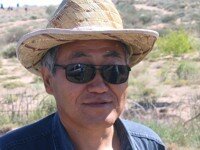
An ethnic Korean in Kyrgyzstan
The Week of Korean Culture here in Bishkek came to an end yesterday. It was organized to commemorate 20 years of establishing diplomatic relations and, as well as the official opening ceremony without which no official festival would be complete, there was a seminar, concerts and degustations of Korean cuisine.
Although I had put it in the diary and fully intended to go to some of the events, I have to confess that things cropped up, and I never actually made it. By all accounts, it was my loss and I hope that I won’t have to wait another 20 years before another such festival is organized.
The Koreans, (or Koryo-saram, as they sometimes refer to themselves – a term that may refer to figures from a particular historical period), can be traced back to the Koreans who lived in the Russian Far East in the late nineteenth century. Migration from the peninsular seems to have started in the 1860′s as a result of the decline of the ruling Korean dynasty, and seems to have grown somewhat rapidly. (In the five years between 18978 and 1902, the number iof Korean speakers registered rose from just over 26,000 to over 310,000.
In the opening years of the new century, but the Russian Empire and Korea found themselves in conflict with Imperial Japan. The Russo-Japanese War was not good for the Russians … the Japanese defeating two Russian fleets and sending shock waves through Europe as an Asian power defeated, or rather humiliated, a Europe one. Following the war, Russia enacted an anti Korean legislation at the behest of Japan. Land was confiscated and labourers “laid off”.
Despite this, many Korean nationalists and communists migrated, (fled, escaped), to Siberia. Following the October Revolution, Soviet Koreans organized themselves into armed units in order to oppose the Japanese
It is said that the first Korean to migrate to Kyrgyzstan was a young woman call Pak, who arrived in 1935. She was not alone for long.
For the record: She died in 1975 – aged 96 – in a small village in the Alamedin rayon, near Bishkek.
In 1937, the Stalinist regime, fearing that the Korean community might form a “fifth column” in support of the Japanese who were then occupying Manchuria and Korea just across the Soviet Union’s far eastern borders, ordered a mass deportation of all 36442 families from Sakhalin, Vladivostok and the Russian Far East to Central Asia – a total of 171781 people.
The journey was harsh. No one really knows how many people died in transit, or in their new home. To make matters worse, members of the Korean Communist Party were amongst the first to suffer under the Stalinist repressions – being liquidated.
In 1959 there were only 3346 living in Kyrgyzstan. By 1994, this figure had risen six fold, and now it is estimated that there are over 20000 ethnic Koreans in the country.
At first life was not easy. Koreans were forbidden, for example, to enter University. Things apparently got easier for the community in the 1950′s – following the death of Stalin.
They established social structures: cultural clubs, schools, clinics and even a Korean language newspaper. However, many of the young people have “forgotten” their mother tongue and, nowadays, most cannot speak or read it – only Russian. (That doesn’t detract from their identification as, and pride in being Korean.)
As conditions improved and new opportunities opened up, members of the community assimilated into society in their new homeland and young Koreans, in particular, were “economically active”, often being promoted to management positions.
Most of the Koreans (just over half of them) live in Bishkek. Another 20% live in the northern Chui and Issyk Kul oblasts, with just over 10% in the southern Osh and Djalal Abad oblasts. Most of them live in the towns – however, about three quarters of the community are commonly involved in agriculture and in many places the markets stalls are dominated by Koreans.
The Koryo-saram have preserved Korean cuisine particularly well, with several Korean restaurants being established in Bishkek and ingredients and spices available in markets. The cuisine of the Koryo-saram is supposed to be closest to that of the Hamgyong provinces in North Korea, and is dominated by meat soups and salty side dishes, (including, somewhat controversially, bosintang – dog-meat soup – which is traditionally served to honored guests).
There is a Korean Community Center in Bishkek – with its own hotel. Korean language lessons are run and as well as many ethnic Koreans eager to lean about their cultural heritage, about half of the students are “interested locals”.
There is also an evangelical Christian Church which has a strong presence amongst Bishkek’s Korean Community.
There is some interest from Korean businessmen interested in investing in Kyrgyzstan … mainly in agricultural projects, but not exclusively.


 Bishkek