Obstacles to doing business
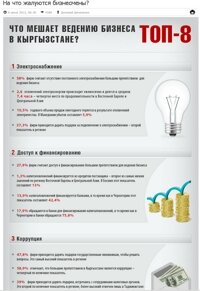
The infographic
Recently, the country’s most popular newspaper, Vecherniye Bishkek, (Evening Bishkek), published an interesting infographic under the headline “What do businessmen complain about?”.
Although it was called an Infographic, I am not sure to what extent it really qualified as such.
Let me explain: An infographic presents information in a visual representation, rather than in words or symbols. The idea is to encapsulate and communicate complex ideas in a simple format which can be easily grasped and understood. This particular example, however, was really just a list of statistics presented with a graphic to illustrate each of the individual eight points.
Having said that, it was a very interesting article … and I think it is worth drawing attention to it.
The value of images should not be underestimated. The Nuffield Maths Project used to have as its motto an old Chinese proverb: “I hear and I forget, I see and I remember, I do and I understand”. There seems to be some intuitive truth behind this maxim. Although some people have very good verbal skills and can remember intricate details of conversations in which they have been involved, or even simply overheard, for most people the visual image tends to stay with us. The image also goes a long way towards convincing us, after all there is another adage that “Seeing is believing”.
As an aside: back in the 1960’s there was a research study done where people were presented with three versions of scientific concept and asked to indicate with which they felt more comfortable and more convincing. Take for example, Pythagoras’ Theorem. Presented with the three versions:
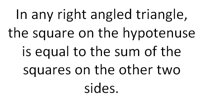 The theorem in words …
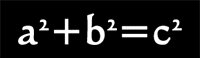
... and as symbols

... as a graphic ...
Most people felt at home with the graphic, some people preferred the comfort of the phrase they had learned parrot fashion and only a few people – Mathematicians felt at ease with the symbols.
Anyway, as I said, this particular example was really just a list of statistics presented with a graphic to illustrate each of the individual eight points. Under the title, “What inhibits business in Kyrgyzstan?”, and a heading “The Top 8”, was the list of concerns which according to the credit at the bottom, came from information supplied by the World Bank. Unfortunately, there was no other information, for example about the survey which revealed these concerns, (and apparently covered several countries in the region), or what other concerns might have been raised.
Also, although each of the eight issues was numbered implying that they had been placed in some form of rank order, it was not clear to me the criterion on which this was based. Bottom of the list, for example, in eighth place was Transport with 31% of firms in the survey considering it to be a big problem whilst in seventh place was Licensing and different types of permits, but only 26% of respondents reported that they gave “gifts” in order to receive a permission, especially when it came to imports.
It would have been nice to see a bit more of the justification for the inclusion of each item on the list, although there weren’t many surprises. The issues are all fairly general and crop up in other surveys, such as the Investment Survey conducted by the International Business Council, (IBC).

No. 1: Electricity supply
At the top of the list was concern over electricity supply with 58% of respondents considering that unreliability of supply was a major obstacle that they faced in trying to conduct their business. This surprised me a little, but I can see the point. We have been fairly lucky in our office in that although we have experienced power cuts, there haven’t been that many of them, and only a relatively few have occurred during the working day or lasted long enough to require us to close the office.
When I first came here seventeen years ago, the power supply was a major problem, so nothing much has changed in that respect, although there has been a difference in the nature of the problem. Back then, the problem was usually one of variations in voltage with the occasional failure of some part of the system leading to a power cut. In recent years the variations in voltage levels, although they still exist, seem to be less marked but other forms of disruption to the regularity of supply have become almost institutionalized, with planned rolling power cuts, and system failures.
If we have suffered relatively little disruption, there have been considerable problems faced in some areas, and the survey reported that on average firms experience about 3 power cuts each month losing almost seven and a half hours. Those are average figures, so if we have been fortunate in having fewer power outages, there are firms which have suffered far more. It’s been estimated that over 10% of production has been lost as a result of the unreliability of power supply. I remember how one manufacturer, (a well known soft drinks manufacturer), complained that the rolling power cuts was doing irreparable harm to the country’s economy and I don’t think it was a just case of “special pleading”.
Interestingly, and ironically, one of the considerations that is often quoted as being attractive for potential investors is the availability of low cost energy.

No.2 : Access to Finance
In second place was access to finance. This was cited by almost 28% of the firms surveyed. Apparently just over one percent of all the financial capital in the economy involves credit finance, and only about 14% of the capital investment in the country is provided by the banks.
Although one might want to praise businesses for keeping within their capabilities and resources, that’s pretty low, (amongst the lowest in the region), and hinders development of new business and the introduction of improvements and modernization.
It’s not that businessmen don’t want to take credit, almost 20% of the firms in the survey said that they consulted banks, asking for information or applying for credit, but that’s actually quite a low proportion when compared to other countries.
There are all sorts of reasons why this situation might exist. Until recently the banking system was mainly used for transactions and there was very little work in the field of credit management. Interest rates tend to be high, for all sorts of reasons – not just profit. The term of a loan was often quite short, partly because the tax system seemed to encourage this. Many of the businesses in Kyrgyzstan didn’t have the collateral to offer to guarantee a loan. As it happens, many of the credits implemented in Kyrgyzstan have actually been quite small – too small for some of the banks, and this has led to the rise in Microcredit organizations, (although these are not always able to meet the demand of the marketplace).
Alternative methods of financing have been explored: in particular leasing and the Islamic system of banking; but with different levels of success when if comes to implementation.

No. 3 : Corruption (For the record: Vzyatka = Bribe)
I had expected the next issue to feature higher than the previous two; in third place, rated by almost 60% of the respondents as an obstacle to doing business, was the issue of Corruption.
Just under half of those in the survey confirmed that the gave “gifts” to government employees in order to resolve problems.
Everyone seems to take it for granted that corruption is endemic in Kyrgyzstan, (and that’s not just a question of Vzyatki, or bribes, but all forms of abuse of power such as nepotism or taking decisions that favour one party at the expense of another).
It’s interesting to note that the major global survey about corruption by Transparency International is called the Corruption Perception Index. By its very nature, it is almost impossible to garner concrete and reliable information about corruption and so the measurable statistic is the perceived level of corruption. As I said, it is almost taken for granted that corruption is endemic and a way of life here.
It is possible, however, to survive and do business without submitting to corruption. It may not be easy, but it is possible. In fact, I think that there is a growing impatience with corruption with the authorities making “lots of noise” about it and introducing measures to combat it. Perhaps more importantly, ordinary people seem to be making a stand and showing that they feel offended at “being used” in this way.

No. 4: Tax Policy and Administration
The next issue was that of the tax system, (policy and administration). About a third of the forms considered that the administration of the tax system caused problems for the conduct of business and almost a half considered that tax rates were a problem.
This is something that I find confusing as. Let’s face it, nobody likes paying taxes so any tax rate, no matter how low, is going to be perceived as a problem. The alternative, however, of no taxes, and therefore no government services, is a recipe for anarchy which is not something that businesses would welcome. People often say that “the government should do something”, but in order to do so it must receive some revenue in the form of taxes.
How the government raises that revenue, however, is another issue. It seems to me that the system is complex – almost too complex to be efficient and appears as if it is designed to create areas of ambiguity and difficulty – thus creating the potential for corruption.
A former Prime Minister offered businessmen the advice: “Pay your taxes and sleep soundly!” If only! We try to be scrupulous about our tax affairs, but this doesn’t stop us facing and fending off inspectors intent on finding fault and applying an ingenuity which has to be admired for its creativity – even if, at the same time, it has to be deplored for it erroneous logic.
Nowhere, it seems to me, is this more evident than in VAT, (Value Added Tax). Now, in theory VAT is an excellent tax; fair and efficient. The consumer pays on the consumption and it can be targeted towards particular products and services, so that essential expenses can be exempt or taxed at a lower rate whilst luxuries or less desirable products and services, (tobacco and alcohol, for example), could be taxed at a higher rate. Through a system of rebates the tax is collected at various stages of the economic cycle, and the full burden falls on on the final consumer. However, it is a complex tax, fraught with regulations and conditionalities, which add complexity and confusion. Although there are many difficulties associated with them, I have come to prefer simplified taxes such as a straight forward sales tax.

No 5: The Shadow Economy
To me, there is a question of striking the balance between funding the essential services that government should provide and yet keeping taxes low enough and simple enough to administer, so as not to be a disincentive to innovation and work – or an incentive to hide in the shadow economy, which, incidentally, was the next concern on the list.
It was estimated that something like 67% of firms face competition from firms that operate in the shadow economy – aren’t registered or work unofficially, (effectively, unfair competition as, for example, they do not pay taxes they are able to charge lower prices). It was also estimated that firms work are able to continue working “in the shadow” for over four years, which is much longer than elsewhere in the region. Over 35% of the firms taking part in the survey felt that this unfair competition was a handicap which prevented them from working normally.
This “not paying tax” is an insipid feature of society, depriving the state of the wherewithal to carry out its functions.
There is yet another factor to bear in mind. Just as “corruption” is considered to be a fact of life, so is the fact that many businesses work in this “informal economy”. People want lower prices and are always looking “for a deal”, which helps to perpetuate the system with all the iniquities that it involves, preventing the development of a a caring and efficient society.

No 6: Availability of Qualified Staff
In the sixth place ion this list of concerns was the low level of education and training of the workforce. The issue of the the availability of suitably qualified staff is always one of the top ten concerns highlighted in the IBC Investment Survey, so I wasn’t too surprised to see it in this list as well.
I know that this is a perennial complaint in tourism, for example. Of the seventeen or so institutes of Higher Education where students follow “Tourism Courses”, tour firms always complain that graduates’ knowledge is patchy and it falls to the new employer to retrain their new recruit afresh.
Oddly enough, I seem to remember exactly the same complaints from employers back in the United Kingdom, twenty years ago.
As it happens I think that the issue is a bit more fundamental. Perhaps it is because I grew up in Britain, but I see Education and Training as being a process and the final result is not a graduate who simply knows things, but is able to do things; is adaptable, resourceful and able to use what they have learned.
As and aside: The graphic quoted statistics to show that institutes of Higher Education in Kyrgyzstan apparently occupy poor positions in the various world rankings. In itself, that doesn’t worry me. Someone has to be at the bottom of the table supporting all the others above them – and that doesn’t necessarily mean that the quality of education is bad. It might be excellent, because it is excellent everywhere. (Ok, I do understand that is unlikely to be the case … but my point is that the statistic doesn’t necessarily support the contention)
There were other contentious statistics, each of which may be telling and important in their own right, but seemed to be quoted in an inappropriate manner. It was pointed out, for example, that there is limited expenditure by firms in Kyrgyzstan on the attraction of, search for and engagement of new employees. As it happens, I think that’s more symptomatic of a poor approach to staff recruitment than a comment on the avail;ability of suitably qualified staff.
(Incidentally, I am not sure why a low level of investment in internet websites and use of email was reported in this particular item. No doubt the authors had their reasons, but it wasn’t clear to me. What’s more, although I can’t argue with their figures – especially when it comes to making comparisons with other countries – as I don’t have access to the data – but the claims seem counter intuitive to my experience.)
No. 7: Licenses and Permissions
Which brings us to the seventh issue identified in the infographic: Licenses and Permissions.
Theoretically, at least, this strikes me as a fairly major issue. I am not opposed to controls – where they are necessary, and some are indeed necessary – for reasons of, for example, Health and safety, national security or to prevent abuse of power and market position by holders of a monopoly. The problem, it seems to me, that there is a tendency to impose a regulatory requirement when there is no such need. Not only does this impose a burden on business, it also leads to a mentality of “going through the motions” and “meeting the minimum standard”, (LCD, or the lowest common denominator), rather than a commitment to quality. In other words, in terms of consumer protection it can be counter productive.
Most importantly, however, it opens the door to corruption … it provides an invitation to corruption. In fact, 26% of respondents reported that they gave “gifts” in order to receive a permission, especially when it came to imports.
In such an environment, to what extent can we rely on the the veracity, validity and reliability of the system. To what extent can we trust it?

No.8: Transport
The final concern cited in the infographic was that of Transport, with 31% of firms surveyed highlighting it.
There’s probably several aspects to this issue – given that Kyrgyzstan is a small landlocked country, a long way from both suppliers and markets fort its goods and services. What’s more, the country is divided into quite distinct small regions by the mountains that crisscross the landscape, making transport between communities difficult. If such physical barriers did not present a big enough problem, there are man made administrative ones, such as borders that have to be navigated. Then there is the question of the state of the transport infrastructure, much of it old and “well worn”, if not actually “worn out”.
We notice this quite a bit in tourism – the lack of air connections with the outside world;the limited rail network – effectively just one line to Bishkek and Balykchy;
One of the questions that immediately jumped into my mind when I saw this infographic was: “What’s missing?“. It seems to me that there are several issues which could have been raised …
- Regulations, whether it be environmental or labour legislation, or ownership (foreigners, for example, cannot own land), not just the question of licenses and permits.
- With the regulatory framework, of course, comes Bureaucracy, with resulting inspections, and the openings that they provide for stress and corruption; just part of the wider issue of relationships and the ease of dealing with the different levels of authority.
- The predictability of the legislation which seems to be constantly changing. Although there’s nothing particularly unusual in that, (all jurisdictions bring in amendments to their legislation – laws, rules and regulations – to take account of changing circumstances), but the scale and the frequency of such amendments in Kyrgyzstan can make it difficult to maintain an overall view and to keep track of the current requirements.
- Relationships with trading partners … whether that is on the international stage or in the form of enforcing contracts, for example in the court system. I have heard it said, for example, that businessmen try to avoid going to court to protect their rights in a commercial dispute because they don’t see court decisions as being impartial or consistent.
- A crucial issue of course is Safety and Security … whether that be in terms of petty crime, organized crime, terrorism or corporate raids. This not only adds to operating costs but also has to kept in mind and taken into account at every step of every corporate decision. Once again, there is no specific Kyrgyz element to this, in that Safety and Security is an issue in all communities around the world … but whist there is uncertainty and unpredictability in society, planning for the future and for development is that much harder.




 Bishkek