Manap Biy
Driving up to Naryn last weekend, instead of taking the faster “new” road which bypasses Kant, Tokmok and the villages on the way up towards Lake Issyk Kul, we decided to drive the more direct route which passes through them all.
It can be quite confusing because both of them are called the A365 … but the funny thing is that it doesn’t seem to matter which of the routes we take – the overall time that time takes is more or less the same. The road through the villages is shorter than the “bypass”, but it is not possible to travel as fast as you pass through so many “built up areas”.
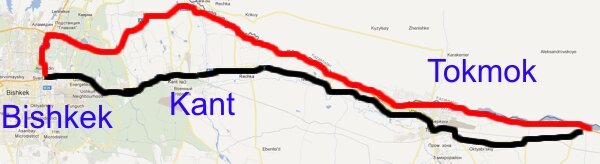
The two branches of the A365
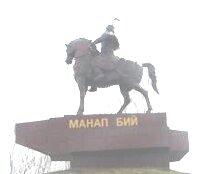
Manap Biy
As we approached Tokmok, we drove past the Mig Fighter mounted on it’s pedestal, which has been repainted from it’s steely grey to camouflage brown and green, (complete with a Kyrgyz flag painted on the tailplane), reached the large roundabout by the Bus Station and the turn off to the Burana Tower. At the side of the road, set back a little from the junction, high on a plinth is a statue of a hero on horseback. I have seen it several times in the past, but this time I finally got to read the golden inscription: Manap Biy
Being a little cynical, I wondered at first if the Kyrgyz authorities had managed to get a bulk discount on a “job lot” of these statues because there do seem to have been quite a few erected in recent past, at least since Independence.
This one struck m as a little odd however, because it seems to be a tautology … both the words, Manap and Biy, are honourific titles used for tribal chieftains; members of the “Kyrgyz aristocracy”.
The title Biy is older and is may be derived from the Enesei period, and was superceded by Manap in the nineteenth century. Some scholars say that Kyrgyz manaps were simply the “best people”, akin to “Duke” in Russian, ; the best from common people, the bravest in combat, who gathered the people together and led them. In fact there were several different Manaps: Chon manap (Great manap); Zhany manap (New manap), and my favourite – a real “put down”, Chala manap (not a real manap). Although it was not, strictly speaking, an hereditary title, by the early 19th century, Manap, (both the title and its attendant privileges), had become so.
For the record: According to the Soviet interpretation of history, the most powerful of the manaps owned huge herds and extensive pastures and it was in the late 19th century and the early years of the 20th century that the most wealthy stock breeders, merchants and landowners, (bai) were incorporated into this informal aristocracy, or nobility, together with the most powerful of the existing manaps, usurping the position of the poorer manaps over the peasants in vassalage to them. Most of the rank-and-file members of the tribes were in bondage to their manap overlords and “were cruelly exploited”. When the Kyrgyz were assimilated into the Tsarist empire the Manaps were associated as supporters of the colonial regime and during the civil war that followed the Bolshevik Revolution, they were identified as being active supporters of the in counterrevolutionary mutinies.
Although he is sometimes described as a legendary character, Manap Doolosbakty uulu, (Manap Biy), was an actual historical figure. It’s not exactly certain when he was born, or died, but we do have an idea of approximate dates. Born sometime around 1595, the fourth son of Doolos Baatyr, one of the leaders of the Sarybagysh tribe. He was a contemporary and ally of the Kazakh khan, Eshima, who made him Governor of the Northern Kyrgyz, and put him at the head of an army of approximately 10000 warriors in order to protect their common border from the Kalmyks from his base in the Orto Tokoi water basin, (to the West of Lake Issyk Kul in the direction of Kochkor).
For the record: The Kalmyks were the westernmost tribes of the Mongols in Russia, whose descendants migrated from Dzhungaria in 1607. Otherwise known as the Oirats, today they form a majority in the Autonomous Republic of Kalmykia on the western shores of the Caspian Sea, which is Europe’s only Buddhist government.
It’s not quite sure when he died. One source suggests it was sometime between 1635 and 1638, whilst other suggest that it was as the result of wounds received in the decisive battle with the Dzungars in 1625.
Manap Biy was not only a close ally of the Kazakhs, creating and leading a united front to face a common enemy, but he is also credited by some with having initiated the Manap system of government. A large number of famous and important people in Kyrgyz history can trace their ancestry to him through his two sons Dzarbana and Sutoya: the heroes Uchukye and Tulku; Tynai Biy; Chon Esengul; Mamatkul Biy; Atake Baatyr; Niyazbek; Ormon Khan; Dzantai Khan and Shabdan Baatyr.
As I said, this is just one of many new statues and busts comprising a “Walk of Fame of the people of Kyrgyzstan” – historical figures who have made a significant contribution in the story of the development of Kyrgyz Statehood.


 Bishkek