An early start to the day
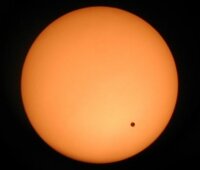
The sun showing Venus in "transit"
I wondered whether to get up early this morning in order to see the sunrise. As I am normally in the office by about six o’clock, that might not seem to be an impossible task. At the moment, dawn begins at about ten minutes to five, local time, and sunrise happens just over half an hour later. The problem is that if I want to see the sunrise then I would have to find a suitable location with a clear view to the East, but as I live in downtown Bishkek, that might not be easy task.
So why would I want to see the sunrise, today.
Back in the salad days of my youth I occasionally got up early, (in the middle of the night, actually), to climb the Malvern Hills in order to watch the sunrise. It didn’t happen very often, just once a year … on June 24th, (Midsummer’s day”). Midsummer is a Celtic, pagan festival, and crowds gather at certain spots, such as Stonehenge, to commemorate the occasion. Lots of people, (well, quite a few … well, some), hang on to tradition and this annual dawn vigil was just one example. The Worcestershire Beacon in the Malvern Hills is the highest point in the county and with a clear across the plain of the Severn valley to the East – affording a magnificent view of the sunrise.
Although the possibility of a dawn vigil today is also connected with the heavens, it doesn’t have quite the same mystical or “quasi religious” origins. Today is the day of the Transit of Venus.
This is the name given to the phenomena when the planet passes directly between the Sun and the Earth, similar to a Solar Eclipse where the moon passes between us. As in the eclipse, the inventing heavenly body obscures the view of the sun, but because of the distances involved and relative sizes, in the case of the transit, the planet doesn’t turn the skies dark but simply creates a small black dot which seems to pass over the surface of the sun.
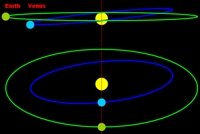
The respective orbits of the two planets
Although the last time the phenomena occurred was back in 2004, it doesn’t actually happen very often. There is a regular cycle of events which takes 243 years … after today’s events there will be 105.5 years before the next, (in 2117), then 8 years, (2125) then 121.5 years, (2247), followed by another 8 years, (ending in 2255). The timing is all to do with the fact both planets circle the sun in orbits at different distances, on slightly different planes and at different speeds.
I first came across those words, ‘Transit of Venus’, when learning the story of Captain James Cook, a British sailor who explored far distant lands, apparently discovering many and mapping them as he navigated his way around the South Seas. He took a scientific expedition to Tahiti to observe the phenomena in 1769 … and I remember visiting point Venus in 1984, but even then I wasn’t really sure of what the words signified and the significance of the event. Apparently, it allowed scientists to learn more about our solar system, making more accurate measurements and the latest measurements from this year’s observations are expected to help in the search for planets outside our own solar system.
Perhaps the most significant impact of the Transit of Venus, however, lies not in the observations and measurements in themselves, but ion the change it helped to bring about in our attitudes to science and exploration. Following the first sightings in 1631 and 1639, each occurrence of the phenomenon has been eagerly awaited by scientists and special expeditions were mounted, (such as the one led by Captain Cook), to get better observations. It almost became de rigueur when organizing any future expedition, not just those designated as “scientific” expeditions, to include a scientist in the company in order to record observations of the natural world.
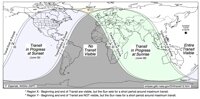
When and where re the Transit is visible
Because the event doesn’t happen very often, maybe it would make sense to make the effort and try and see it.
As the event is supposed to last for several hours, (the one in 2004 lasted for six hours), maybe I didn’t have to get up so early, however, the transit should already be underway at sunrise, so there wouldn’t be the full six hours available to me.
Getting up a little earlier than usual shouldn’t have presented too much of a problem. Although Tuesday had been cloudy, the forecast was quite good predicting sunny weather, but as it happens there was enough cloud to obscure the view.
My biggest problem, however, was be trying to find a suitable vantage point. Although Kievskaya runs East-West I wasn’t sure that the sun would “play ball” and rise in line with it – it didn’t.
So, although I got up in time … I missed … again … I missed it back in 2004 as well. There has been lots of talk about this being a “once in a lifetime” possibility – what with the next transit not occurring until 2017 – but those who do say this have forgotten that for most of us this was the second possible chance to see it.
It would have been so much easier if I was living in the United States, because that’s where the phenomenon was first visible, during the late afternoon yesterday, (on the fifth …) so, there would have been no need to have to get up at the crack of dawn. Indeed it would be even easier if I lived in the Falkland Islands, just off the coast of South America, because there, (just like most of that continent), the timing was such that there will be no view of the event at all.
Maybe the simplest solution would have be to wait for the footage on the news programmes on TV. In the meantime, here’s an educational clip from NASA, posted on youtube:
x
http://www.youtube.com/watch?v=-nXv9YvkNyA&feature=relmfu




 Bishkek